
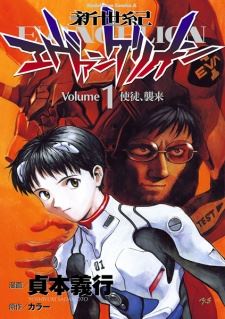
In 1999, a meteorite struck Antarctica, causing the continental ice to melt and dramatically raising sea levels. This event severely disrupted the world's climate and led to the deaths of more than half the global population. By 2015, mysterious creatures known as Angels began wreaking havoc on what was left of Earth.
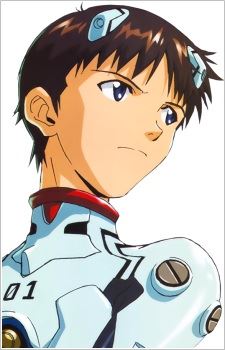
In the fortified city of Tokyo-3, 14-year-old Shinji Ikari is called upon to stop the Angels' rampage. Recruited by his father's secret organization, NERV, Shinji becomes a pilot of an Evangelion, a colossal bioorganic android designed specifically to combat the Angels.
Thrust into a position where he must bear the weight of the world's future, Shinji struggles to find the courage and determination to fight for both humanity and himself. As battles between the Evangelions and Angels become more frequent, the terrifying truth about the world slowly comes to light.
Shinseiki Evangelion was initially serialized in Shounen Ace but later moved to Young Ace on July 7, 2009. Although it was originally scheduled to release shortly before the anime series aired, production delays pushed the anime’s debut to 10 months later.
The series was published in English as Neon Genesis Evangelion by VIZ Media from December 1998 to May 2003, spanning seven volumes. VIZ Media rereleased the manga under their Action imprint from February 25, 2004, to February 10, 2015, and also in omnibus form from November 13, 2012, to June 14, 2016. The series was also translated into Spanish by Norma Editorial from May 2003 to January 2015, into Brazilian Portuguese by Editora JBC from November 2001 to December 2014, and into Italian by Panini Comics from October 18, 2001, to November 22, 2014.










Neon Genesis Evangelion – Spoiler Free – Recommended
TLDR
Story – 9/10 – 9 x 0.275 = 2.475
Art – 8/10 – 8 x 0.2 = 1.6
Characters – 8/10 – 8 x 0.225 = 1.8
Enjoyment – 8/10 – 9 x 0.3 = 2.4
Total: 8.275 -> 8
Story – 9/10
This review focuses on the story of the Neon Genesis Evangelion manga, which includes the original anime, the director's cut, The End of Evangelion film, and the ending from the Rebuild version. As an adaptation, comparing the manga to its source material is inevitable.
There are multiple versions of Neon Genesis Evangelion, with the manga being just one variation. Despite this, the core narrative remains consistent and can be viewed as a more polished (subject to debate) and cohesive (definitely) rendition of NGE's extensive media collection.
One notable aspect of the manga is its darker twists on certain details. For instance, a character—who I won't name—dies in the manga but only gets injured in the anime, aligning well with the series' overarching melancholic tone. The pacing also shifts towards deeper character development rather than action sequences.
The lore offers valuable insights that help interpret the mystical religious themes inherent in Evangelion. It’s worth noting that the story isn’t overly complex. The first half of the manga is arguably better executed than the anime, partly due to fewer angel battles. The final volumes are compelling page-turners that demand binge-reading. However, I found the manga's ending unsatisfactory—it felt like an easy resolution to an otherwise engrossing narrative. In this respect, The End of Evangelion still reigns supreme (in my opinion).
Art – 8/10
The artwork in Neon Genesis Evangelion is excellent. It conveys emotion effectively and enhances the impact of key scenes. Certain pages are visually striking, adding to the shock value without feeling excessive. Character designs are distinctive, making it easy to differentiate between them. Action sequences are clear and enjoyable to follow.
Characters – 8/10
The characters are memorable and possess unique personalities. Their teenage years introduce elements like sexual discovery and puberty, handled tastefully. Interactions among characters are intriguing and engaging. Additionally, their backstories are more thoroughly explored compared to the anime, which adds depth and is appreciated.
Enjoyment – 8/10
Neon Genesis Evangelion provides a uniquely depressive yet captivating atmosphere. Differences from the anime include a reduced number of angels at the start, minimizing the monster-of-the-week trope. The pacing adjustments feel more refined here, fleshing out the narrative and developing characters further. After reading the manga, other versions may seem less complete. Nonetheless, all formats offer valid ways to experience Evangelion’s story. Without an OST, some charm is lost, especially missing the iconic intro or Beethoven’s 9th symphony from the original. Still, if everything’s right in God’s heaven, then all’s well with the world!
Acknowledgements
Special thanks to Turambar5 for his insights into the various anime versions of NGE and his feedback on this text.
This manga nearly outshone the anime, except for its ending. The endings of both the anime and the movie "The End of Evangelion" have sparked extensive discussions for nearly three decades. Among all the endings, I believe the manga's is the weakest.
However, there were many aspects of this manga that I loved. Firstly, the art maintained an exceptional standard throughout, especially during the Third Impact, keeping readers engaged constantly. Additionally, many characters were handled better due to the opportunity to add more scenes than in the anime. Many of these scenes focused on Shinji and Rei's relationship, leading to significant character development, particularly for Rei. This made you feel more empathy for her character before she sacrificed herself compared to the anime. The relationship between Gendo and Shinji was also further developed, making Gendo appear more humanized. Readers learned that Gendo avoids interacting with Shinji out of fear of damaging their relationship further. This explains why he interacts more with Rei, seeing her as easier to connect with due to her lack of social skills and resemblance to his wife, Yui.
Unfortunately, the ending ruined the entire reading experience up to that point. The ending essentially negates the entirety of the manga. The hero is not celebrated, receives no congratulations, and even loses his memories. While the endings of both the movie and anime are bleak yet hopeful in retrospect, none erase the main characters' memories or those of all humanity. It renders the sacrifices of Misato, Kaji, Yui, Ritsuko, Rei, and numerous NERV and UN personnel meaningless, as no one will remember them. Even Shinji's personality has changed somewhat, becoming more cheerful than usual. Although this might be comforting given the horrors he previously encountered, it ruins the experience by suggesting that the previous 95 chapters were pointless and a waste of time for the reader. Someone unaware of the earlier chapters could skip straight to the end and think it's where the story begins.
Therefore, I thoroughly enjoyed most of this manga but had to lower my rating from a 9 or even 10 solely because the ending leaves such a bad taste in your mouth.
I finally wrapped up the manga adaptation of the renowned anime series, Evangelion. Honestly, I enjoyed the manga significantly more due to its distinct ending. This is a much deeper series than your typical manga. It heavily incorporates Christian mythology, particularly using it symbolically. There were likely parts I didn't fully grasp because, as someone raised in a Muslim household, my understanding of Christianity is limited. Nevertheless, the human element of the story was exceptionally well-done and truly impressed me. Beyond all the themes explored in the manga, the core aim of the narrative seemed to be making Shinji, the protagonist, want to live. He's a 14-year-old angst-ridden boy whom the creative team saw as their audience (I'm not Shinji, damn it! lol). By having Shinji desire life by the end, they hoped that their audience—essentially 14-year-old (in spirit) sulky otakus—would also wish to live. Well, fingers crossed for that.
The series falls under the mecha genre, with Eva 01's design being absolutely stellar. I genuinely loved how it looked. The designs of the other Evas, which were variations on Eva 01's look, were also impressive, given the original design was so strong.
Misato was such an endearing character; she's definitely waifu material. :D
Most likely, you're here because you just finished watching the anime "Neon Genesis Evangelion" and are craving more content than what the Rebuild movies can offer. You might be wondering if reading this manga is worth your time. Assuming you enjoyed the anime series enough to consider it, that's a good start. However, if you didn't like Neon Genesis Evangelion from the get-go (and that's perfectly fine!), you'll probably find the manga mirrors the anime too closely and might want to skip it.
For those who genuinely enjoyed NGE, I highly recommend this manga without hesitation! On the surface, the story and characters are essentially the same as in the series. So why read it if it's basically the same? Is there anything different?
Well! For starters, imagine getting to know most of the characters more deeply than you did in NGE. Rei, for instance, is much more talkative while still retaining her secretive and quiet personality from the anime. This portrayal helped me find Rei more likable due to increased interaction with other characters. The relationship development between Rei and Shinji is also more fleshed out, giving insight beyond the obedient 'doll.' Asuka remains feisty, perhaps even more so, ensuring fans will love her even more. Her background story is still included too. Shinji stays relatively the same—a self-loathing, depressed, hopeful, rebellious, and redeeming young man that makes Shinji, well, Shinji!
Still curious? Alright!
The story mostly remains untouched, but there are three main differences:
1) In the first chapter, Shinji first encounters an Angel fighting Rei in an Evangelion. This detail, not shown in the anime, helps explain Rei's injuries when Shinji agrees to pilot Eva, adding depth to the narrative.
2) A lot more background information is explored. Want more about Kaji? Check. Want to see what Rei thinks about Gendo? Check. More daily life with Shinji and his friends? Absolutely. Deeper insights into Shinji's mind during pivotal moments? You got it. Even Kaworu Nagisa gets more character development and backstory than in the brief encounters in NGE or End of Evangelion.
3) The manga assumes you've watched the series, briefly covering certain events already explored in the anime. This happens rarely since the additional content outweighs any omissions.
I had a few minor gripes. Some story details I preferred in the anime were changed, and some parts were left out. For example, Touji comes across as more hillbilly-like in the manga, which contrasts with his more serious attitude in the anime. However, these issues didn't detract from my overall enjoyment.
In summary, this manga is perfect for NGE fans wanting deeper exploration of the story and character development. Feel free to drop me a line if you found this review useful or inaccurate to your experience~
It was nearing the end of summer, and I had never read a manga before. With plenty of time on my hands, I decided to dive into the Neon Genesis Evangelion manga adaptation. The anime left me somewhat bewildered, and I didn't fully grasp why people said Eva was deep—until I read this.
Impression:
From the start, I was drawn into the story just like with the first episode of the anime, but it felt different. Some events were altered compared to the anime, making getting from point A to point B a fresh experience. Although the manga doesn’t stray far from the anime’s narrative, the first three volumes were already out before the anime aired. The manga can be seen as an alternate interpretation of the same story, with slightly different handling of characters and plot. Since most of the manga was written after the anime concluded, everything feels more planned and purposeful, giving a sense of progression.
I can't predict how original series fans will feel about this manga, but be aware that the story is handled differently. If you found the anime unsatisfying or even hated it for common reasons (I won’t delve into those), good news: this manga won't depress you. It's still Eva, retaining its charm and complexity, including dark psychoanalysis and religious symbolism. But instead of ending confused, you'll likely understand the story better, as I did. For newcomers, expect an engaging ride.
Characters:
The manga expands on the characters well, considering Eva is character-driven. One notable con might be Asuka; she becomes more of a secondary character at some point, which may disappoint her fans. Shinji, our lead protagonist, is better portrayed here. We see more of his thoughts, making him more understandable. He seems a bit braver in the manga, and I found him more likable without losing his original essence. Rei appears more talkative and gets more focus, leading to smoother character development. Ryoji Kaji, though not a major character, receives a backstory explaining his motives, adding depth. Kaworu also develops significantly, starting cold but gaining personality later. Other characters remain similar to their anime counterparts but get more in-depth treatment.
Final verdict:
I have to give this manga a 10 out of 10, something I rarely do. There aren’t many flaws here. Hardcore anime fans might disagree, but if you're confused by Eva, I highly recommend reading this manga.
This manga singlehandedly turned me from an Eva hater into an Eva enthusiast. If you're new to Eva, I suggest watching the anime first. One of the best parts of reading the manga is comparing it to the anime and appreciating the differences.
For context, I initially gave up on the Evangelion anime because it felt too "deep" for my taste. I watched about 16 episodes but ended up hating every character and had no intention of continuing. So when I picked up the manga on a whim, I was utterly amazed.
First off, the art is incredible. While I had mixed feelings about the anime's art style, Sadamoto’s linework in the manga is outstanding. The shading, line thickness, facial expressions, composition—it's all immaculate. I could go on forever praising how good everything looks.
Secondly, the story and characters in the manga are *satisfying*. The anime often intentionally makes things unsatisfying for artistic reasons, which can appeal to some but not to me. In the manga, nearly every character gets a subtle personality shift that makes them less "realistic" but much more appealing as characters.
Take Kensuke Aida, for example. You might think, "Shinji's classmate with glasses? Why is he important?" Well, the changes made to Kensuke perfectly illustrate what I dislike about the anime and love about the manga. When Toji confronts Shinji, Kensuke is there in both versions. In the anime, Toji beats up Shinji while Kensuke just watches, despite Shinji being a hero who saved the city. In the manga, Kensuke stops Toji before he can fight Shinji, saying something like, 'dude, what are you doing to the guy who saved this city?'
In the anime, Kensuke's actions are "realistic." Most people don't have strong moral compasses and wouldn't stop their friend from beating up someone, knowing their sister could have died. But that realism is incredibly unsatisfying! I was yelling at my screen during the anime, "aren't you going to stop Toji??? Shinji literally fought off the thing trying to kill all of you!"
The manga, almost as if it knew exactly what I was thinking, addresses this directly! This isn’t an isolated incident either. Even small details most people wouldn’t think much about are changed in ways that make the story feel better without drastically altering the plot or characters.
Many point out how much more of a "gigachad" Shinji is in the manga compared to the anime. However, his actions are mostly identical (except for a few at the end). The only difference is his mindset and how he views himself and the world. Shinji actually grows meaningfully because he’s willing to improve rather than being depressed most of the time.
These kinds of changes are found throughout the story—Asuka, Kaji, Misato, Akagi, even Gendo gets a more fitting and appropriate ending here than in the anime. Some may disagree whether these changes are improvements, but they definitely made reading Eva at least a hundred times more enjoyable than watching it.
Evangelion is a masterpiece. But I never would have known that without this manga.
Neon Genesis Evangelion has left a profound mark on anime culture and continues to embody archetypal tropes seen not only in contemporary mecha anime but across various genres. The original series sparked countless discussions and theories about its characters, offering depth that often came off as pretentious.
The 1995 anime felt dull, despite the film wrapping up the story neatly albeit grotesquely. The TV series' disjointed narrative confused viewers regarding the broader picture without providing enough context for events to make sense. This transformed what could have been a grim and dark deconstruction of the mecha genre into an unnecessarily disturbing plot mess. Thus arises the question: What if Evangelion had better pacing?
Yoshiyuki Sadamoto, a regular Gainax character designer, helped create some of the studio's most iconic characters, notably in the cult classic OVA FLCL and Neon Genesis Evangelion. Few know there is an Evangelion manga—conceived and drawn by him from 1994 to 2013—which brings us to the review.
Starting with the art, knowing it's by Sadamoto reassures consistency. For nearly two decades, Shinji and the cast remained visually consistent, mirroring their anime counterparts. Facial expressions, scenery, and battle scenes resemble the Rebuild films.
A noteworthy point is the presentation. While Hideaki Anno and Sadamoto are distinct creators, they work under the same umbrella. The show’s cathartic effect through disturbing imagery is challenging to replicate in manga. Surprisingly, the manga retains core themes with less nudity and graphic content, focusing more on emotional depth.
The Evangelion series merits attention but remains obscure. Approaching it feels like observing an art piece, requiring investment and immersion. Sadamoto's art direction fills this void, fostering sympathy for the characters and their struggles.
In my End of Evangelion review, I criticized the characters. They lacked appeal; Shinji seemed stupid, while Asuka was likable. The manga offers deeper character analysis than the anime, which, despite being psychological, sometimes felt shallow due to excessive Freudian perspectives. The manga leans more philosophical, allowing readers to connect with the characters’ questions about life, motives, and principles.
Focusing on the three main characters:
Shinji blends Rebuild and TV iterations, representing a self-doubting person learning confidence. This Shinji is more realistic, self-questioning yet not entirely apathetic. I enjoyed his philosophical musings and felt connected to the character.
I didn’t dislike Asuka's portrayal, but it’s weaker than her original depiction. She starts strong but stagnates, with later chapters focusing on Rei and Shinji. Despite becoming an MVP in the End of Evangelion arc, she offered nothing new. If anything, she’s less harsh—an ambiguous change.
Rei became one of my favorite characters, possibly inspiring the Rebuilds. I appreciate female characters originally heartless who become more human (e.g., Saber, Arcueid). One event in Rei’s arc hurt more than the anime did. The manga portrays Rei as an important character, not a mere plot device.
Other side characters develop better than in the show, notably Kaworu and Gendo, becoming characters you care about rather than gloss over.
The manga's plot mirrors the TV show but improves minor details, enhancing storytelling. It allows readers to catch up while maintaining obscurity. Watching the series and film first enhances enjoyment. The manga stands alone but complements understanding Evangelion's complexity.
Subjectively, listening to "Komm, Susser Tod" during the End of Evangelion arc is awesome.
The ending isn't as controversial but gives Shinji a deserved happy ending.
The Evangelion manga addresses many plot holes from the original anime, clarifying confusion and answering lore questions. Yet, it leaves one crucial part open, questioning Evangelion once again. Compact, complete, wholesome—it is Evangelion.
"You and I may closely resemble each other, but we are not the same." —Rei Ayanami
Definitely, it's one of the Manga series you must read before you die. The drama and suspense are excellent as the story unfolds. The plot begins in a future where a catastrophic event nearly wiped out humanity. In response, the United Nations backed a private company named "NERV" to develop massive machines called EVAs.
Fifteen years after the impact, extraterrestrial beings known as Angels started attacking Earth once again. At this critical moment, our protagonist "Shinji" turned out to be the only person compatible with piloting the EVAs. Suddenly, the fate and security of humanity rested on Shinji’s shoulders at just 14 years old. This immense responsibility began to take its psychological toll on him. Some of his friends lost their lives battling the Angels. Furthermore, there were significant political and religious divisions within NERV and the government.
The plot is exceptionally well-written, with each character adding unique purpose to the series. The artwork is stunning and stands among the best in Manga overall. This series is influential for good reasons; it set a high standard for the Mecha genre. If you haven't read this, you're missing out on something extraordinary. Just dive in without hesitation.