
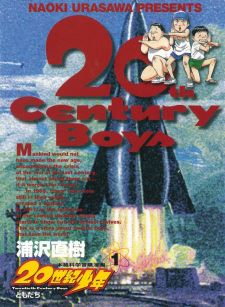
20th Century Boys
- Genre: award winning drama mystery sci-fi
- Author: urasawa naoki
- Artist(s):
- Year: Sep 27, 1999 to Apr 24, 2006
- Original Publisher:
- Status: Finished
Rating(4.1 / 5.0, 77 votes)
5 stars
31(40%)
4 stars
25(32%)
3 stars
21(27%)
2 stars
0(0%)
1 stars
0(0%)
Popular Reviews
"20th Century Boys" stands out from everything I've ever seen. It presents a couple of guys living in an "adult world," yet with the mindset of children. The ability of the character known as "Friend" to persuade people is remarkably high, but it also shows how easily influenced people can be, including influential figures like the first minister of Japan and even organizations such as the UN. The world seems naive; people don't think critically and follow a mysterious man who never shows his face, convinced by mere tricks.
The minority who behave like true adults form the "resistance" in this world. These are the main characters fighting against "Friend." They attempt to battle him as real adults, but they never succeed. Ultimately, the story shifts when these real adults start acting with the minds of children, leading to "Friend" beginning to lose. So, what does this mean?
I believe "20th Century Boys" is a tribute to the manga industry, which has been a significant part of many children's lives, especially in Japan. The protagonists only start winning their fight when they embrace a playful, childlike approach, much like a prank-filled evening on a Sunday.
The series is filled with "Easter eggs" referencing other titles, such as the "master" who trains Ochiai, mirroring the typical mentor figure found in many action stories.
I highly recommend this series. It's incredibly unique and well-crafted, making you believe that its world could exist. You get drawn into this crazy "prank evening" and leave feeling very satisfied.
BEST MANGA I HAVE READ IN MY ENTIRE LIFE!!
What are you waiting for?
Dude, go read it now!
Just the author's name is enough to make you want to read it.
A MASTERPIECE!!!!!!!
-
Characters, story, flashbacks, art, and the mystery!
All of these are 10/10.
-
NOTE:
The first chapter might not give you a full understanding of the story, and you may feel like dropping it.
But try to read at least 15 chapters before making a decision.
-
MY FAVORITE CHARACTERS:
I love all of them, but especially Kenji and Shogun.
Kenji is the badass, mad, crazy leader and perhaps the smartest one!
After all, he wrote the book.
And the second one is the badass bodyguard—strong, patient, and filled with madness!
-
MADNESS IS THE MOST SIMILAR TRAIT BETWEEN THESE TWO CHARACTERS.
-
That’s it for my review. I hope I’ve made you excited about this masterpiece.
Sorry for any grammar mistakes; I’m still learning English. ^_^
This is unequivocally one of the best stories I've ever read, whether in manga or any other format. From the very first few chapters, it captured my attention and never let go. Once I started, I found myself binge-reading not because it demanded it, but because I simply wanted to.
Naoki Urasawa is a master storyteller, and 20th Century Boys makes it abundantly clear why. The narrative evolves into something I could never have anticipated at the start, seamlessly blending various genres—be it comedy, paranormal, or outright horror. It explores the whimsical dreams of children and the potential terror those dreams might hold. It simultaneously sheds light on both the horrors and the beauty of humanity. This is a story about heroes and villains, justice and evil, and so much more.
I might already be rambling, so I'll wrap things up. The story, artwork, and characters are all nearly flawless. Urasawa did an incredible job crafting characters who feel like real people. If you're looking for an engrossing and thrilling story, I couldn't recommend 20th Century Boys more highly.
P.S. - While I maintain that the story is amazing, the ending is somewhat... oddly executed. You'll probably want to read 21st Century Boys (a 16-chapter continuation) afterward to get a fuller sense of closure.
The series suffers from the same issue as Urasawa's other works: it continues well beyond its natural conclusion.
Story: 8/10
The story begins slowly but reaches a masterpiece level in the first 60 chapters. After a time skip, it feels like a fresh start, which is still quite good. However, it then drags on and on until another time skip, by which point you may feel exhausted with it.
Characters: 9/10
The characters are outstanding, each with distinct and well-written personalities within the main group. Unfortunately, as the story drags, it introduces plot points that detract from the characters. Additionally, characters introduced later tend to be less interesting.
Art: 9/10
The art is generally great, though not exceptionally so. There's something about Urasawa's art style that resonates with me.
Enjoyment: 8/10
The enjoyment factor decreases as the story progresses.
Overall: 8.5 ≈ 8/10
Overall, this is a really good series. If you enjoy Urasawa's work, this is a must-read. If not, you might find it less appealing due to its similar structure to his other works. Despite this, I would still recommend it as it was my favorite among Urasawa's creations.
20th Century Boys is a Seinen, Sci-fi, Psychological manga that elevates storytelling to new heights.
Right from the start, it's clear what has happened, and the story gradually reveals, bit by bit, the events that unfolded. However, be prepared for some major plot twists. What makes the story intriguing is its setting across different timelines (Childhood Era, Adult Era, and Friend Era), offering deeper insights into characters and events. Following these timelines can be challenging as it feels like reading a story within a story. Yet, after a while, it becomes easier to follow, with plenty of plot twists and unexpected surprises along the way.
The characters in 20th Century Boys are crucial to the story, as it revolves around ordinary people doing extraordinary things. Though not well-defined initially, the characters develop incredibly well over time. The challenge lies in remembering the numerous characters and keeping track of them across various timelines.
The artwork is impressive, featuring the same sketchy style seen in Urasawa’s other works. The environments are detailed, but the character designs can sometimes be too sketchy, making subtle changes in facial expressions hard to notice. On the flip side, once you get used to it, the characters' distinct facial features make them easy to distinguish.
Overall, 20th Century Boys redefines the concept of regular people trying to save the world from evil villains. When I started this manga, I had no idea what to expect or why it was so popular, but I'm glad I found out. One key lesson I learned is that good does not always triumph over evil, which made the manga both frustrating and highly addictive to read. If you're a manga fan, 20th Century Boys is a must-read.
This one was truly excellent! I picked it up almost immediately after finishing Monster by the same artist and was instantly greeted with the same overarching themes of mystery and conspiracy that I loved so much in Monster.
The story was incredibly engaging, largely due to its grounded feel. However, there were moments where I found myself getting lost when the narrative strayed from the main group of childhood friends. This isn't to say that the supporting cast wasn't fascinating; the short asides featuring Father Luciano and Detective Chouno were particularly interesting, offering insights into how Friend exerted his influence over the police and the church. Nonetheless, there were instances where the plot didn't seem to move forward, causing the pacing to slow down significantly.
Artistically, Naoki Urasawa's style has become instantly recognizable to me. I admire how he portrays distinct differences among each of the boys as children, and how he shows their aging process uniquely while maintaining their individuality. Compared to Monster’s depiction of European architecture and landscapes, 20th Century Boys' backgrounds and environments don't quite reach the same level initially. However, this improves in the latter half of the series, especially with the fantastical settings brought about by Friend's rise to power, such as the contrast between Friend’s tower and the town below, and the Potemkin castle at one of the checkpoints.
Building complex characters seems to be Urasawa's forte. Each member of the main cast is endearing and maturely written. None of the childhood friends stood out as the weakest link, with each having pivotal moments in their arcs that kept me excited whenever they appeared. One minor issue is the reluctance to remove characters from the narrative, often reintroducing characters thought dead or long after their mini-arcs concluded. Another point of contention for me is the use of supernatural elements. I felt that attributing ESP to Friend’s rise to power detracted from what I believed to be the character's core essence as a charismatic leader fitting for a contemporary cult. Similarly, Kanna’s ESP seemed like an inadequate explanation for her leadership abilities and luck; I would have preferred these traits to be attributed to her strong personality and intuition rather than the supernatural.
Overall, 20th Century Boys provided a consistently good experience, strong conceptually and unwavering in its key themes, which I’ve come to expect from Urasawa’s work. I recommend this to anyone looking for a modern take on a mystery story with a more positive and less depressing atmosphere compared to others in the genre.
Being a fan of T. Rex, I was immediately intrigued by a book that referenced the band in its title. My interest peaked further when I discovered it was authored by Naoki Urasawa, the mastermind behind Monster. I began reading right away and hardly put it down until I finished both the book and its sequel. There are two points I want to address initially. First, while this is an outstanding manga series, I can't help but feel it doesn't quite reach the heights of Monster. That said, it certainly isn't the #1 manga. It's amazing enough for me not to mind its placement, but I felt it necessary to mention. Second, as a music enthusiast, I found the musical references in this series somewhat superficial. Expecting more niche references due to the T. Rex nod, I hoped for something less mainstream than The Beatles or Bob Dylan, perhaps Van Morrison or Leonard Cohen. Instead, most references were to well-known artists like Hendrix, The Stones, and Mitchell. This was another aspect I wanted to highlight.
The story of 20th Century Boys is peculiar and occasionally self-contradictory. It centers around a group of childhood friends who used to gather at their secret base, reading manga and listening to the radio. One day, one of them, Kenji, started writing his own manga plot about a hero saving the world from a virus and a giant robot. Initially a simple childhood fantasy, these events begin unfolding in reality, with their fort symbol being used by a mysterious cult leader called "Friend." Kenji realizes something is amiss and, along with his friends, must save the world. The narrative quickly shifts from a typical "save the world" plot into a complex mystery with one central question: Who is Friend?
Despite my admiration for the series, Friend is one of my major criticisms. While I understand Kenji and his friends' motivations, Friend's backstory feels lacking. Is he merely a deranged individual seeking amusement through destruction? I wished for a deeper exploration of his motives beyond mere enjoyment in chaos. Alongside the shallow musical references, this was a letdown in an otherwise fantastic story. However, despite this flaw, Friend remains an intriguing villain.
The art in this series is probably its strongest aspect. The illustrations are beautifully crafted, with moments like the first two pages of Chapter 100 standing out for both their script and stunning visuals. Even characters that didn't particularly stand out visually had scenes that made me pause and appreciate the artwork. Chapter 100, with its mysterious aura and musical references, encapsulates the series' greatness and is one of my favorite parts.
The characters are another highlight. The main character, though absent for significant portions, is compelling. One memorable line stands out from his interaction with a young guitarist at a crossroads. Other characters, such as the enigmatic Friend, his twisted followers, the childhood friends, and notably, the hobo called God, add depth and humor. God, in particular, is a standout character, blending foresight with humor and always providing entertaining moments. While some villains may seem pointless, they still have standout moments, making them enjoyable despite their lack of clear motivation.
20th Century Boys has it all—great art, a unique and engaging story, excellent scripting, memorable characters, amusing references, and most importantly, it's incredibly enjoyable to read. Although I don't agree with its #1 ranking on this site, Urasawa once again delivers a fantastic story filled with mystery, thrills, drama, and touches of comedy, romance, and slice-of-life elements. It's all there, and 20th Century Boys is definitely worth reading.
This is one of the most captivating and delightful works of fiction I've had the fortune to experience. Among films, books, or graphic novels, "20th Century Boys" stands out as a genuine treasure.
The narrative will seize your imagination and refuse to let go until you reach the end. (I read it twice within two years; both times barely allowed me to complete my daily tasks during the weeks I spent reading.) "20th Century Boys" doesn't try to transcend its melodramatic structure, but it excels precisely because of this approach. Simply put, Naoki Urasawa is a master of melodrama, skillfully manipulating the reader's emotions. You root for the heroes and despise the seemingly insurmountable evils they face.
The vast scope of the story adds to its enjoyment. It blends the summer adventures of school children with intricate mysteries and against-all-odds action spanning from the nostalgic '60s to the present and even into the future. You'll immerse yourself in this expansive, epic world, feeling every triumph, loss, joy, and tragedy that befalls its many characters.
On the technical side, Naoki Urasawa's exceptional cartooning skills enhance every emotional and dramatic turn of his story. Every location and scene distinctly conveys the appropriate tone to captivate the reader. Even more impressive are the character designs; in a story with countless characters, you'll easily recognize each one by their unique features and gestures.
If there is any criticism of "20th Century Boys," it would be the ending. After such an engrossing, roller-coaster ride of a story, the conclusion feels somewhat abrupt. However, this critique is unfair; for such an epic tale, any ending might fall short. The real disappointment is that the story has to end at all.
What could be the consequences of a child's game? What could be created by the imagination of children craving adventure? "20th Century Boys" is a manga that shines with its unique brilliance and marvelous idea. Created by Naoki Urasawa, it truly captivates every reader with its story. Once again, the mangaka showcases his distinctive storytelling and proves that he is like a "prodigy" in the manga world. He shows us that every memory we have from our years of living is precious and remembering them makes us feel as if we are back in our childhood days, playing with friends, fighting, laughing, and most importantly, spending carefree days.
The story of the manga isn't something new, but it is indeed special, even in the 21st century. It revolves around Kenji and his group of friends who create their own "shelter," a place they go to when they feel anxious or face problems. Despite many fights with other children, this shelter feels safe from everything. While there, they share stories and write them in a notebook. Little do they know that each action will eventually change their lives. Every word, action, or decision significantly impacts their future. At the beginning of the manga, the story focuses on Kenji, who struggles with work and life. His sister gives birth to a child and leaves, so Kenji has to take care of his niece and raise her well. While dealing with his life challenges, he notices events reminiscent of his childhood and soon finds himself embroiled in a great adventure filled with plot twists.
The art of the manga is fantastic. It features the well-known style of the manga artist. Characters are drawn simply yet very detailed. The artwork is consistently high-quality, with no poorly drawn elements, even in the background. The consistency of the art is breathtaking. The main characters aren't depicted with exaggerated features like gigantic breasts or big muscles, but after a few chapters, you couldn't imagine them drawn any other way; they are so well-chosen and well-executed.
The characters make one of the significant differences between this manga and others in the same genre. Their character development is consistent throughout the entire manga, regardless of their role. At first glance, the main characters don't possess superpowers to help them fight "evil," but they have something even better—charisma. Kenji is one of the best leading characters in manga, but he isn't the only standout. The character that truly catches the eye is Kanna. She is one of the most complete female characters in manga history. She isn't portrayed as helpless and always needing assistance. Instead, she is strong and intelligent, never acting without thinking. Every action she takes is carefully considered.
"20th Century Boys" is something you should definitely read. Despite having 22 volumes, you won't notice the time passing as you eagerly turn page after page to uncover the ending.
*Spoiler-free - Rapid Review*
Perhaps the most overrated manga ever.
This manga is *extremely* overrated. Despite having well-developed characters that interact well with each other, the plot is weak and supported by a flimsy mystery that should have been resolved within 100 chapters. It feels like a mishmash of various ideas that don't complement each other, leading to boring resolutions of plot points. In essence, this manga is just plain boring. The artwork is decent, and some scenes look great, but the story itself is so random and poorly executed that I cannot recommend it to anyone. It's unfortunate that this manga is often considered a "rite of passage" for becoming a "proper manga fan," as the writing is quite basic. The entire mystery aspect is laughable. It seems like ten different genres crammed into one story, and it simply doesn't work. Trying to be too many things at once is a significant drawback.
I'd give it a 3-4 out of 10, but the somewhat innovative, albeit unsuccessful, approach and a few standout scenes bump it up to a 5/10.
It is truly a masterpiece, a manga with an exceptional story and characters. Highly enjoyable and outstanding, though it begins in a peculiar way. Clearly, Naoki's work improves with age, becoming better and better!
As you progress through the story, you'll notice a flawless plot and start to appreciate even the smallest details that initially go unnoticed. This manga is designed to captivate and entertain you, drawing you into the lives of its characters—a testament to Naoki's brilliant writing style.
However, at times, the story can be somewhat annoying, and focusing more on the events would have been more efficient. When it comes to the artwork, it isn't the best aspect of this work. In fact, the art is what I rate the lowest.
Despite this, the story is great, and the enjoyment is outstanding. I don't regret spending my time on it. I love it, and I'm sure you will too!
Leave a Review