
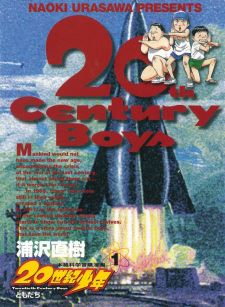
20th Century Boys
- Genre: award winning drama mystery sci-fi
- Author: urasawa naoki
- Artist(s):
- Year: Sep 27, 1999 to Apr 24, 2006
- Original Publisher:
- Status: Finished
Rating(4.1 / 5.0, 77 votes)
5 stars
31(40%)
4 stars
25(32%)
3 stars
21(27%)
2 stars
0(0%)
1 stars
0(0%)
Popular Reviews
I was on the edge of my seat the entire time, and I loved it. "20th Century Boys" is one of THE mangas to read because it excels in every aspect. The characters? Chef's kiss. The story? Big sloppy kiss. Everything about this manga is top-notch, like Naoki Urasawa was cooking up a storm when he created this masterpiece. Special shoutout to "Friend," who is truly the best friend. I give this manga a "goon" out of 10 because that’s exactly how it made me feel the whole time.
Ignore this wall of text; I needed it to post this epic review.
Is the story unique? Absolutely, it stands out from the crowd. Was it predictable? Not really, but even if parts were, the enjoyment never waned because of the genre and setup. Does the art style fit the story? Yes, it complements the narrative perfectly. Were the characters well-rounded? Definitely, they had both flaws and strengths, reacting realistically to situations and events. Do I think others will enjoy this series? Without a doubt, even if some might not typically enjoy this genre. It’s just that good.
Don't be fooled, this manga is full of flaws.
Don't get discouraged, this manga is full of epic moments.
Don't get too excited; you can summarize everything that happens in this manga in a way that makes it clear how formulaic it is.
Infinitely better than Monster, and I say that objectively.
20th Century Boys has a lot of nonsense that leads to great payoffs. Monster, on the other hand, has nonsense that leads nowhere.
I remember this manga especially for this pattern:
- You announce what you are going to do.
- You go ahead and do it.
- Everyone who heard you the first time is still very surprised because you did it to perfection or in such a way that you turned it on its head while staying true to your initial announcement.
It's hard to explain that without spoilers.
In summary, it's a nice manga with great moments. Maybe those moments didn't deserve the goosebumps I got when I read them, but I got goosebumps nonetheless.
This is another series that is just… I can’t even cover half of it without explicitly giving parts away. There’s so much to it...
One thing to note: this series does flashback a lot, and it does it extremely well, so you just need to hang on.
The basic plot is that Kenji and his friends have formed a club in their secret base, a grass hut they built in a meadow. They meet there often during the summers of 1969-70. Like all kids do, they make up adventures about how they’re going to save the world, to the point where they write down their stories in a book called The Book of Prophecy with their own secret symbol.
Fast forward to their thirties, and nothing has gone the way they planned. They’ve all grown up; some have families, some have great jobs, some have less than stellar jobs, and one (Otcho) has gone missing. Kenji himself has turned his father’s liquor store into a convenience store and is raising his niece, who was suddenly dropped off to him and his mother one night by his sister, who has also disappeared.
And then The Friends spring up. It’s a slow burn, but little by little, Kenji starts recognizing things that he and his friends invented in their childhood stories. But The Friends are trying to do them for real to bring about the end of the world. So which one of them is actually The Friend and leader of the cult?
I just really love the concept of this. Plus, it never tries to take the methods The Friends use too seriously. It’s stated numerous times that it’s unbelievable because those are things a kid would think up… because that’s exactly what happened. Would such a tactic play out in real life? Eh, I don’t know about that, but I do think the reactions to things happening are dead on. Just completely dead on. This is probably one of the more accurate looks at a post-apocalyptic society that I’ve seen, partially because it’s only really focused on Japan (with some asides in the US, London, the Vatican, and Hong Kong, but those are brief). It also really tries to utilize each member of the cast. At one point, I was a little concerned that Otcho was almost too strong of a character because he’s So. Damn. Cool. And I questioned the sanity of taking your main character out of the bulk of the series… but when the lead comes back, it’s in a way that I completely wouldn’t have thought to do. And it’s amazing. I also really like how Kanna is depicted – it’s a version of the teen girl trying to save the world that doesn’t make me want to punch myself in the face. All of the characters get a decent amount of screen time and all get a good amount to do. A lot of side characters come back in deft ways, and it really shows how random, typical people are impacted by events like germ warfare and an actual giant robot trying to destroy cities. The Friends are suitably creepy, and there’s a lot of intrigue trying to figure out who this "Friend" is and what’s going on with his followers, too.
The only thing I can say is that at times the pacing feels a little slow, but honestly, I think that’s because there’s a lot going on. This is a tight, tight series, and the pieces make sense once you’re reading them. Some people may not want to invest the time/effort to read this long of a series, but it is completely worth it.
We've all probably dreamt about being the "heroes" or being "worshipped" in our own created story. Some of us may have also dreamt about destroying the world by being the "villains." What if all that was a reality?
20thCB became the story that breathed life into hopes, dreams, and admirations. Kenji and his friends enjoyed a lively childhood, running away from and facing their current time villains, Yanbo and Mabo, having a secret headquarters, and overall just having fun as kids. Fast forward to the future, they are still running away, facing new villains, maintaining multiple secret headquarters, and working together against all odds. Would you really be friends if you wouldn't want to do the same things you did when you were kids?
20thCB is a fantastic read, filled with beautifully crafted characters like Kenji and the Friends. The insane lengths that the Friends go to and the amazing character dynamics throughout the plot make it compelling. Although the plot progression can be rough at times, the story connects its abstract elements well, with many older plot points remaining relevant until the end. The bond between the group made my attachment to them even stronger, especially reading about their childhood memories and their reminiscence, which evokes a sense of nostalgia I never personally experienced.
This was my first long manga read, and I gave it a chance after seeing its well-received reviews. I would definitely recommend 20thCB.
Additionally, I was introduced and reminded of the fantastic songs present in the story, with the most impactful being "20th Century Boy" by T. Rex.
20th Century Boys is a story about a group of childhood friends, including one woman, who shared a "secret base" in an overgrown field. This sanctuary was their escape where they could read manga, listen to music, and hide from the notorious twins, Yanbo and Mabo. One day, their "creative genius," Kenji, suggested burying a time capsule filled with their cherished items, to be unearthed only when the world needed saving.
Years later, these once-great dreamers find themselves living mundane lives, their aspirations buried under the weight of adult pragmatism. However, strange deaths caused by a mysterious virus begin to occur, followed by a series of murders and disappearances. When one of their own becomes a victim, Kenji uncovers clues pointing to a man calling himself "Tomodachi (Friend)," who uses a symbol known only to their circle of friends.
As the death toll rises, Kenji realizes that the unfolding events eerily mirror a story he and his friends had written and buried in their time capsule. Summarizing 20th Century Boys without revealing too much is challenging, but even if half its secrets were revealed, the mystery surrounding "Friend" and his motives would remain unsolved.
At first glance, 20thCB might seem like a crude shounen manga, unappealing due to its artwork alone. However, it transcends this initial impression. While there are no pretty boys or girls to fawn over, the story doesn't need exaggerated beauty in its artwork to thrive. The plot moves swiftly and intelligently, relying on substance rather than visual gimmicks. The art is polished, with clean inking and effective panel arrangements. Unlike many manga artists who rely on "special effects" or glamorous visuals, 20thCB focuses on a compelling plot, making any eye candy a bonus.
The character development in 20thCB is another highlight. Kenji and the other characters evolve as the series progresses, with believable dynamics between the friends. Their heroism is simple yet understated, adding depth to their personalities.
I struggle to fully articulate how good and intriguing this manga is. If you're seeking a fast-paced, intelligent plot, well-crafted characters, and a gripping mystery, then give this series a chance. It’s worth every moment spent reading.
This is a unique manga that has been thoughtfully crafted, offering insightful commentary on the societal conditions at the time of its creation. It predicts a plausible future world based on these observations. The manga delves into themes such as cults, government, secret organizations, propaganda, and mass control/surveillance. Many events depicted in the manga have already occurred in the real world, lending an air of mystery and prophecy to the work.
Nostalgia is a recurring theme throughout the manga, serving as the foundation of the plot and motivating various situations. The characters are driven by this sense of nostalgia. While discussing the characters, I find that aside from the main character, they are not very well-developed. They tend to follow archetypes or have simple backstories, which isn't necessarily bad, but I wish there had been more depth and expansion.
One aspect that I found frustrating was the lack of dynamism in the final arcs. It seemed like the author wasn't sure where to steer the events and ended up dragging out certain chapters in circles. Despite this, I now understand why this manga is so popular and serves as a reference for many subsequent works.
"20th Century Boys is indeed a lengthy manga." You're right; it spans 300 chapters, and the initial chapters can seem quite mysterious, offbeat, and even confusing. However, let me assure you—it's totally worth it.
Let's start with the story of this masterpiece:
Since this is a spoiler-free review, that's all I can say for now.
If there is a particularly remarkable element in Urasawa's acclaimed story, it's the invitation to the reader to make an effort to unveil its mysteries. Few similar works come to mind in this regard, and most of them are visual novels. This tangential aspect in the story arouses interest in those who are fans of collecting clues and making conjectures. Once the reading is over, I invite you to search the internet for the numerous fan theories about the central mystery of the story, "Who is Friend?"
However, although that denotes skill in the writer, it could only be the central element when the work is exclusively addressed to the writer. In other words, the presence of an elaborate mystery doesn't in itself supplement a thematic approach through its characters. And in that section, Naoki delivers... as far as you are willing to make concessions.
The story is complex in presentation and narrative, stretching over three decades with different characters in their own arcs that occasionally intersect. Still, most have the same particular element in common: childhood. A high school summer where different memories were forged that will have an unforeseen effect on the future, linking them back together to strive to unravel the sequence of events.
And that is where the first "acceptance" by the reader begins. The story is presented with verisimilitude from its drawing or in its different dilemmas, which facilitates the acceptance of its implausible premise about a world conquest based on tricks and gimmicks. In this scenario, apart from a few main characters, few perceive the deception or take it as a threat. True, the latter implies making the plot even more complex without providing any purpose, but as part of the premise, I accept it to be the narrative starting point.
What I don't quite agree with is the fortuitous connection of almost every character to the protagonist, Kenji. Numerous times someone who is introduced is revealed to have made contact with him at a certain point for some reason. It could be put down to some thematic idea of "how someone normal can influence so many people," but if so, we already have the other recurring characters making that position clear on a constant basis. There was no need to use those other secondary characters for the same purposes, notable to the contrast of the other secondary characters present in different contexts and reasons that do contribute to a more globalized view of the scope of events.
Nor have I been a fan of his sense of rhythm. This is the first work I read by Naoki; my other connection with his work is the anime Monster, one of my favorites, so I don't know if he usually works like this. I refer to the almost abuse of the cliffhanger to keep the interest. What at the beginning absorbs the reading and invites continued reading tires in the long run, especially when it is not resolved immediately but is continued with some time jump or narrative and will not be mentioned until 20 chapters later, where, in addition, it will be subtracted from importance.
It's true that this positioning of pieces is what manages to build its mystery. However, the repetition of the artifice ends up detracting value, noticing even more when being close to its end, it is still presented and through another abused resource, the flashback of the sudden memory of something that was and had not been remembered until that particular moment. And it can be accepted as coherent, again it is up to the reader to make that acceptance or not.
These shortcomings were a burden to a set of elements with marked potential. The set of characters each has an arc and idea, although not all end up reaching port. It is understandable given its narrative ambition. The general sense of the narrative falters, even though I can appreciate the approach on responsibility and how someone common can inspire others. In certain characters where it should be evident, Urasawa gave more importance to the construction of the mystery, so contrary to close plots and provide a connection, it opens some mystery, another prophecy, a new misunderstanding.
A constant promise that is never fulfilled.
There are three other interesting aspects of the work. The first is the verisimilitude of its narrative being a point of contrast to the events. There are several "supernatural" facts in the story, whether psychic powers or predictions of the future, which constitute another point of interest that fans can argue about how real is what is presented. For the purposes of the narrative, they are approached as trickery and deception, although at certain particular moments they are taken as real by the characters and even used to their advantage, so the story has an unbiased stance on them.
Due to Naoki's characterization of the bygone era and by a couple of other characters, there is some homage to the manga and anime of his childhood. It's nice to see mention of the shows, series, and authors that built the foundations of the industry, and that surely influenced him to pursue writing stories himself. And given the events of the story, it also serves the purpose of reflecting how the programs we watched as children are capable of influencing us all our lives.
In the same vein, the story provides a tribute to music, be it Rock, Enka, or the simple act of singing for the sake of it, in the sense of expression and individuality. It takes center stage during the final phase of the story, yet I consider it halfway through what could have been a stronger message. Again, the eagerness to construct a mystery got in the way of what would have been a valuable reflection.
Although there are other considerable aspects of "addressed," I consider them to be used for the purpose of the topics already mentioned, such as bullying, sense of belonging, or biological experimentation. In any case, they are correctly treated for their respective moments, and because not necessarily every element in a story must lead to a reflection of it.
And then there's the cult of personality addressed through contrast. Obviously, it's Friend who comes to mind, yet we have Kenji right there. Kenji is "Friend" to his friends. So readings and observations can be made according to the events reflecting a thematic intention, to know if intentional, whose depth is again proposition of the one who analyzes and the reader.
What I cannot leave in doubt is Urasawa's talent in the construction of tension. There are particular moments of the story that have a fundamental importance in the narrative and are those who best exhibit this quality, whether in the present or past. They are made up of different character points, and the omission of information in the particular moment to wrap it with even more expectation before the next panel, constituting the sequences of events that will be remembered by his fans.
I emphasize that I value this dedication in specific moments of the narrative that, given their importance, deserved this narrative presentation, unlike other less transcendent ones that wear out the artifice and accustom us to surprise.
Being my first work read by the author, along with admiration for his writing, I can add his drawing along with the sense of illustration and movement. He knows when to include wide panels to emphasize the moment, to focus on the facial expression of a character, to represent the character in the middle of the scene, not wasting any element in the panel but all of them directed to what he wants that scene to be. And by this sense of action, he manages to represent the tension he is planning.
Ultimately, my opinion is in the convergence of different elements that I highly appreciate, be it its drawing, the homage to the time when the manga and anime industry was consolidated, the power of music, or the consequences of our actions, in front of a mystery and the need for tension that takes precedence over the characters, logic, or having given us a more meaningful reflection.
"Let's Take Back Our Symbol"
20th Century Boys is a masterpiece by Naoki Urasawa (I believe it's even better than Monster). It has one of the greatest stories ever told in any work of fiction and an almost perfect cast of characters. One reason I love this manga is that I've always enjoyed stories about adults dealing with problems connected to their childhood, and this manga excels in this type of narrative, rivaling Stephen King’s "It".
A. Story
This manga features a dark, brutal, mature, and realistic story. It showcases what could happen if humankind makes all the worst possible decisions. It illustrates how corruption can ruin the world but also highlights that even in the direst circumstances, some people will continue fighting for a better future, no matter how hopeless the battle might seem.
The premise revolves around a cult/political party rising in both power and popularity in Japan. The group's leader, known only as "Friend," always wears a mask. An adult named Endou Kenji starts investigating this cult and realizes that current events involving Friend's cult have connections to his childhood. Now, Kenji and his childhood friends must investigate and recall their past to understand what's happening and prevent a potential catastrophe.
B. Characters
The characters in 20th Century Boys are very real. Don't expect your typical shonen protagonist with a grand dream. Endou Kenji is not that kind of hero. He's just an ordinary, somewhat unsuccessful adult who wants to live in peace but is forced to face an unknown threat that threatens his everyday life. Kenji undergoes significant character development; initially, he acts for himself, but eventually fights to protect his family, friends, and uncover the truth behind his childhood. Kenji becomes a hero, though he never intended to be one. When you see his transformation, you'll find him inspiring.
However, when I think of 20th Century Boys, the word "Friend" immediately comes to mind. Friend is the best antagonist I’ve encountered in any manga or anime. In my opinion, Friend is the most evil character in any manga or anime, making even Johan Liebert look like an angel. Friend's plans and actions are diabolical, reflecting someone who truly despises humankind. A crucial aspect of the story is Friend's identity, which the manga teases constantly. Once you figure out who Friend really is, it will blow your mind. Other notable characters include Kenji's friends, especially Otcho, Donkey, and Yoshitsune, who are among the best secondary characters in any anime or manga. Yukiji, Manjome, and “God” are also excellent characters.
C. Art
Naoki Urasawa's art is great, though not the best you’ll ever see. However, it perfectly captures the depressing, mundane, dark, and realistic aspects of the story.
D. Enjoyment
This story was an incredible ride and is my second favorite manga of all time. If you enjoy realistic and dark stories, you should give 20th Century Boys a chance. It is a true masterpiece in storytelling and character development.
How can I put this? It was soooo good. The journey was amazing, but we're talking about Naoki Urasawa here. While the journey itself is a masterpiece, I can't say the same for the ending, so I gave it a 9.
I couldn't stop reading it; it was addicting. I felt satisfied whenever an arc ended, but not when I reached the final part. I wish more elements had been foreshadowed at the beginning rather than suddenly popping up as if they always existed. Specifically, what happened towards the end left me wanting. I also need more explanation on how Kanna was created. Like, seriously, you can't just fall in love after "that."
Pros:
The first arc was masterfully executed, instantly hooking me. I appreciated how hateable yet relatable the initial main character (MC) was. It felt like revisiting the things you despised about your own childhood actions and trying to move past them. The supporting characters in their group of friends were well-developed and felt fleshed out.
Cons:
The series felt artificially extended beyond its natural conclusion. The future arc was a letdown despite the promising seeds planted in the first arc. There were many instances where I had to suspend my disbelief due to absurd explanations for events. The constant "Who is the villain?" plot dragged on unnecessarily. Seriously, (SPOILER:) he died halfway through! Why introduce an 'imposter'? Is this Among Us!? It would have been more intriguing to see how his empire crumbled without him as its figurehead.
Conclusion:
The series should have ended with the first arc. The subsequent 100+ chapters were a chore to get through. The new MC came across as a Mary Sue and was poorly received. The final reveal of the mystery and motivation was disappointing. After building it up so much, the revelation fell flat and left me unsatisfied.
Leave a Review