
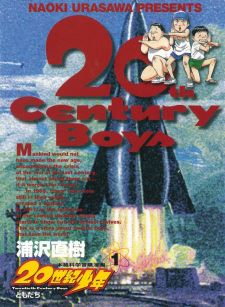
20th Century Boys
- Genre: award winning drama mystery sci-fi
- Author: urasawa naoki
- Artist(s):
- Year: Sep 27, 1999 to Apr 24, 2006
- Original Publisher:
- Status: Finished
Rating(4.1 / 5.0, 77 votes)
5 stars
31(40%)
4 stars
25(32%)
3 stars
21(27%)
2 stars
0(0%)
1 stars
0(0%)
Popular Reviews
This is the sign you've been looking for... Stop scrolling through the reviews and read this masterpiece. There is nothing more to say.
One of the best suspense thriller manga, written by none other than Naoki Urasawa, this manga moves like a movie rather than a book, all thanks to Urasawa's panel composition, art style, and storytelling. It's an absolute ride, to say the least.
The characters are well-developed, with moments that will have you laughing or crying. Every decision a character makes in the story has clear motives, showing a sense of development throughout and not just rushing to a conclusion.
There is a lot of revisiting done for each story in this manga, which helps you unravel more of the plot.
This manga is probably one of the best works by Urasawa-san.
How do I explain it? Ah, it's one of those manga that really draws you in and makes you want to keep reading. It's a mystery manga that shows how propaganda plays a significant role in shaping society. A simple children's game can have real-world implications on adult life and the future. Honestly, it's really, really good—you've got to trust me on this.
If you're looking for other works by Urasawa-san, you should also check out Monster and Pluto.
MYSTERY MANGA ENTHUSIASTS UNITE
I can't even begin to describe how phenomenal the manga "20th Century Boys" is. This manga gave me a feeling I had never experienced before while reading, and it kept me hooked until the very end. The structure of this manga is nothing short of divine, and the story itself is a true masterpiece. All the characters are incredibly enjoyable.
There are numerous side plots happening simultaneously, but it never becomes hard to follow or annoying. Watching all the side plots, mysteries, and questions come together in the end is an absolutely groundbreaking experience. Urasawa really knocked it out of the park with this one.
(Now I just need to finish "Monster")
Manga you should read before you die. One of the greatest mangas of all time. A true masterpiece, the story blends elements of 1984, A Clockwork Orange, Monster, and Anohana—dark yet colorful at the same time. You will never be bored with each chapter, as every one of them only heightens your curiosity. The mysterious atmosphere envelops you throughout. The timeline shifts are executed perfectly. This manga plays with your emotions, evoking deep feelings. The art is classic Naoki Urasawa. The character development is exceptional, with amazing attention to detail for each character. Their backstories are beautifully crafted and heartwarming. Naoki Urasawa is a genius.
This is my favorite manga so far.
20th Century Boys is incredibly good; everything about this manga is remarkable, from its story and characters to its art. I have never experienced a story like this before, and I was absolutely amazed when I finished reading it.
Story: 10
The story is amazing. Every time I finished a chapter, all I wanted to do was dive into the next one. The narrative is filled with mysteries that are slowly unraveled, piece by piece. By the end, all the dots connect, giving you goosebumps and an electrifying feeling down your spine. This manga left me speechless with its storytelling prowess and its ability to keep you on the edge of your seat with every passing chapter.
Characters: 9
The characters in this manga are very well-developed. They all have realistic personalities that make them feel like real people in dangerous and confusing situations. Each character has a distinct role in the story, ensuring there are no pointless characters. It's impressive how each character has their own motivations and isn't just a random NPC.
Art: 10
The art of this manga isn't hyper-realistic with insane details, but I love its style because it enhances the mysterious atmosphere of the story.
Overall, I give this manga a 10/10 for its insanely good story and mystery.
20th Century Boys is essentially a story about the dreams and hopes of a group of friends going terribly wrong.
The limited number of pages per chapter allows readers to consume a substantial portion of the story in each sitting, which is aided by the compelling narrative. The plot is meticulously crafted, the suspense is masterfully executed, the world-building is detailed and immersive, and the characters are well-developed, especially Kenji. His struggle to fight the future he inadvertently created is deeply moving, and it's hard not to root for his success. As expected from Naoki Urasawa, the artwork is exceptional.
My main criticism of 20th Century Boys is the abundance of unresolved plot threads and characters who seem to disappear without explanation.
The ending, while satisfying, feels rushed. Some chapters come across as filler material, and there are a few unnecessary clichés.
Overall, 20th Century Boys is an engaging manga that I recommend every fan should give a chance.
Slow yet effective.
This manga/story reminds me of that line. A thrilling narrative for those who understand how this type of story operates. One of my favorite mangaka created this manga. A childhood fantasy turning into reality in some of the most terrifying ways possible.
Not much to say. Read it with patience, and you will be rewarded with a reality that feels cinematic. It's unique in its own way because there are very few authors willing to take such a big risk. Not all characters shine, but it's for the best. It will conclude like a classic thriller but grow efficiently. Hope you enjoy this manga.
20th Century Boys promises a lot, shows the most exciting teases and engrossing demonstrations, but all the build-up is hardly worth it when nothing substantial follows.
I held off reviewing this until reading 21st Century Boys since that seemed to be the real conclusion to the story. While it does offer some closure, it's still awful.
Art: One of the few aspects of this manga that is absolutely impeccable. Urasawa excels in almost every aspect of the visual elements. His characters fit seamlessly into the world with grounded designs, making them appear extremely human. This accomplishes two things: it makes the story more realistic and ascribes depth to characters without even writing much. While most characters in 20CB aren't particularly multi-layered or well-developed, their appearances often suffice to convey their personalities. Some faces show wear and tear from decades of hard living, while others hint at intellectual limitations. You can look at these characters and already assume who they are and how they act because you can likely find someone similar in real life unless your flat is your universe. This description might make it seem like Urasawa is a genius of photorealism, but while his backgrounds and inanimate objects look very realistic, his characters are anything but. They are cartoony and exaggerated to highlight their defining features, yet the range of emotion and human expressions on their faces is incredibly lifelike.
Also worth mentioning is the fluidity with which everything moves. Urasawa is amazing at depicting movement, force, and momentum, making every action sequence a joy to see. This talent also influences his paneling, aiding pacing significantly. Panels are structured so that scenes and actions never stay on a page longer than necessary, prompting readers to turn pages quickly, matching the story's pace. Even during drawn-out dialogues, he rarely overloads any page with too much dialogue, spreading it out to maintain a consistent flow.
Story: 20CB is the worst thing I've read by Urasawa and a massive disappointment overall. It's a mystery with unparalleled build-up and suspense, but what was the point? The actual mystery and its resolution were terrible. I'll assume you've read 21CB because if you haven't, you didn't finish this manga.
One brilliant aspect is the perpetual cycle of reveal and further mystery. Every other chapter introduces something new while posing intriguing questions that keep readers hooked. These questions are so interesting that they make thousands of readers eagerly devour each chapter. This means Urasawa succeeds in making you care for the characters and their world. He crafted a mystery so fascinating that no matter how formulaic and repetitive the plot progression becomes, readers still crave more.
However, all this falls apart in the end. Despite his flaws, Urasawa is an excellent writer, meticulously introducing new plot threads and tying them into the overarching story, making this manga's failings all the more peculiar. Many characters are introduced merely as convenient plot devices, only to fade into irrelevance. This applies not just to minor characters but also to Kenji’s gang, which seems to grow bigger and bigger. Another group related to the antagonists gains a new member near the end, and this seemingly minor character turns out to be the big bad himself.
The Friend, the main driving force of this mystery, is simply awful. Without going into spoilers, my issue is that their motivation is ridiculous, and they aren't even a fully realized character. The childish reason behind a significant portion of the planet bleeding out is meant to tie into themes about children overdramatizing things and taking silly matters seriously. However, I think this theme is garbage. Even if this theory stemmed from the gap between Urasawa’s talent and the poor writing in the last stretch, what’s the point? This non-existent theme doesn’t benefit the story, so why praise it? There's nothing to commend.
Another aspect is the paranormal and psychological elements. Everything related to precognition, telekinesis, and supernatural phenomena is there to explain the plot without bothering to make Friend’s plan coherent in a real-world context. How did he gather so much power and loyalty? "Charisma" and other "ESP" nonsense—it's never explained or used outside of convenient situations. Two events provide some insight into his popularity, but even then, humanity here is supremely impressionable. If they heard the War of the Worlds radio broadcast, it would end with mobilizing the military and launching nukes instead of mere panic.
Finally, the story drags on too long. Urasawa keeps coming up with new "real" threats until reaching some arbitrary goal. The result is a jumbled mess of a story with no real conclusion.
Fun factor: If you're into mysteries for the ride alone, give this a shot—you might love it more than expected. If you prefer stories with a purpose and a clear destination, there’s probably little here for you. While most of this manga was thrilling, the ending is so bad that if I had known beforehand, I probably wouldn’t have bothered reading it.
20th Century Boys may initially appear to be a standard manga with a theme of saving the world, which doesn't sound particularly unique. However, the mangaka, who also wrote 'Monster,' is a genius, and everything he touches seems to turn to gold.
The brilliance of this manga lies not in its premise of saving the world but in its exploration of friendship and youthful memories. It delves into the bonds formed with old friends and highlights how each person has their own distinct qualities. The numerous side characters are all portrayed as real people with genuine lives, making them relatable and memorable. What makes this manga truly special are the frequent flashbacks that show the characters when they were younger, helping readers understand and love them even more.
The story revolves around Kenji, the protagonist, whose childhood friend has turned into a psychopath calling himself 'Friend.' This mystery keeps you hooked as you try to figure out who this villain is. After the reveal, the story jumps fifteen years into the future. Without giving too much away, once the narrative shifts to focus on the future, it loses some of its tension. While it's enjoyable to see lost characters being found, the overall suspense diminishes. The mystery seems solved, and there isn't much left to uncover. Despite this, it remains a good read, though not as compelling as the earlier parts.
The artwork is highly realistic and not fantastical, which suits the serious tone of the manga. There are some beautifully detailed illustrations, and everything is drawn realistically. Though not extraordinary, the artist didn't create an entirely new world for this series, but the art is still well-executed and satisfactory.
The characters are the standout element of this manga. They are so well-developed and engaging that you'll feel like you've made new friends by the end of it. Their stories will make you care deeply about them, almost to the point of tears during emotional moments. Reading this manga feels like forming meaningful connections, no matter how lifeless that might sound.
I thoroughly enjoyed reading this manga, despite the slight dip in quality towards the end. Nevertheless, it's definitely worth a 9 out of 10!
I would have loved to give this series a perfect score.
At its heart, this is a story about life itself. It’s about childhood dreams, those hazy summers where days blur into one another until everything feels like one long, indistinct memory. It’s about lazy afternoons spent at friends' houses, voicing grand visions, but also about gradual separation, the disillusionment brought by harsh reality, and the transformation into someone who barely remembers those beautiful, carefree days.
In many ways, this is the most complete manga I’ve ever read. It feels almost perfect. If we were judging solely on premise, this manga would easily be the greatest single story I’ve ever encountered.
However, somewhere along the way, the manga shifted from near-perfection to just another silly suspense thriller. As a suspense thriller, it wasn’t terrible, but for me, it disrupted the narrative flow and broke the story’s cohesion.
Despite this, I’d still recommend everyone who has lived a bit of life to give it a read. I’m sure everyone will find something interesting within its pages.
Leave a Review