
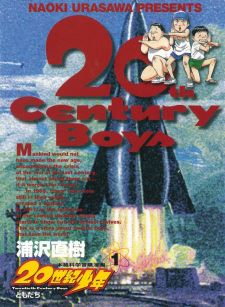
20th Century Boys
- Genre: award winning drama mystery sci-fi
- Author: urasawa naoki
- Artist(s):
- Year: Sep 27, 1999 to Apr 24, 2006
- Original Publisher:
- Status: Finished
Rating(4.1 / 5.0, 77 votes)
5 stars
31(40%)
4 stars
25(32%)
3 stars
21(27%)
2 stars
0(0%)
1 stars
0(0%)
Popular Reviews
"20th Century Boys starts off incredibly strong with a global conspiracy that surpasses anything else I've personally read. The first 100 or so chapters are even better than Monster. However, it takes a sharp nosedive into mediocrity after that. Characters inexplicably return without any explanation of how they survived, and the antagonist shifts from one person to two, then three, which doesn't make sense given the information provided. The beginning of the story sets up a mystery you can solve yourself based on the clues given. But the second half just throws random elements at the wall to see what sticks. There are virtual reality memories, characters coming back to life because their arcs weren't resolved earlier, and an absolute mess made of Kenji, Kanna, and Otcho's storylines. My recommendation is to read only the first 130 chapters and end the story there—it's not worth your time to go through the last arc. If you want a complete masterpiece, read Monster instead. The art in 20th Century Boys is good, though; no complaints there."
Sorry for my bad English, I guess.
20TH CENTURY BOYS is a masterpiece because it has everything that a great manga should have. However, the problem was me. Here's some advice: Don't look at the cover of a volume until you've reached that point in the story, as it might spoil a character you shouldn't see yet. Read the manga at your own pace and don't rush it, as this manga requires at least one re-read. I didn't re-read it entirely, but I did go back to previous volumes and chapters to clear up confusion.
Here is my review (sort of):
Story: 10
The story is told across different timelines, such as 1969, 1971, and 2015. One of its strengths is that characters age with time, making it easier to identify them as they grow from children to adults. The story is essentially about good guys fighting against an evil group, but it's much more complex than it appears at first glance. There are many factors driving the story smoothly. Sometimes the author jumps between timelines without warning, which can be irritating, but it becomes less prevalent as the story progresses. I don't want to spoil anything because there are many plot twists—just read it! More people need to talk about this manga. Even though I haven't read Monster, I've been spoiled, maybe minor or big, but I don't care. I'm going to read it soon and see if my enjoyment remains high even though I know things I shouldn't.
Art: 8
The art is very good, especially in some scenes which are breathtaking and beautiful.
Characters: 10
This is my favorite part of the manga. My favorite character is Fubuki, but my all-time favorites are Otcho and Yoshitsune. Otcho has an interesting arc where he meets someone who trains him to become a better person after his past experiences. He's just great. Yoshitsune is fascinating too, and I like how he deals with the concept of leadership despite struggling with it.
Enjoyment: 10
Fun, thrilling, and marvelous. I read this manga in about a week and three days, and there are 249 chapters total. Weird flex, but ok.
Overall: 10
I'm glad I read it, even though it took me a long time to pick it up again. I loved every bit of the story.
An exciting mystery that will keep you on the edge of your seat, but suffers from padded length and weak characters. Despite its flaws, it's still worth recommending.
Story: 7/10
The plot is a mixed bag for me. There’s an over-reliance on time skips, making the story feel meandering at times. However, just when I started doubting whether the manga was worth my time, an explosive plot twist would pull me right back in. While I can’t say I loved the plot, it kept me reading.
Plot twists are crucial for a mystery, and this manga delivers them in spades. Each twist hits hard but never feels random, with clues for astute readers to pick up along the way.
Flashbacks to the main cast's childhood could have been annoying, but they enrich the manga by contrasting the grim present-day events with happier memories. This not only provides relief but also emphasizes how the chaos around the characters originated from a child’s mind, adding a chilling layer.
Despite my criticisms, the story kept me hooked for many chapters. The reason I rated it a 7 is because, despite its flaws, it managed to maintain my interest.
You’ll need a hefty dose of suspension of disbelief due to the central mystery's magnitude. On one hand, the all-encompassing intrigue drives home the desperation and elevates stakes. On the other hand, the plot becomes so dramatic and overblown that it veers into the realm of comedy rather than tension.
Time skips are used too frequently, often mentioning interesting events in passing before moving on. This technique feels lazy and skips over potentially engaging content. Additionally, the expansive cast feels largely redundant, with new characters constantly introduced and quickly discarded after their brief relevance.
The manga feels overly long, dragging at times with little plot progression. The revolving door of characters prevents reader connection, making the world feel forced to fit the plot. Introducing a new protagonist midway through is a poor decision, leading to the next section.
Characters: 4/10
Kenji starts as a relatable, down-to-earth protagonist but deteriorates with each time skip. He transforms from a fearless hero to a messianic figure without clear development. His drastic changes feel jarring, especially since he’s the viewpoint character for half the manga.
The primary antagonist’s motive is bafflingly stupid, bordering on comical. Without depth or perspective, it’s hard to take them seriously.
The large cast prevents any real personality development, with most characters serving mere plot convenience. One egregious example is a character who appears solely to deliver exposition, helps the MC without motive, and then disappears.
Kanna epitomizes the Mary Sue trope, being endlessly capable and confident with no real reason. Characters treat her like a savior, which grows tiresome.
Art
Exceptional art, though some minor characters look too similar. The artist ensures each character has a unique look, maintaining continuity between child and adult versions. Background art enhances realism and induces intended emotions, contributing to the atmosphere and enhancing the reading experience.
Overall: 7/10
While this manga might be considered a masterpiece due to its age, modern standards reveal numerous flaws. It’s far from bad and recommended for mystery buffs, but it’s overhyped. Despite my complaints, it’s hard to stop reading, which is perhaps the best reason to give it a try. Avoid spoilers if possible.
Story: 8
SHOCKER!!! The story isn't ORIGINAL! It's your typical tale of an insane cult working in the shadows to take over the world, and an unlikely hero with virtually zero chance of stopping them tries to protect humanity. As generic as that might sound, the execution is wonderful, and the first 50 chapters are by far the greatest piece of literature I've ever seen. Those initial chapters had a great main character, exciting drama, a solid backstory, and a formidable villain (at least for the first 50 chapters). The problem is the nosedive the series takes afterward. Kanna is nowhere near as cool and epic as Kenji was; the drama and thriller elements degrade, the manga becomes slower, and there are unanswered questions like how Kenji manages to escape Friend on New Year's Eve 2000 and what happens during the altercation between Kenji and Friend. Introduced characters aren't as strong as those in the first arc, and overall, it just gets worse. The story is still solid, but they should have ended it with an extension to the first arc. However, getting Ca$h Monie$ seems to be the priority.
Art: 7
The art was nothing special. Literally, nothing stood out about it. I gave it the most borderline grade I could.
Character: 7
"Kill Yourself" is what I hear when I say "Character: 7." Honestly, I don't like saying that either because if they had just ended with an extension to the first arc, this would be a solid 9. But that's only in a perfect world, and I'm being nice to this series. For being significantly shorter, Monster was able to create a perfect, complex, entertaining, and badass villain many times better than Friend. Friend, for being the major villain and the most important character in the second arc, is the most underdeveloped character in this manga and maybe in manga altogether. Friend basically has no backstory, and his first identity was pathetic. His second one is UNKNOWN! If that isn't bad enough, he actually doesn't have much dialogue or screen time in the second arc, making him more of a wimp. Other than that, the characters were all solid. I didn't like Kanna too much mainly because of the drop in quality from the "God of Normal Main Characters living in an Utterly Realistic World" to her. Otcho was pretty badass, though.
Ending: 3
I was going to put this in the story/characters section, but I saw so much to write about that I had to create a new section. This ending was what MAL describes as "poor," and that's what I'm going by. This ending was poor. (THIS IS OBVIOUSLY GONNA HAVE SPOILERS SO YOU DON'T GIVE ME THAT BS SAYING I DIDN'T WARN YOU.) First of all, what the hell is Kanna doing at a concert? This is her last conflict with Friend, so why is she hosting a concert? Better yet, she is UNCONSCIOUS during the final encounter. This is majorly pathetic knowing the fact that Kanna is the main character for more of the show than Kenji was, and yet she isn't even awake when the final showdown takes place. I expected her to learn something about her "bending spoons" superpower that would be used to finish off Friend and could give off some good character development and backstory off of it, BUT NOOOOOOOOOOOOO (too many caps, but no fishes given) instead we get a suicide bomber who is basically a forgotten character for much of the series to risk his life to conveniently crash the UFO on top of Friend to save the day (the hype that UFO had was unbelievable, and for it to end as quickly as it did is just unethical). And on top of that, what was with Friend? He seemed so weak and pathetic leading to the showdown and for him to die the way he did TWICE is just sad. And why did all the characters come back for the end? The series seemed as if it couldn't let go of all the characters that should have died or at least been forgotten, so it just jammed them all together to make a weird and a bit forced ending. And Friend deals with many problems at the end such as having a weak sendoff, no mask reveal, a master plan that he planned for four years got shutdown in one weak blow, no revealed backstory, no revealed motivations, and just being way too overhyped for what he actually brought to the table, making this ending "poor."
Enjoyment: 9
Goddamn, I'm tired from all this writing, so I'm just gonna say that for me, the first 50 chapters were enough to give it a 9.
Overall: 8
The first arc was a 10. The second was a 6. Average that out, and you get 8. The first 50 chapters are definitely worth reading, and after that, you can decide where to go from there.
No Spoilers
Slow beginning, amazing middle, fumbled ending.
This manga is a classic and rightly so. It is very well written and feels like a piece of literature that you could study in a college class. The symbolism, themes, and religious imagery will be good talking points to analyze with others. The manga excels at non-linear storytelling, frequently jumping from the present to the past to the future, especially in the beginning. Be aware that this style may not appeal to everyone; personally, there were times when I became deeply invested in a subplot only for the story to flashback or flash forward, introducing an entirely new subplot.
The manga is excellent at introducing new characters and keeping them relevant. Even minor characters have meaning and interesting backstories, often reappearing throughout the manga, which was always fun to see. The author is particularly skilled at this. The story, especially in the middle, has so many twists and turns that you will be hooked.
I gave it a nine, but the manga does have one issue: its ending. The ending was really disappointing. Throughout most of the manga, it felt like every character and scene had a purpose. But after around chapter 18, it seems like all that careful planning went out the window. The last six chapters felt rushed and dragged on simultaneously, lacking the thoughtfulness of the rest of the manga. There were too many unnecessary additions near the end that only complicated the story, turning what could have been an amazing manga into merely a great one.
Read 21st Century Boys. It's not a sequel; it's a redo and continuation of the ending.
Have you ever had those moments when you breeze right through a manga volume, really getting into its flow and feeling completely immersed? 20th Century Boys made me cry, and it was every bit as awesome as I could have hoped for.
The thoughtful paneling and the natural unfolding of Urasawa's art style breathe life into all the well-conceived and implemented characters. It was an absolute joy to experience. The tale is windingly wild, with interpersonal interactions so well-executed that you'd think the mangaka had lived multiple lives already. What some might consider filler or derailment actually adds rich textures to the overall plot in varied and deft ways, never feeling forced or repetitive.
The characters are unmistakably themselves; Urasawa excels at characterization, which is refreshing for such an older series. Read 20th Century Boys if you appreciate well-crafted manga. I believe anyone who didn't enjoy it just wasn't at the right point in their life to appreciate it fully. There really isn't much to be critical of here. Unmistakably, this is a masterpiece.
If you were the kid in class dreaming of one day saving the world from evil, STOP EVERYTHING AND READ THIS. In 101 chapters, I know this story is a masterpiece. I don't believe I've ever read a story that gave me anxiety; Junji Ito stories creep me out, but 20th Century Boys gives me anxiety. I had to force myself to write this review to stop reading the story—I'm still shaking. If you want to experience slow-burn storytelling that induces borderline paranoia, this is the story for you.
The characters grow on you in perfect Naoki Urasawa fashion; their hopes and fears become your own. This story is like no other; it takes place over 46 years, jumping from year to year, perfectly melting into one another. Everything is connected; not a single plot hole exists. The best way to describe the vibes and atmosphere is the Dutch Angle. Read it in darkness, let the uneasy feeling consume you. Question everything.
It's intense, but far from perfect. The story boasts a fantastic setting, and the frequent time jumps were particularly well-executed. The mystery surrounding "Friend" was intriguing, though the ultimate reveal could have been more impactful. However, the manga suffers from an overly extended main narrative, weighed down by unnecessary subplots and side characters. Cutting out 60-80 chapters would have made for a tighter story. Despite this, the unique mystery elements and monster themes will appeal to fans of the genre. Overall, it was an enjoyable read for me, though there are better mystery manga out there. I rated it an 8.5.
In 1999, acclaimed mangaka Naoki Urasawa embarked on his next thrilling adventure. A tale of mystery, suspense, childhood dreams, manga, and rock and roll, "20th Century Boys" spans 22 volumes with a 2-volume epilogue. Let's dive in.
STORY: The narrative begins with Kenji Endo, who works at a convenience store while caring for his aging mother and baby niece. His life reflects the fears many of us have—growing apart from friends, failing to achieve our dreams of becoming musicians, and struggling to make ends meet. However, peace is disrupted by a cult led by someone known only as "Friend," and a series of mysterious deaths caused by a virus that makes people bleed out. During a liquor delivery, Kenji discovers an old symbol from his childhood, linking it to Friend's cult. This sets him on a quest to uncover the truth before the world ends with the twentieth century. The story is full of twists and turns, staying fresh and surprising without falling into clichés. While not perfect, with some parts feeling dragged out or questionable, overall, it's more hit than miss, offering an engaging ride for most readers.
8/10, fun and exciting with a few bumps along the road.
CHARACTERS: "20th Century Boys" boasts a large cast. Kenji is a standout character, embodying the hero with a guitar. He pursues justice through revolutionary means, focusing on public displays rather than violence. His dedication to non-violence and protecting others adds depth to his character. Among his childhood friends, Maruo, Yoshitsune, Yukiji, Otcho, and Mon-chan all have their own compelling arcs. Yukiji, in particular, stands out for her charming and bittersweet relationship with Kenji. Another highlight is Kanna, whose direct approach and personality make her memorable. The villain, "Friend," is intriguing, always one step ahead and pulling off stunts reminiscent of classic shounen manga. While the reveal may not be earth-shattering, it remains engaging. Other notable characters like Ujiko Ujio, Shono Chohei, Koizumi Kyoko, and God add richness but can lead to spoilers. Despite the large cast, some characters lack development, but overall, the variety and values they bring are endearing. Music and classic manga play significant roles, reflecting Kenji’s love for rock and the impact of classic tropes on Friend’s plans.
8/10, a few standout characters and no real misses. I found the cast endearing.
VISUALS: Naoki Urasawa's art isn't just functional; he brings his A-game here. His ability to seamlessly integrate cartoonish elements from classic shounen manga into a semi-modern setting is impressive. Seeing things like giant robots and laser guns fit naturally into grounded locations enhances the story's believability. His designs, especially the iconic look of Friend, are distinct and detailed. The amount of detail in some pages is astounding. There's little to criticize unless comparing it to other greats like Makoto Yukimura or Kentaro Miura. The settings, particularly run-down cities and semi-slums, are beautifully rendered.
9/10, nothing to complain about, just stuff to write home about.
FINAL SCORE: 8/10
I truly loved this series and would rate it higher if it were flawless. It's an intriguing story with a big cast of lovable characters and amazing art. The love for music and manga culture is evident throughout. If any of this sounds interesting, I highly recommend checking it out. Naoki Urasawa's work is accessible to nearly everyone, except those sensitive to blood and violence. Fans of rock and classic manga will find many delightful nods in this series.
When I think of 20th Century Boys, I'm always reminded of a quote my dad told me when I was learning about Freud at school: "Give me the child of seven and I'll give you the man." While this saying is open to debate and Freud has little to do with this manga series (I'm not particularly fond of him, but that's another story), it raises an important question: how much does your childhood shape your later life? 20th Century Boys explores this idea, among others, in a surreal way.
We are introduced to a group of boys and one girl living in early 1970s Tokyo, part of the second post-war generation. Everything is changing; it's the height of the hippie era, and science is advancing rapidly. This group of children grows up amidst these changes, influenced by both the counterculture and scientific progress. Three events repeatedly referenced throughout the series mark this period: Woodstock, the 1970 Osaka Expo, and the moon landing. However, these major global events don't significantly alter the day-to-day lives of our protagonists. Homework still needs to be handed in, and they still have to run from the world's meanest twins. One of the first scenes in the manga illustrates this well: rock music is played for the first time in school, but nothing really changes—school continues as usual, and not even a teacher complains.
Now adults stuck in their mundane routines, saving the world and playing sell-out shows at Kabuki theaters are long-forgotten dreams. Mysterious deaths, a deadly virus, and an upcoming "Friendship Party" all seem linked by a symbol the group created during their childhood. The group must now come together to prevent the very events they dreamed up as kids.
With 22 volumes and two additional final volumes to conclude the story, there's much more to this tale than meets the eye, with plenty of plot twists to keep readers on edge. However, this is also partly its downfall. When I finished the manga, there were questions left unanswered simply because Urasawa added more twists without a clear plan to tie up loose ends and conclude the story cohesively.
The art style resembles Western graphic novels rather than typical manga, offering a refreshing break from the current moe trend in anime and manga. It's clean and well-executed, with each character distinguishable through notable facial traits that aren't overdone. A good example is Keroyon, whose features resemble a frog. The aging of characters is also done plausibly, and the panels flow smoothly, making even mid-page time switches look natural.
Another noteworthy point is how Urasawa handles time switches within chapters, something many manga artists avoid for fear of confusing readers. Yet, Urasawa manages this seamlessly.
The group evolves over the years, each facing individual challenges in their quest to stop "Tomodachi." Every character gets their moment to shine, and no one is less important than another; everyone plays a crucial role in the fight against "Tomodachi." The antagonists are well-developed, though a few could have benefited from dedicated chapters to flesh them out further.
A trait of Urasawa's, which I haven't seen in his other works, is that no character is forgotten—each has a purpose. This is undoubtedly one of the series' strong points: every character serves a function and will likely reappear later to advance the plot. Pure genius.
20th Century Boys is undeniably a page-turner. If possible, I would have read it all in one sitting. I didn't know what to expect when I picked it up, but I was pleasantly surprised. Once I started, it was hard to put down. Each chapter and volume ended on a cliffhanger, leaving me breathless as the plot never slowed down. There were a couple of areas that could have been improved, and in my opinion, the real ending was found in the two volumes of 21st Century Boys rather than the conclusion of 20th Century Boys, since the latter felt blunt and unclear. Nevertheless, this is a manga I'd recommend to almost everyone, especially those looking for a deeply engaging story.
This is a classic Urasawa manga, which means it starts off brilliantly, introduces captivating characters, and intricately weaves an engaging mystery with great care and skill. However, when it comes time to wrap things up and resolve the various plot threads and mysteries, he fails to deliver.
Instead of a satisfying conclusion, readers are subjected to several self-indulgent volumes where the author inserts himself as a wandering musician. Meanwhile, the carefully constructed plot crumbles, with well-developed characters suddenly acting out of character. Chapters end in increasingly nonsensical cliffhangers that never get satisfactorily resolved, and the focus shifts to a tedious messianic musician subplot as Urasawa desperately tries to stretch the story out for as long as possible before his audience loses interest.
Objectively, there is a lot to appreciate about this manga. The artwork is excellent, and most of it is genuinely gripping. However, I will never read it again. It's unclear whether Urasawa ever had a satisfying ending planned or if he was simply making it up as he went along. In either case, it feels like a waste of potential.
Leave a Review