
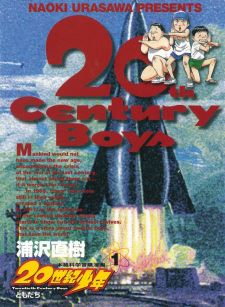
20th Century Boys
- Genre: award winning drama mystery sci-fi
- Author: urasawa naoki
- Artist(s):
- Year: Sep 27, 1999 to Apr 24, 2006
- Original Publisher:
- Status: Finished
Rating(4.1 / 5.0, 77 votes)
5 stars
31(40%)
4 stars
25(32%)
3 stars
21(27%)
2 stars
0(0%)
1 stars
0(0%)
Popular Reviews
For all the manga lovers out there, this manga is a must-read. After many years, there's finally an original story. It revolves around a kid with ideals about the world's future, striving to be the hero who saves the world according to those ideals. Decades later, without knowing anything, one of their friends turns those ideals into reality. Naoki Urasawa is very clever in plotting the whole story. How he manages flashbacks, the present, and the future without confusing the reader is highly commendable. All the flashbacks, present events, and future scenarios are interconnected, and you need to read all the chapters to discover who the villain in this story is. The final action in this story continues in another series called "21st Century Boys."
A global conspiracy plunges the world into chaos, with everything hanging on the answer to a single question! However, 20th Century Boys seems to lack an answer to this pivotal question, making the entire narrative feel like an empty promise.
The story is incredibly engaging and constructs an elaborate conspiracy filled with fascinating characters and dark secrets. Each mystery solved only spawns a dozen more, leaving you more confused the further you delve in. Eventually, the stakes become so high that the fate of the entire world rests on answering one question: "Who is Friend, and what's his motive?"
I feel it's important to warn you (without spoiling too much) that the "big reveal" happens in literally the last five pages of the final chapter and feels like the biggest cop-out I've ever encountered. There’s no foreshadowing or plot relevance; it’s something utterly inconsequential that handwaves away the central mysteries. This leaves a very bitter aftertaste, especially since the manga constantly teases the 'big reveal' every few chapters, building expectations sky-high despite having nothing substantial to offer.
That said, the story remains highly entertaining. The characters are memorable, the plot is gripping, and the artwork is distinctive and expressive. The narrative evolves through shifting character perspectives, drastically changing settings, and an ever-deepening mystery at its core. Despite the disappointing resolution of that mystery, it remains intriguing until the end.
This surreal mystery blends a level of realism unusual for anime with an absurd premise, managing to be both a wacky comedy and a dark thriller simultaneously. The execution is nearly flawless, balancing gritty drama with humor and crazy premises. However, as the story progresses, the circumstances become increasingly unrealistic, making suspension of disbelief impossible, even though we're told everything stems from mundane childhood events.
If you can manage your expectations for the ending, this is a fun read. It’s emotional, compelling, and complex. The key characters are unique and multi-dimensional, evolving throughout the story. The plot is far from cliché or predictable, constantly moving forward, even if it means venturing into ridiculous territory. While the constant teasing of the 'big reveal' becomes annoying and drives the plot, the story mostly stands on its own merit.
20th Century Boys is a unique amalgamation of three distinct stories, each varying in quality, bundled into one package. It's an intriguing case of good intentions but misguided execution. If Naoki Urasawa had taken the time to separate these narratives into three individual manga series, he might have created one of the greatest works of the early 2000s. Unfortunately, that didn't happen.
The story begins with a gripping and unsettling mystery centered around Kenji, a failed dreamer. The narrative initially follows two threads: Kenji's nostalgic memories of his childhood and his mundane life as a shop owner. This changes dramatically with the arrival of Baby Kanna, around whom strange events begin to unfold. From this point, the plot accelerates through various twists, characters, suspicions, murders, and suicides, all revolving around a mysterious cult leader.
The dual narrative becomes a brilliant storytelling device, with warm nostalgia suddenly tinged with ominous undertones. It's a race through Kenji's shared childhood to uncover forgotten memories. Paranoia, fear, and conspiracy are masterfully woven into the narrative, making it deeply unsettling. Urasawa's talent as a storyteller is evident here, creating a tense and atmospheric thriller.
However, his brilliance in the minutiae—dialogue, panels, and emotions—is lost due to a lack of cohesive vision. I see 20th Century Boys as a three-act tale. The first act showcases Urasawa at his best, crafting a Kafkaesque maze of terror and apprehension that leaves readers on edge. The tension builds relentlessly, keeping you invested in the protagonists' struggle against an unknown evil. But then, abruptly, everything falls apart.
Suddenly, the story collapses. The tension dissipates, and our characters seem to wander aimlessly. What was once an incredible thriller transforms into something akin to a parable. The second act feels disjointed, with weak attempts at political commentary that never evolve beyond superficial cries for "freedom" or "fascism." Without the same driving force, the story becomes dull and predictable, and the characters turn cliché.
The third act is even worse, lacking any clear direction. It feels like a rushed collection of loose ends and hurried conclusions. Urasawa tries to incorporate various themes—from references to American outsider culture to peaceful protest—but these elements feel forced and disconnected. The story ultimately concludes with a clichéd "happily ever after," typical of shonen manga.
This work is worth analyzing, especially considering its likely response to the 1995 Aum Shinrikyo attacks, focusing on themes of free thought and cultism. While Urasawa's intent seems noble, there's a fundamental flaw in trying to artificially make the story "moral" or "deep" rather than focusing on what he does best: creating atmospheric and tense narratives.
Art: 6/10 - Practical but unexceptional. Clean and defined, with sharper angles adding a menacing quality, though not much else stands out.
Character: 7/10 - The characters are relatable and show multiple facets, lending them a certain humanity. However, their development can sometimes feel forced or irrational.
Story: Rating this was challenging due to the wildly varying quality. The first arc is easily a 9/10, the second a 6/10, and the third a disappointing 2/10.
Overall: 20th Century Boys earns a deserved 6/10. While parts of the manga are absolutely captivating, the latter portions are underwhelming. Give the first arc a chance, but be prepared for disappointment with the subsequent acts.
I don't usually binge anything; I prefer taking my time with things. But when I was reading 20CB, the power in my house went out for an entire day. With nothing better to do, I ended up reading the final 130 or so chapters of the manga that day. Honestly, I think it enhanced my experience with it.
Personally, I find myself more drawn to the scenes featuring the boys as children rather than their more significant adult moments. The flashbacks have this whimsical quality that feels nostalgic. Building secret bases and hiding in them with your close group of friends, away from a parent's watchful eye—these are activities I remember fondly from my own childhood, even though I'm only 20.
On the other side of the story, the adults fighting against the mysterious 'Friend' is an incredibly well-written mystery, as is typical of Urasawa's work. I derive great satisfaction from seeing seemingly invincible forces that control everyone's lives being taken down. There's a special kind of freedom in that, which just makes me feel good. I particularly enjoy seeing controlling forces fall. The theme of rock music also adds to the sense of liberation you get from defeating 'Friend,' as freedom and anarchy are core ideas in rock.
Naoki Urasawa's art isn't particularly exceptional. His style is very recognizable, and I can immediately identify his work, which is important for an artist. However, his characters tend to look quite similar, and many of them have big, curved noses instead of straight ones. It’s not a flaw, but something I noticed. While he aims for realism, there's a lack of variety in his character designs.
I enjoyed 20CB more than both Monster and Pluto because I could relate more to the characters. While the story might not be as tightly crafted as in Monster, or the pacing as good as in the more compact Pluto, the overall experience surpasses those two in my opinion, by a considerable margin.
To me, 20th Century Boys represents Urasawa at his best. It combines his masterful storytelling with a compelling mystery full of unexpected plot twists and a core theme that fits the premise perfectly. In my view, it's a masterpiece.
20th Century Boys is the manga that brought back nostalgic memories of my childhood. This manga was truly beautiful and evoked more emotions in me than any other story I've read.
Story:
In most of my reviews, I avoid detailing the plot and instead focus on my thoughts and feelings. 20th Century Boys has one of the best-structured plots I've ever encountered. Each chapter ends with a page that makes you eager to read the next one. The mystery kept me thoroughly engaged throughout the entire series. Although the ending felt somewhat underwhelming, it was still quite good.
Art:
The art is typical of Urasawa's style—clean, pretty, and characterized by his unique artistic touch.
Characters:
20th Century Boys features one of the strongest character casts I've seen. Every character feels unique and is magnificently written. However, there are three characters I'd like to highlight. First is Yoshitsune; I really loved him. His self-doubt, despite accomplishing something extraordinary, made me appreciate his character deeply. Next is Kenji, who is largely absent from much of the story but is present through memories. He draws respect and love, though I can't pinpoint exactly why—he's just an excellent protagonist for such a great story. Lastly, there's Friend, the antagonist. He's probably one of my favorite antagonists in all of manga. I admire everything about him—his design, ideology, struggles, and weaknesses.
Overall, 20th Century Boys is an excellent story, and I wholeheartedly recommend it.
I wanted to discuss this manga as I am currently reading it. I have reached chapter 19, and let me just say, "Wow!" It's such a gripping read! You can get the basic plot from the synopsis or more detailed reviews, but I felt compelled to share a few thoughts to let others like me know how fantastic this manga is. I thoroughly enjoy being immersed in the world that this manga creates and am eager to uncover the mystery behind the symbol and the "friend." Time to dive back into it then.
This manga is truly a masterpiece. The most beautiful aspect of "20th Century Boys" lies in its storytelling. At its core, the story revolves around "Saving the World," which may seem straightforward, but the author skillfully adds layers of depth to it. From the moment you start reading, you'll find yourself completely engrossed. The seamless flashbacks and the overall mysterious atmosphere will keep you craving more, making you wish the story would never end.
Beyond the captivating narrative, the artwork is magnificent. The author not only captures emotions and sets the tone through dialogue but also through his drawings. You can clearly see the anguish, sorrow, despair, or happiness depicted, which, in my opinion, greatly enhances your emotional connection with the characters.
The characters themselves are probably the second best thing about "20th Century Boys." Urasawa Naoki masterfully creates three-dimensional characters that evoke empathy. Each character gets sufficient "screen time" for you to develop a deep connection with them. They undergo significant changes and arcs, experiencing highs and lows, all beautifully portrayed through excellent character development.
I hope you enjoy this manga as much as I did. As mentioned earlier, "20th Century Boys" is highly engrossing and somewhat addictive. The pacing and constant influx of new information will keep you guessing and ensure there's never a dull moment.
Overall, in my humble opinion, this is one of the greatest mangas ever written. Ten out of ten stars. Do yourself a favor and read it.
I gave this a 10/10 - A must-read for fans of drama, mystery, or those intrigued by the socioeconomic climate, pop culture, and conspiracy theories of the late 20th century. The narrative weaves these elements to create a vivid, believable setting that feels like a trip back in time. If you're nostalgic for that era, this story is perfect for you. While fans of the band T.Rex might be drawn to it, the title is somewhat misleading as the story isn't actually about the band.
"20th Century Boys" excels with its superb writing and timeless art, effectively transporting readers to the latter part of the 20th century. It captures the essence of being young during that time, filled with uncertainty about the future and the hopes and dreams of the coming century. There's something here for everyone.
At its core, the story is about how good intentions can go awry when they are misguided or manipulated, turning innocent dreams into dangerous weapons with catastrophic outcomes. Layered with mysteries and conspiracies, you'll find yourself unable to put it down until you've unraveled the truth. Thrillers succeed based on their lasting impact, and this eerie tale promises to stay with you long after you've finished reading.
*No Spoilers, TLDR at bottom*
20th Century Boys is an essential read. Every aspect of this manga is outstanding, and I would recommend it to almost anyone. If you have even a slight interest in mystery stories, you will find this incredibly enjoyable. Throughout the narrative, new questions and mysteries are introduced, but the story never becomes confusing. Even the time skips and flashbacks are executed well. As someone who isn't always fond of frequent time jumps, I found 20th Century Boys remarkably easy to follow without feeling overwhelmed.
The standout feature of this manga is undoubtedly its plot. It’s lengthy and expansive, yet by the end, every minor mystery across the 249 chapters is resolved. It's uncommon for stories to maintain reader interest with unanswered questions, but 20th Century Boys does just that. You'll constantly be pondering questions like: Who is Friend? What did Donkey see in the science room? What is Friend’s plan? Some critics argue that the story becomes too complex and random towards the end, with too many cliffhangers. However, this isn’t true; all the puzzle pieces are there. If you take the time to connect them—whether through rereading or watching analysis videos—you’ll see how everything fits together. The story may be intricate, but it’s not incomprehensible if you invest time in understanding it.
The characters are equally impressive. Friend, in particular, has numerous layers of symbolism that I won’t delve into here, but any analysis or review will highlight how brilliantly he’s written. Kenji’s group of friends is also excellently characterized, with rich backstories and growth through time skips. Watching these characters evolve from children in the 1970s to adults fighting to save the world in the 21st century is captivating. Kenji stands out as the most compelling character due to his significant development throughout the story.
In summary, 20th Century Boys is nothing short of a masterpiece. Each page turns leaves you intrigued but never lost, with the mystery and looming threat masterfully woven into the narrative. Just when you think you’re closing in on the answer, you realize you’ve only uncovered part of the full story. Ultimately, I can’t say much more than just read it—the genius of 20th Century Boys lies in the twists you’ll discover.
TLDR: This manga is a must-read for anyone who enjoys mystery stories even a little bit. 20th Century Boys boasts one of the best-written plots and character arcs out there.
Leave a Review