
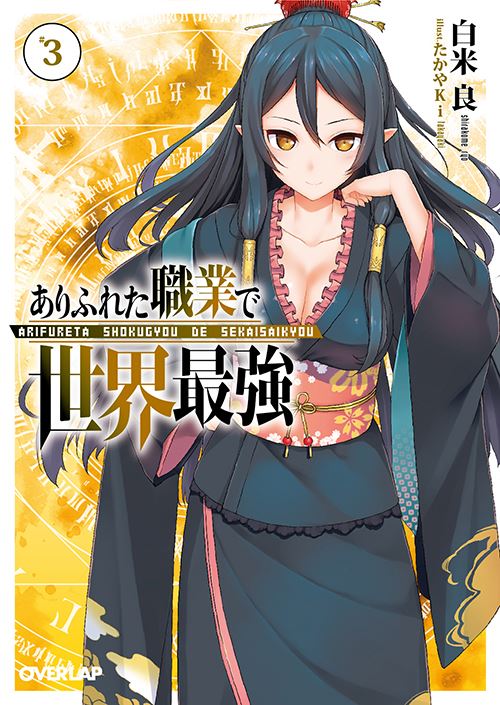
Arifureta Shokugyou de Sekai Saikyou (WN)
-
Author:
Chuuni Suki,Ryo Shirakome,厨二好き,白米良,
- Status: Completed)<br /> 306 WN After Story Chapters (Ongoing
Rating(3.9 / 5.0, 196 votes)
5 stars
58(30%)
4 stars
69(35%)
3 stars
69(35%)
2 stars
0(0%)
1 stars
0(0%)
Popular Reviews
Here are my reasons for not recommending it:
1. The main character, Hajime, lacks depth to be a compelling protagonist. His fighting scenes are neither impressive nor easily comprehensible – perhaps due to translation issues or my own limitations in understanding. Furthermore, the harem aspect feels forced, with numerous female characters added without much development, as the author chooses one after almost 160 chapters. It would've been better if they addressed this issue or resolved it before resorting to a time skip.
2. The pacing becomes拖沓 in certain parts, feeling unnecessarily stretched out. Despite being familiar with other lengthy series like DxD, Bleach, Naruto, and One Piece, this book still managed to irk me with its drawn-out storytelling.
3. The logic behind many of the creations in the story is inconsistent, especially when it comes to the magical elements. There are too many plot holes that undermine the credibility of the action sequences, and it seems like the author keeps adding layers without a solid foundation.
I managed to finish the main storyline but dropped off after just five sentences into the next chapter. Had I continued, I might have given it a similar rating to "Hand Shaker," which I enjoyed despite its flaws, and that would be disappointing.
While I still find the main plot enjoyable, it gets overwhelmed by random and inexplicable sideplots that can be frustrating. The supporting characters, excluding the harem, are poorly developed, and the harem itself isn't particularly deep. The overall concept and world-building are commendable, but the characters outside the protagonist's circle often fall into stereotypes or negative roles.
The story improves later on, becoming more serious with meaningful character development. Since I'm currently on a break, I can't comment further on the later parts. I might revisit it when I'm in the mood for it, perhaps out of boredom.
Potential readers should note that the official website for ElementalCobalt is no longer active, so they'll need to search for chapters online.
The story started strong, but gradually declined. There were peaks and occasional enjoyable arcs after the BBG's departure, but the last few major sections were truly abysmal – I'd almost argue a 1-star rating would be generous. Despite acknowledging the sunk cost fallacy, I believe 3 stars may be too high. I usually give stories the benefit of the doubt, but this one has lost its spark.
I haven't delved into the clichéd aspects or the主角's Mary Sue tendencies, as those aren't my primary concerns. However, the worsening quality of the narrative is hard to overlook. It seems the author is running out of ideas, possibly milking the fanbase or prolonging the series without a clear conclusion. I'll continue reading, but I wouldn't recommend it to others. If you're considering giving it a chance, only do so if you have little else to entertain yourself. While the anime adaptation was disappointing, it's not unusual for light/web novels to suffer, and I don't think the entire story is worth your time. Everyone's preferences differ, though.
Throughout the plot, readers witness Hajime's growth while still maintaining his core identity.
The characters are well-developed, despite the light novel format, with distinct backgrounds and consistent personalities. The main character evolves throughout the story, developing feelings for his party members, which was expected. His harem is not an instant thing; he only accepts Shia after finding a way back to Earth, and Yue's influence played a role in that decision. They both recognize their mutual dependency.
While some might perceive Hajime's actions as contradictory, I don't think it is. His main goal was to return home, and he took on additional objectives like protecting others. His decision to help Yue was a deliberate choice, not a deviation from his original plan.
The exaggerated behavior in the story can be seen as a comedic exaggeration of not caring about the world, which balances out the serious themes. The novel is not overly dramatic but rather filled with humor, making it enjoyable despite its serious undertones.
The MC's breakdown is a powerful moment, but it's tempered by his reaction to eating a bear's arm, demonstrating that not everything should be taken seriously. The novel addresses serious issues like discrimination and manipulation, but often uses irony or parody to address them.
I've read the main novel multiple times and still find it funny. The after-story is even more entertaining, both in a good and a satirical way. The fact that the MC stands up for himself and isn't a passive protagonist is refreshing. Hajime's actions are not ruthless for the sake of it, but driven by purpose.
In conclusion, I wholeheartedly recommend this novel, especially if approached with a light-hearted mindset. It has a consistent plot and well-rounded characters, offering a humorous and straightforward story with occasional side quests that serve the main narrative.
Additionally, the reviewer dislikes the portrayal of a lolita vampire in the story. They question the choice of making a young vampire character, especially since it's unnecessary. Furthermore, the vampire character is depicted as excessively submissive, agreeing to anything the main character says, which the reviewer finds unappealing and describes as "simplistic."
1. It's not a dark tale: Although some compare it to renowned works like "The Heroic Heroine's Sidejob," Arifureta possesses a darker edge, but the author restrains it by introducing the "I want to go home" wish early on and having a supporting female character. The protagonist's primary goal is to return home with his treasure, not seeking revenge, which keeps the story from becoming overly dark.
2. Multiple plot twists: Initially, readers assumed the protagonist would become increasingly sinister, but the heroine's presence mitigates these changes. Later, the MC showcases badassery, but another heroine intervenes, leading to disappointment and attrition among readers.
3. Focus on love and protection: The MC evolves into a protector, showering love on those he cares about, embodying a devoted husband-like persona, in my personal view.
4. A turning point: The catalyst for his protective nature is his teacher's observation about the loneliness of living solely with loved ones. Believing he cannot survive in modern life that way, he unintentionally starts protecting his surroundings.
In summary, while the story might not adhere to typical expectations, it offers a unique blend of elements, with the protagonist's journey shaped by his relationships and desire for a fulfilling life.
The reason I could appreciate it despite the shift in genre is that the later volumes were well-developed, although they did exhibit an attempt at being cool or edgy, which sometimes verged on cliché (I actually found it amusing when the author poked fun at it).
The main issue with the novel lies in the lack of genuine suspense during fight scenes – they failed to create the necessary tension that keeps readers on the edge.
Avoid reading Arufureta, especially if you're sensitive to young adult protagonists with no literary background. The series lacks value for your time.
For a detailed explanation:
The first volume starts off decent, with a standard revenge tale about a desperate protagonist overcoming adversity, seeking freedom, and acquiring unique abilities. It's a compelling story with a clear goal. However, volume two marks a rapid descent, akin to a kamikaze dive in the原著.
While the first volume isn't revolutionary, it's enjoyable. If the series were adapted into an anime (which might happen despite its lack of quality), one can hope for a limited 12-episode adaptation sticking to the first volume's plot. But once beyond that point, the narrative loses its coherence and creativity. The main character becomes a dark and brooding anti-hero, riding a magic-powered motorcycle, accompanied by a vampire love interest, and engaging in unrealistic actions without logical explanations.
The author seems to justify these actions arbitrarily, disregarding the rules of the story universe. There's no depth or originality to be found, making the series feel like a shallow, self-indulgent creation. It's as if a group of adults invaded a child's play area, forcing their own interests upon it.
Those who enjoy the mindset of a pre-teen or immature reader might find something to like, but for the rest of us, the series earns a score of 4/5 for the initial volume and a disappointing 0/5 for the subsequent parts.
Leave a Review