
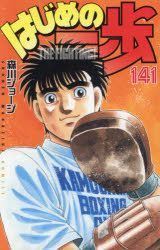
Hajime no Ippo
- Genre: action comedy drama martial arts shounen slice of life sports
- Author: morikawa jyoji
- Artist(s): morikawa jyoji
- Year: 1989
- Original Publisher: kodansha
- Status: Ongoing
...
Show More
20th century 21st century adapted to anime adapted to game adapted to movie adapted to ova / oav adapted to stage play americans travel to japan award-winning work black characters boxing character growth classic manga comedic facial expressions coming of age dead parents determined protagonist dogs extended flashbacks facial expressions fisherman friendly male lead friendship hard-working protagonist high school huge cast of characters injury/ies japan long-running story love polygon multiple couples muscular male lead nurses old man partial nudity perverts polite male lead professional sports rivals rivalry romantic subplot sexual innuendo slow romance strong characters strong male lead strong to stronger symbolism tournaments trainer-trainee relationship training unarmed combat unrealistic fighting violence weak to strong young male lead
Rating(4 / 5.0, 93 votes)
5 stars
33(35%)
4 stars
27(29%)
3 stars
33(35%)
2 stars
0(0%)
1 stars
0(0%)
Popular Reviews
Hajime No Ippo, despite having some weak points, is still a great manga nonetheless.
Story: 9
The story started out simple with Ippo wanting to know what it means to be strong. While this is a straightforward goal, later on, Ippo delves into a deeper meaning. The "strength" he sought wasn't physical strength but something much more profound.
Art: 9
In the early chapters of Hajime, the art isn't bad but not particularly impressive either. However, its progression becomes apparent. Morikawa-san has one of the best art progressions I've seen in a manga. During the climax of each fight, Morikawa builds up anticipation and then delivers an impactful final shot. He puts so much detail into one big hit, and the illustration truly captures the impact and destruction of the punch. Additionally, the art conveys so much emotion through every punch.
Characters: 10
I like to think of Hajime No Ippo's characters as the One Piece of sports manga. There is a large cast with very strong motivations and dynamics, often getting arcs dedicated to them. Not one character is there just to box; they all have personal reasons for engaging in the sport. In many cases, you might find yourself rooting against the main character himself.
Enjoyment: 10
This manga can teach you so much about boxing. Morikawa even takes the time to show you the basics and then walks you through more advanced techniques. Often, he teaches you about real-life boxers, mainly from their style to their careers. I enjoyed this manga so much that I became a fan of boxing.
Overall:
While this isn't the perfect manga out there, it has very few flaws. Honestly, it's one of the greatest sports manga I've had the pleasure of reading. The length may be a huge turn-off for some, and I understand that. So, if you want to cut down on the number of chapters, I advise you to watch the anime (it covers 558 chapters). Either way, you're going to witness some powerful and impactful moments.
PS: My Favorite Quote
Coach Kamogawa
"Constant effort is life's greatest shortcut."
Thank You for Reading :)
Hajime no Ippo was great until the series decided to repeat everything, with no changes and barely any plot, becoming worse over time.
Story: 6/10
The story is fine, typical of a shonen manga with the protagonist striving to be "the strongest."
Plot: 3/10
While this series is supposed to be a sports manga, it desperately needs some changes. Almost nothing that happens seems to matter.
The typical formula in the manga goes like this: Ippo trains, we get introduced to the new opponent, Ippo nearly loses but wins at the last second, the cast does some "side quests," and then it repeats.
This pattern continued for the first 40 volumes and worked well for a 40-volume manga, but not for a series that has been running for over 30 years.
Characters: 10/10
Possibly the best part of the manga, the dynamics between characters are great. I don't really have any negative points here.
Art: 10/10
The art is fantastic—detailed and polished. Again, no negative points here.
Overall: Hajime no Ippo should have ended sooner and ran much longer than it should have. The "story" kept repeating itself and got old too quickly.
The more it progresses, the better it gets; it's incredible. With 1300 chapters, it just keeps getting more appealing. Although the serialized fights may not be as engaging, it can still be thoroughly enjoyed. This is a god-tier manga. The character designs differentiate cultures appropriately, with Nijongos looking quite usual and Americans, Mexicans, and other Asians having distinct traits that set them apart. The quality of the story improves with the twists in Makunouchi's career. Overall, the experience is very good, and the story's expectations are like a dream (lol).
Hajime no Ippo holds a very special place in my heart. Starting this story over a decade ago as a preteen, I've somehow managed to keep up with it all these years. It's a unique tale that, at its best, touches on fundamental themes like family, persistence, determination, the harshness of life, and loss.
However, at its worst, it can feel like a monumental task to get through, especially considering its length (over 1300 chapters at this point). Admittedly, it's not for everyone.
Possible cons:
Possible pros:
This manga starts off absolutely amazing and remains thoroughly incredible for about 900 chapters. However, everything after that is absolute trash—please don't read it. I'm doing you a huge favor by warning you. This manga is as bad, if not worse, than how Fairy Tail ended, and I don't make that statement lightly. What I mean by this is that the entire last arc is the worst thing to ever grace the medium of manga.
Ippo, our main character, goes through a large training montage and a road to redemption, which is all great and dandy. But after that, man... I can't even describe it without getting angry. It's really bad, guys. So bad that I feel like my best friend of 18 years stabbed me in the back and stole my wife from me (if I knew what that felt like, I imagine it would be similar).
Don't read this manga after around chapter 900, or you might end up breaking your laptop out of anger and disappointment, just like so many others have. Specifically, skip chapters 1199-1202 or risk hearing my voice in the back of your head saying, "I told you so." Unfortunately, this is just another manga that went through the classic downfall of going on for too many chapters and eventually losing everything that made it great from the start. After all, 1200+ chapters is quite a lot, and this decline was almost to be expected. The way this manga falls apart is truly heartbreaking.
This is the manga that marked my return to the genre, one that has set a standard so high that no other manga can quite measure up.
Initially, I thought, "1400 chapters? I'll read 200 and see if it's worth continuing." But I ended up devouring all 1400 chapters available at the time—and I still crave more. Almost every chapter was excellent and enjoyable, and even now, with the series still ongoing, I thirst for more of Hajime no Ippo’s unique style.
The standout feature of Hajime no Ippo is its characters. Ippo Makunouchi stumbles into boxing almost by accident, learning from Mamoru Takamura, a towering beast of a man. While Takamura helps him, his real role is to guide Ippo to the Kamogawa Boxing Gym—almost.
Takamura has his own arc, aiming to be the best fighter ever, not just a world champion but a six-title world champion. And he might just achieve it.
Aoki and Kimura, two fighters at the Kamogawa Boxing Gym, could be considered side characters, but they each have long, intricate arcs throughout the series. Each character’s storyline feels interesting, important, and unique. Though every character wants to win fights, they each have their own strategies, fighting styles, and personal stories. Even the coaches get enough development that over 1400 chapters, you grow to care about every single one.
This isn't limited to the gym itself; opponents are wonderfully written, many getting enough development to become side characters in their own right. To say more would be spoilers, but I particularly love one of Ippo’s opponents as my favorite character—not the one everyone else chooses.
There’s no plot armor here; no "hero’s ability" ensures victory. Every fight feels like both fighters could lose. The moment you think you know who will win, the tide changes, and the manga pulls the rug out from under you. The fact that our main character might take a loss makes each bout more engaging than typical manga where we know the hero must win. There are heartbreaking bouts, surprises, and the pure joy when a fighter gets a victory, every single time.
The point is, 1400 chapters flew by. Almost every fight feels amazing, to the point where I might go back and reread only the fights. The character development is usually above average, the storylines are well-developed but don’t linger (though the current arc is dragging on too long, but there’s so much development happening). And the fact is, this series broke me.
But before that, I have to acknowledge that Hajime no Ippo isn’t perfect. Some plot lines feel lost to time, rivalries once hot are now stone cold. Characters once thought to be central have been relegated to the background, and the romance story is slightly drawn out (though many fans overblow this issue). These are minor problems in a series that out of 1400 chapters, probably has over 1350 enjoyable ones.
So how did Ippo break me? Because Hajime no Ippo sets such a high bar that no other series comes close to my expectations. Amazingly consistent characters, great fight scenes that are easy to follow yet flow well, a story that never truly cools off, and a manga with over a thousand chapters that never makes you want to stop reading?
There aren’t many mangas that achieve even one of these points, let alone all of them together. It will be hard to beat, and that’s my standard for manga. Even Berserk, which is an absolute joy to read, falls short in its fight scenes compared to Hajime no Ippo. Hajime no Ippo is truly a monster worthy of its own World Champion belt—and I can’t wait to see what comes next.
Note: I’m unlikely to update this review until possibly the end of this series (likely decades from now). But rest assured, I’ll still be here, loving this series with every new release.
Since the author realized he's going to make this series as long as he lives (or as long as there's interest), it has become formulaic and repetitive. The story essentially follows this pattern:
- Training
- Fights
- End fight filler
- Rinse and repeat... FOREVER!
Of course, there are good fights with the occasional serious Takamura title match. However, there are too many filler fights (like Ippo's title defenses and matches involving Kamogawa gym underlings) to keep things interesting beyond volume 50. With how things are progressing, this manga seems likely to stretch on indefinitely.
Despite this, it remains likable since I have continued reading up to volume 60 and beyond. However, I find myself skimming through the post and pre-fight fillers as well as the filler matches, hoping to get to the more important matches. This sums up the current state of Hajime no Ippo.
Unless the author keeps things interesting, I will simply skim through the repetitive and formulaic discussions and fights, focusing only on the significant matches.
Even though it's often labeled as such, Ashita no Joe isn't the best option for boxing fans, but rather for those who appreciate great storytelling, characters, and drama. If you're looking for the best approach to boxing as a sport, nothing comes close to Hajime no Ippo.
Some people say it gets boring or is too long, but in reality, there isn't a single moment where you feel like you're reading filler chapters. Hajime no Ippo is like following boxing in real life for a decade. New fighters emerge, others decline, and so on. With Hajime no Ippo, even though there is a main character (Ippo), this isn't just his story—it's the story of boxing during the years of his career. There are many weight classes, different boxing styles, and the personal lives of each boxer to explore.
This is why the series is so long (1311 chapters as of this review). Typically, any pro boxer will have around 30 to 60 fights in their career. You can't rush things. This isn't a narrative created by Morikawa; it's a translation of reality into manga. The perfect portrayal of that reality (as luckily happens with Hajime no Ippo) needs to be this long. Each character needs time to evolve, train, change weight classes, and become the best in their country before going for world fights. It's not about repetitive storytelling; it's about how this reality works.
That's why, for me, Hajime no Ippo is probably at its best moment right now. Many characters are approaching or are already in elite fights. If you think it's dragging too much, maybe the issue is that you don't truly appreciate this sport and are looking for just another story where the protagonist gets bullied, wins the Japan belt, and marries the girl he likes.
George Morikawa makes his love for and knowledge of boxing clear. Many fighters and situations come from real life and boxing history. If you share that passion for the sport, Hajime no Ippo is the way to go. If you're looking for a great and moving story, Ashita no Joe might be a better option.
Leave a Review