
...
Show More
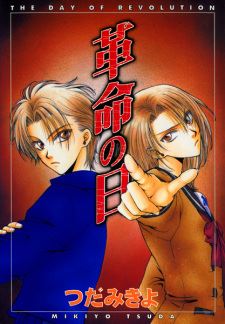
Meet Megumi! She's petite, adorable, and a total eye-catcher. In fact, she reminds almost everyone at school of the very elite (and very missing) boy student Kei Yoshikawa. Whispers and wild rumors begin to run riot from the hallways to the exclusive school rooftop...and the most powerful clique on campus has their sights set on sweet Megumi, too. Can her good friend Makoto shield her from a showdown and help her "skirt" the issue? Are some secrets just too big to keep?
The Day of Revolution was published in English by Digital Manga Publishing from September 20, 2006, to January 9, 2007.
Get ready to meet Megumi, a petite and adorable girl who captures everyone's attention. Her resemblance to the missing elite student, Kei Yoshikawa, sparks rumors and gossip throughout the school, even reaching the exclusive rooftop. The most influential group on campus also sets their eyes on sweet Megumi. Will her friend Makoto be able to protect her from a confrontation and help her avoid the issue? Some secrets may just be too big to hide. The Day of Revolution, originally known as Kakumei no Hi, was released in English by Digital Manga Publishing between September 20, 2006, and January 9, 2007.
I signed up just to rate this manga. It means something happens that makes it difficult to enjoy. Here’s my spoiler-free take first: The problem I have is with the character representation. It's assumed she'll marry a man after the change. While I appreciate the handling of genotype women with phenotype male traits, it trivializes women and their desires. She's ignored when she brings up her concerns repeatedly.
All the guys pressure her, including her new female friend, about conforming to gender roles. Despite being told to be more feminine, she doesn't become so beyond looking visually beautiful. This seems to satisfy everyone because the main reason appears in the ending.
Initially, it seemed like a story about a guy who discovers he's actually a woman and decides to undergo surgery but remains attracted to women.
SPOILER SPOILER SPOILER SPOILER SPOILER SPOILER SPOILER
////She//// becomes//// attracted////to////// guys//and//dates//one//////
For most of the manga, she's attracted to women and her attraction to females is portrayed as trivial. After surgery and still attracted to women, a guy declares she's a woman and should be with him because he's a man. Before this, she was practically dating a girl. Suddenly, once he proclaims this, her heart beats rapidly, and that’s the end of it. Never mind this happened every time she touched her girlfriend. Her hormones were already active before; she fainted because they were increasing, so saying it’s a surge of new hormones is illogical and degrading to women on many levels.
I’d be okay if it wasn’t so against the idea of Yuri. The men make light of her association with women, implying it’s something to cast aside because it won’t last. Her girlfriend, initially an ideal partner, suddenly shows flaws once the guy she’s to date is introduced. Why should someone undergoing this condition have to be attracted to men after surgery, which only changes her outward appearance, and why should her girlfriend suddenly become unappealing? The story falls apart at that moment. Why tackle one issue and not support the other, I don’t know.
END OF SPOILERS
Edit: Aside from this main issue, the story is well done, which only makes the bias worse and more intentional. If the main character hadn't been so firm in her initial belief, I might not have felt this way.
Combining a real-world issue like intersex with a more grounded setting than many similar gender transformation manga makes the standard tropes creepier than usual for the genre, which already has numerous problematic elements.
The protagonist's decision to transition is presented as inevitable, and their initial resistance is dismissed by their parents with flimsy justifications. The reason given for transitioning—that they wouldn't look or fully be a man—is insulting and inadequate.
The sexual harassment by their friends is largely played for laughs, which trivializes serious issues.
Homosexuality is barely addressed; it's simply assumed that the main character will date men and not pursue romantic relationships with women.
The protagonist's desires are frequently ignored by supposedly supportive friends, undermining their agency.
I correctly predicted who the protagonist would end up dating almost immediately after the character was introduced, making the plot predictable.
Only three characters have any significant personality, and I didn't particularly like them. The protagonist is overly passive, rarely making decisions without being coerced by others. The primary female character mainly serves to pressure the protagonist into various actions. Her brother is defined almost entirely by his insecurity about being perceived as less masculine due to his meekness, otherwise lacking depth. The protagonist's former friend group consists of interchangeable characters without meaningful distinctions.
The artwork is adequate but unremarkable.
I wish it lasted longer. I truly enjoyed Megumi as a character. However, I understand that extending the story would mean her old friends constantly pestering her, which initially saddened me since it felt like friends drifting apart due to different interests, and it quickly became annoying. Nonetheless, it reaches a satisfying conclusion. Megumi's situation is intriguing, and I appreciated hearing her thoughts. The comedy was well-done. Mikoto shines both here and in Princess Princess, so I was delighted to see more of him. What I'll miss the most is the artwork featuring Megumi.
I've been attempting to fill the void in my heart, but it has only expanded as I search for similar manga...
This story revolves around a high school boy who discovers one day that he was originally born female, with the diagnosis being hermaphroditism. Rather than continuing to live as 'half a boy,' he chooses to transform into 'a complete woman.' The manga charts his transition into Megumi and how she adjusts to life, including going back to the same high school. There were numerous fascinating elements to this narrative, yet there were several instances where I felt the storyline wasn't fully realizing its potential. Had this been an ongoing series, I might have abandoned it out of frustration. However, since it's complete in just two volumes, it remained engaging enough to finish.
This story revolves around a boy discovering that he is actually a girl. Surprisingly, this kind of situation occurs more frequently in real life than one might imagine. The author even mentions in an extensive note that she received a letter detailing a case eerily similar to the events in her story.
There's a slight disjointedness due to the mangaka initially planning for the story to conclude with Volume 1. However, prompted by numerous letters and particularly encouraged by a fellow mangaka and close friend, the second volume was created. I believe the challenge of selecting a suitable love interest was well addressed in Volume 2. You'll understand what I mean when you read it, but it must have been especially difficult for the mangaka to make this decision. In the end, I think she did a commendable job, which also linked "The Day of Revolution" with "Princess Princess."
Since "The Day of Revolution" was written before "Princess Princess," the artwork isn't as polished, but it remains attractive and fairly well-executed.
The most crucial aspect of this story is character development. We see, in a mostly lighthearted manner, the thoughts that might run through the mind of someone who has had to change their sex, along with the reactions of those around them, and how they react to these responses, and so on. While there is some angst, it isn't overly emphasized, yet some serious reflections are portrayed.
I enjoyed the story, although I would have liked a bit more development of the main romance and a resolution for the other "suitors" as well (poor guys!).
I recommend this story to those who enjoy gender-bender comedies, romances, and anyone who likes "Princess Princess." This work essentially belongs to the shoujo genre.
Although it's true that this manga isn't a perfect representation of intersexuality and its cancellation robbed the story of much potential to mature and improve, I still find it a heartwarming tale despite the classic shoujo clichés and dated jokes. Considering it was published in 1999, it remains an advanced narrative. It's refreshing to see Megumi's intersexuality not causing her family to fall apart but instead bringing them closer together. The loss of her former clique and sudden exposure to experiences typically reserved for women are genuinely overwhelming for her, even if everyone pestering her for dates is played for laughs; her feelings on the matter are undeniably present. This story could have evolved further had it continued longer, but as it stands, it's a light, enjoyable read about an intersex girl finding love and trust.
"What would you think if you were told you were the wrong sex?"
Quite a profound question, isn't it? This is precisely the dilemma faced by the protagonist of this remarkable manga. Yoshikawa Kei collapses on his high school roof one day and discovers at the hospital that he is intersex. The manner in which the mangaka addresses such a sensitive and intricate issue—one experienced by many in our reality—is a significant reason why I adore The Day of Revolution. Another compelling aspect is how the mangaka tackles yet another delicate subject: Kei's decision.
Kei, having been inadequately informed by his doctor, decides to take a leap at 15 years old and embrace the young woman his genetic makeup reveals him to be, changing his name to Megumi. This is undoubtedly a major decision, leading into territory I know well (the other part I mentioned earlier), transsexuality. While as an intersex person, Kei had a choice—something most transgender individuals might argue they didn’t have—Megumi transitions from living as a boy for 15 years to being a girl. Anyway...
Juggling these two issues so beautifully while maintaining entertainment value is no small feat, but Mikiyo Tsuda pulls it off brilliantly. Unfortunately, Megumi encounters her old group of friends on her first day back at school, forcing her to reveal her true identity to them—and others along the way. Her friends, however, remain undeterred by who she used to be; one even proposes marriage on the spot. Naturally, this alarms her, and she declines. The four boys won't be deterred, continually trying to get her to date one of them and sabotaging any attempts by her to form relationships with others.
I believe I've said enough for now. The artwork is splendid, and the character development couldn't help but be outstanding given its intimate connection to the storyline. Everything came together, in my honest opinion, to create a very enjoyable manga. Others may—and almost certainly will—disagree with me and my rating of this work. But my subjective opinion, fueled by my ability to relate to some extent to the challenges Megumi faces, is that this is a truly wonderful piece of work. I sincerely hope you'll consider reading it. You might even learn something about your fellow human beings and their experiences and struggles.