
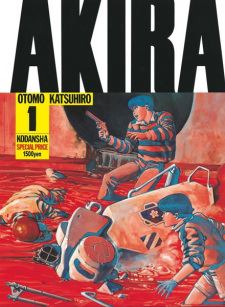
Akira
- Genre: action award winning sci-fi
- Author: otomo katsuhiro
- Artist(s):
- Year: Dec 6, 1982 to Jun 11, 1990
- Original Publisher:
- Status: Finished
...
Show More
Rating(4.1 / 5.0, 35 votes)
5 stars
12(34%)
4 stars
14(40%)
3 stars
9(26%)
2 stars
0(0%)
1 stars
0(0%)
Popular Reviews
You know that feeling when you start something and can't get enough of it? Well, I felt that way while reading Akira. I bought it from a local manga shop without high expectations. As I began reading, I found myself deeply engrossed in the story. At the beginning, the narrative is filled with mysteries, confusing elements, and secrets that you're eager to uncover. With each chapter, you unlock some secrets only for new ones to emerge, compelling you to keep reading until the end.
The artwork isn't groundbreaking, but it's still impressive. There are no "chibi" drawings or scenes, maintaining a serious tone throughout the manga. During casual dialogue or character development moments, the art is quite standard, not overly detailed. However, during intense action sequences like explosions, gunfights, or survival scenes, Katsuhiro Otomo showcases his talent. The illustrations become incredibly vivid, with details that leave you in awe. You might pause your reading just to admire an explosion's magnificence. It feels as if Otomo reserves his best work for these climactic scenes.
The characters are exceptionally crafted. You won't fully understand their allegiances until the very end. This adds a layer of intrigue. For instance, much about Akira remains mysterious even after finishing the manga. When you close the last page, you might search for missing pages because it's hard to believe it's over with so many unanswered questions.
That's the beauty of this manga. While it clarifies most intriguing aspects to satisfy your curiosity, it leaves you wanting more. You'll find yourself pondering the ending, the characters, and the overall story, thinking, "What just happened?"
I thoroughly enjoyed this manga, and it's my favorite (though I haven't read extensively). If you consider yourself a manga enthusiast, this is a must-read. In fact, it's essential for anyone who has ever held a manga. I'm not exaggerating; this is truly special, and I'm confident you'll love it.
Enjoy.
As a title, "Akira" will always evoke the same reaction, recalling the 1988 film. It's inevitable; the feature is one of the most significant works in its medium. Its influence, evident in references or philosophies, what it meant for the coming decade, and its connection to the West, forms an imprint few have achieved. This has also contributed to manga developing its own mysticism.
Beyond accolades, Akira's film occupies an awkward position. Despite its far-reaching influence, it rarely makes it onto most "best picture" lists. The reason lies in one factor: the story is convoluted. Critics point to the script as the culprit for failing to capture the greatness of the manga, the complexity of its dilemmas, or the evolution of characters. Thus, Akira becomes the "great" ignored (a perception widely held by the public but extensively studied among specialists).
What does this have to do with the manga? Clearly, everything. There are clear expectations when reading it, and comparisons with its animated adaptation are inevitable. Of course, this doesn't mean I haven't approached the manga uniquely; only that some appreciations can only be seen through contrast. Clarified, let's delve into key points.
The first is the structure differing from the original material to the adaptation. Originally, there are two parts clearly distinguished by a peak event. In the film, both are intertwined superficially but not fundamentally. Characters, concepts, and situations unique to each part in the manga coincide in mention but not background in the movie. That key event separating sections doesn’t exist in the same timeframe in the comic.
This provides a solid basis to highlight all the film’s shortcomings. Omitting a section signifies suppressing plots, characters, and ideas. Of approximately seven main threads (varying per section and chapter), only two (three if counting mere presentation) are used in the film. Others were reduced to cameo seconds or omitted entirely. Not surprisingly, the manga wasn’t finished during production and release. No matter how long the movie could have been, it’s impossible to cover it in common length.
We start with the inherent question, "How important is what was omitted?" Here lies the irony: the flaw of Akira's manga is its convoluted story. Transition between parts showcases ambition. From four debatable threads in the first half, almost double are present to cover all possible strands of new context, even if several lead nowhere or reinforce themes left lame.
The reason lies in its characters. Among a wide cast, only Kaneda and Akira transcend in readers' consciousness. Kaneda for his impeccable evolution and personification as "the power," Akira for his mysterious character and threatening aura. Others serve merely as vehicles claiming motives but lack depth, existing solely to provoke ongoing events.
Given the narrative’s choral aspect, we won’t focus on structured characters but rather secondary ones. They aren’t boring or purposeless, but their development lacks justification. If needing to cut for a film production, I understand the acting decisions made.
Thematic approaches reflect the softness of characters. Apart from those around power and its human implications, others like duty, destiny, and justice appear conveniently without substance. A more interesting theme involves societal collapse, political fragility, and homeland formation, demonstrated through secondary characters’ actions in the second part, or the price of scientific progress implied throughout and ratified in final chapters.
Of these, only the discourse about power and the cruelty of progress are present in the film. Understandable given their interrelation. Otomo, writer/drawer of the manga and director of the film, transferred crucial elements of protag plots, reaching similar conclusions via different decisive factors.
This implies readers of the manga won’t find more explanations or reflections on the main plot. Both film and original arrive at the same through shared narrative points expressed via intrinsic tools of their mediums. You’ll find a whole world, characters, and untold plots, though they don’t significantly add perspective to the main plot. Individual stories about the world and governance may interest some.
Both are absolutely impeccable visually. Regarding the manga, I’ve read the colored version, my favorite to date. A color palette converting powerful strokes into fragments. Facial expressions, frame composition, sense of rhythm for character movement and storytelling, detailed backgrounds marked by sections, lighting capable of generating selected palettes, symbolic meaning—all robust quality intertwined where criticism is nonexistent.
Akira's ambition is notable whether film or manga. Both aimed high, falling short due to aspirations. However, I appreciate the '88 classic more, accepting it as one of history’s best films. The manga isn’t considerably lesser; it offers unique observations/conclusions. But for greatness, conciseness is evaluated, not attempts.
Akira is undoubtedly a classic. I can only imagine how groundbreaking it was during its time. My main criticisms of the manga are that, while its storytelling and characters were breathtaking in the 80s and 90s, they don't feel as remarkable today. The themes explored in Akira were well-developed; the sci-fi elements surrounding life and death were awesome. However, if I had to pinpoint Akira's primary weakness, it would be the characters.
Over time, I came to appreciate Kaneda, the others, and even Tetsuo more, but overall, they weren’t that appealing. The story had some intriguing plot twists and events, but there were also some less exciting arcs. Expect those, but know that the story remains interesting, especially when it goes over the top—it truly blows everything sky high!
The best thing about Akira is undoubtedly the art! For its time, it is outstanding—detailed, massive, clean, sharp—and the action scenes are excellent. I cannot praise the manga enough in this category; it is artistically that good. From the gore, the intricately detailed action scenes (some epic in scale), to the beautiful landscapes and decaying city filled with dirt, rubble, and dust, Otomo Katsuhiro’s skill with a pencil is godlike. Even today, the art is stunningly beautiful, retaining a classic charm with incredible detail.
I recommend reading the Epic version, which comes in full color, spans 37 chapters, each around 70 pages long. It’s of high quality. Some might prefer the classic black-and-white version, and I understand that, but consider the colors as an amazing extra to enjoy after experiencing the original. Seeing it rendered with the rich palette used in the Epic version feels like viewing an artbook.
The manga itself, whether colored or not, is essentially a giant artbook! Add to that a solid and mature plot, interesting character development, amazing action scenes, and a great setting. The sci-fi aspect is fantastic, and I was pleasantly surprised by all the philosophy and other themes the mangaka boldly kept exploring, keeping it real and engaging.
When people talk about the classic manga Akira and all the praise it receives, rest assured, it truly is a masterpiece that has aged exceptionally well with time.
Akira undoubtedly stands as a classic, deserving of the accolades and comparisons it receives whenever modern manga is released. Many panels are true works of art, complemented by an engaging story that accompanies the visually stunning presentation. The narrative primarily revolves around the relationship between the brash, flawed yet likable Shoutarou Kaneda and his best friend, initially timid and lonely Tetsuo Shima.
The highlight of the story lies in their shared journey through the heart of Neo-Tokyo, a futuristic city teeming with more than just dangerous biker gangs and drug-addled psychopaths. The plot swiftly evolves into something much deeper, involving government corruption, clashing ideologies, gifted children, and total anarchy centered around the enigmatic Akira.
However, there are moments when the manga drags, particularly when the focus shifts away from Kaneda or Tetsuo for too long, becoming overly convoluted for my liking. Supporting characters remain strong pillars in the story, but their extended focus sometimes causes the narrative to feel slightly lost. Fortunately, the story does regain its momentum.
The ending feels somewhat incomplete—not entirely definitive but also too open-ended. It leaves you wishing for at least a short sequel, though we live in a world where that's not possible.
Despite these minor shortcomings, the story remains thoroughly enjoyable. I highly recommend anyone who appreciates a fantastic sci-fi tale to read it.
I entered this manga without any prior knowledge of the anime or its storyline, so initially, I thought the entire book would revolve around Kaneda and his gang's delinquent activities. The story that unfolded was much grander, involving psychic children, the city's destruction (twice), military intervention, and a war between two surviving cults in a post-apocalyptic setting.
The characters are somewhat difficult to like at the beginning of the story. Kaneda is an orphan and the leader of a Bōsōzoku gang frequently engaging in fights with rival gangs, especially the clowns. As the leader, Kaneda gets the most badass and technologically advanced bike—an electronic racer he stole from a sponsored rider. At 15, with no parents and living in a cyberpunk dystopia, his morals are questionable. For instance, he impregnates the school nurse but couldn't care less, using her only to get free drugs for his gang. Despite his questionable morals, I'll admit he is pretty badass.
Tetsuo, also an orphan like Kaneda, lacks confidence and has an inferiority complex, possibly due to his terrible hairline. He wants to prove himself and be as badass as Kaneda, so during a motorcycle race, he decides to take the lead but crashes into one of the psychic children. The army retrieves their esper along with Tetsuo, who is injured but miraculously alive. They conclude that if Tetsuo survived the explosive crash, he must be a psychic too. Realizing his powers, Tetsuo struggles with how to act. All his life, he's been a beta, and now he has godlike powers. This drives him mad; he kills his friend, takes control of the clown gang, and uses them to get drugs.
Some truly messed-up events occur in the latter chapters. Tetsuo starts a cult centered around Akira (the child who destroyed the city multiple times) and builds an army to fight Lady Miyako, another cult leader. Tetsuo drugs and rapes three girls simultaneously, and two of them die. The lone survivor, Kaori, becomes his loyal slave.
The artwork in this book is absolutely phenomenal. I love it immensely. The cityscapes, in particular, are beautifully drawn. The city itself almost becomes its own character, making the impact of its destruction even more significant. Otomo dedicated considerable time and detail to crafting Neo-Tokyo, only to destroy it and introduce us to Neo-Neo-Tokyo.
I absolutely adore the artwork, but the rest of the manga has some flaws. The dialogue can be poor at times, the characters can be flat, and some parts of the story are overly drawn out. However, overall, I very much enjoyed the 2000+ pages of this manga and plan to read it again.
Pros:
The art is decent.
The fast pace is enjoyable.
Volume 2 stands out as particularly good.
The villain is both enjoyable and menacing.
Characters are fun.
Some genuinely impressive body horror scenes.
Strong female characters.
Exceptionally well-executed fight scenes.
Cons:
The handling of rape is poor (characters end up dating their rapist or attempted rapist).
Volume 3 features a weak villain.
Character motivations often remain unclear.
Characters lack depth.
Despite being fun, the characters aren't very likable. Many times, I found myself rooting for the protagonist to be defeated.
Several confusing moments that aren’t explained, like the end of volume 4.
Trigger/Content Warnings:
Sexual assault (occurs once in volume 1 and frequently in volume 4. These scenes don’t contribute to the plot and can be skipped without losing the storyline).
Drug addiction and dependency (mainly present in volumes 1 and 4. Skipping these scenes would affect understanding of the plot).
Graphic violence (present in practically every volume. Too pervasive to avoid).
I would honestly give this a lower rating if I had only read the standard black and white volumes currently in print. Luckily for me, I stumbled upon the full-color version spanning around 38 volumes of this manga.
The art style, rendered in full detail and color, undoubtedly elevates the story to an entirely new level. It makes everything just 'pop'.
If you have the chance to access these original color manga versions, please read them, buy them, or even go to great lengths to obtain them. They truly transform this manga into a genuine work of art.
Overall, it was a very enjoyable read. The story doesn't adhere to typical manga tropes such as escalating power levels or significant character development. Instead, we delve deeper into the existing personalities of the characters rather than witnessing dramatic transformations.
The artwork is exceptional. My only visual gripe is that sometimes the speech bubbles can be ambiguous, making it hard to determine who is speaking. In scenes with multiple characters and vague lines, this can be quite challenging.
I would have appreciated more explanation about Kei towards the conclusion. Without giving anything away, there's an escalation of events surrounding her that I felt wasn't well elucidated. Similarly, Miyoko's intentions remain somewhat unclear throughout the narrative, shifting in ways that might confuse readers. However, this aspect adds a layer of mystery that enhances the story more than detracts from it.
The climactic finale was fantastic. The post-climax wrap-up was merely "okay"; I didn't particularly love it and found some elements inconsistent with the characters' previous experiences and feelings towards the "Greater Tokyo Empire." Still, it wasn't a terrible ending either.
It's definitely worth reading, though I think it's slightly overhyped. If I could, I'd give it an 8.5 rating.
Teenagers revolted by the system, showing no respect for teachers and authorities, addicted to drugs, who instead of complaining on Twitter, ride futuristic motorcycles and get into big trouble with the government. These are Katsuhiro Otomo's tools to express his criticisms against Japan and the post-nuclear world in AKIRA. It’s amusing how marginalized and abandoned adolescents by society become the main triumph of the plot, mocking the government's oppressions.
Tetsuo—a teenager with the personality of a school terrorist—awakens paranormal powers after running over an elderly child who has escaped confidential Japanese government experiments. Kaneda—leader of the teen biker group, whose Tetsuo was a member—needs to prevent Tetsuo's psychotic breakdown, armed with unbridled paranormal powers, from destroying any sign of life that comes his way and even worse, reactivating the sleeping AKIRA—an entity with powers even more immeasurable than those of Tetsuo.
We read the clash between Tetsuo and Kaneda, set in a post-World War III NeoTokyo, guided by a political and revolutionary narrative. While Tetsuo becomes more violent, powerful, and unsociable—with the blind support of the army colonel and his team of scientists—Kaneda is allied with Kei and Ryu, members of the Nezu political party opposing the military.
In 112 chapters and 6 volumes, the plot can be divided into two parts. The first half sets up the mysteries and establishes its cyberpunk universe with motorcycle racing, chases through the sewers, escapes from prisons, enemies being hurled into the air with telepathic powers, walls and rocks exploding with paranormal waves, and Tetsuo pissed off at everything, while the reader screams inside: "WHAT IS AKIRA?"
In the second part, it clarifies its mysteries in an absurd and surreal way, heading the narrative to unexpected places, with catastrophes at all times. Instead of people being thrown around by the power of the mind, now it's buildings falling down and ships exploding. Motorcycle racing has become motorcycle racing... with missiles. Everything from the first part is boosted by 1000x, and Tetsuo is even more pissed off. "THIS TIME TETSUO WENT TOO FAR!" says Kaneda.
The characters are similar, to the point of looking like generic versions of Kaneda and Tetsuo. Kei looks like the female Kaneda. Her brother, Ryu, looks like Tetsuo with a mustache. Every soldier, monk, bandit is like the other. It is normal to ask yourself "Who is who?", especially in the busiest parts. Despite improving in the second half, with features gaining more details like scars, wrinkles, bulging eyes, etc., and hair being "combed" in a more stylized way. In addition, new ethnicities and different types of fat, muscular, skinny people gain space.
Akira's macro point is the urgency of the plot in which heroes need to stop Tetsuo, and the way things change from Eleven from Stranger Things to Vegeta from DBZ as credibly and interestingly as possible.
"KANEDAAAAAAAAAAAAAA!!!" By Shima Tetsuo.
"TETSUOOOOOOOOOOO!" By Shotaro Kaneda.
The manga highlights the anime that popularized it and any other generic version of its work (cough... Stranger... Things... cough).
GOOD FOR HEALTH BAD FOR EDUCATION
Finishing Akira left me heaving a massive sigh of relief, not one of contentment. There's no denying it; the manga is astonishingly poor considering its fame. Reading Akira felt like enduring an endless action sequence without any respite. It brought to mind the Æon Flux short "War," but stretched out into an unbearable 120 chapters. Keeping track of the panels was a strenuous task, and the relentless action became tedious quickly. The characters were either forgettable or erratic, and the lore of Akira’s world barely existed beyond a superficial synopsis. Don’t anticipate anything more than intricately detailed backgrounds of devastation and debris here.
Akira is one of those colossal works that everyone should read and see. Given that the saga, somewhat chaotic, has branched out through Otomo's dual roles as both a demigod mangaka and a pressured director, multiplying its possibilities. Akira is a comprehensive work, published over several years and condensed into six hefty volumes. Admittedly, this rather titanic piece, for this type of narrative, can be daunting—and it did act like a shockwave in the West—but upon rereading, sometimes tedious, it doesn't quite live up to its legendary status.
To blame? A story that excessively multiplies action sequences, quickly becoming wearisome. It's as if, at the very least, 80% of the panels are dedicated to chase scenes, escapades, shootouts, or explosive psychic brawls (not to mention the catastrophic big bangs). Of course, these sequences are masterfully drawn and staged. Nevertheless, fatigue sets in rapidly... Which is even more disappointing since the established universe holds great promise, albeit not always fully realized.
For the time of its initial publication in 1984, Otomo attempted an anticipation that was ultimately completely off-topic, with issues tied to the Cold War nearing its conclusion. Thus, military experiments on children allude to nuclear danger. And the geopolitical stakes (USSR vs US) would soon become obsolete in real life. Still, even though Otomo is focused on his frenzied chase, he touches upon the zeitgeist of his era: rebellious Japanese youth wanting to break free from paternalistic attitudes.
The characters' psychology, not deeply explored (a fratricidal struggle between two ex-best friends, a love story that repels then attracts... We've seen more original), still offers some pleasant surprises. For instance, the obvious villain character, The Colonel, turns out to be much more complex, driven from the start by a Hume-like dilemma (sacrificing a few to prevent a major catastrophe). Conversely, there’s no clear-cut Manichaeism, despite some somewhat functional secondary roles (the rat politician, the schemer using Tetsuo/Akira for personal power). And a plot that manages, with the mid-story rupture (apocalypse as you’ve never seen it) and thanks to an ellipsis, to create a broad, romantic gesture.
In the end, it's an imposing demonstration of strength, a bit heavy and repetitive, but with undeniable majesty.
Leave a Review