
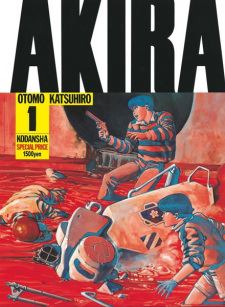
Akira
- Genre: action award winning sci-fi
- Author: otomo katsuhiro
- Artist(s):
- Year: Dec 6, 1982 to Jun 11, 1990
- Original Publisher:
- Status: Finished
...
Show More
Rating(4.1 / 5.0, 35 votes)
5 stars
12(34%)
4 stars
14(40%)
3 stars
9(26%)
2 stars
0(0%)
1 stars
0(0%)
Popular Reviews
Some productions from past times have become milestones that have marked history and have become classics of their time and segment. Some of them, many even, have an intrinsic technical and artistic quality, which leaves no doubt about their importance. It takes very little to understand why it has reached the status of a “historic landmark”. Others, on the other hand, end up being more mixed, with qualities and defects – sometimes even more defects – but which managed to establish their own unique aesthetic, represent the spirit of an era or simply be in the right place at the right time. Akira, an almost mythical name amidst comics, is representative not only of a segment but also of an idea. It has its many positive points, but, as a whole, it fits more into the second group.
With over thirty years since its release, Katsuhiro Otomo's Akira has a lot of history. Launched in 1982, during the heyday of punk culture and even before seminal works such as the novel Neuromancer or Blade Runner, the manga appeared during a period of renewed Cold War tensions and intense anti-establishment sentiment. This context becomes integral to the core of the manga, introducing a post-nuclear destruction Neo-Tokyo infested with misguided youth who make rebellion their greatest weapon against the government and military. Not only does it represent the spirit of an era that saw punk culture slowly enter pop culture, but the work also ended up representing the cultural production of Japanese comics.
Akira was brought to the West in 1988 by Marvel Comics. Otomo's work was one of the first manga to be translated into English and established much of what is thought of as Japanese comic book aesthetics, influencing the Cyberpunk genre. Along with Blade Runner, the manga established a significant part of the aesthetic used in dystopian futures with pessimistic conspiracies, making possible works like Ghost in the Shell, another great exponent of the genre, and marking tropes and clichés still used today. In 1992, the anime would also emerge in the West, and despite having a very summarized story compared to the original work, it instantly achieved cult status, marking the imagination of a whole generation of western pioneers when it comes to Japanese works. Despite gradually losing some of its fame, Akira was once—and in some ways still is—a synonym for manga: a legendary work, memorable and full of icons (such as Kaneda's mythical motorcycle).
Even so, despite the legend, the fame, and the affection of fans, the complete work is far from perfect. Katsuhiro Otomo's care in his work is undeniable. Although Akira is entertainment-oriented, it is by no means frivolous and manages to approach timeless themes in its construction. Though never directly exposing the thought, the first edition brings a clear anti-war and anti-militarist sentiment, presenting the social consequences of a third world war and creating an image of a conspiratorial and controlling army willing to experiment on civilians just because they were in the wrong place at the wrong time. Civil obedience is praised, while rebels receive positive exposure, though the delinquent biker gang are the big heroes, despising both the army and society, yet not succumbing to the military’s fascist methods.
However, despite making good introductions to these elements within fiction, the author does not elaborate much on any of these particularities. The group of rebels, of which character Kei, the only girl in the plot, is part, barely has history, method, or motives in this volume, existing almost as something that should naturally be there. The delinquents of Kaneda's gang, in turn, despite being well-grounded within their own culture, end up not receiving a more refined approach. From an almost childish point of view, they use drugs and skip school, engaging in fights and violence because it's all "cool," but this routine is never treated maturely. They seem like rebels without a real cause, destined to be heroes of the story.
Still, the author manages to paint an interesting picture of Kaneda and the gang, taking the time to present their school situation, how they interact with each other, and some of their other hobbies beyond motorcycle racing. Kaneda's relationship with others isn't deeply explored, but it is introduced enough that the group’s bonds of friendship and loyalty are perceived. However, none of these characters can be described as complex or multifaceted. All are almost perfect examples within their environment, showing no negative traits within their logic, only some characterizing traits. Not only apart and rebellious in relation to society, but they are almost above humanity itself, reminiscent of the hedonistic and rowdy vampires from the movie Lost Boys, released in 1987.
If Kaneda himself and his sidekicks don’t have too many problems with the presentation of their life in the gang, the story’s initial antagonist, Tetsuo, ends up being unforgivably harmed. The manga opens with a sequence of nightly motorcycle races by the gang, and soon the event triggering Akira’s main plot occurs, causing Tetsuo to be taken to an unknown place and set on the path to antagonism. However, this context loses strength because the story never effectively shows his relationship with the rest of the gang – and especially with Kaneda – when everyone was friends and everything was fine and normal. Later, the manga shows scenes of friendly interactions between Kaneda and Tetsuo, but friction between the two already exists, and the effect of bonding with Tetsuo’s past is not achieved. A very significant – and even amateurish – flaw in the manga’s script.
However, these are not the major flaws of the work. The biggest problem with Akira is that Katsuhiro Otomo isn't very good with pacing, and his frame transitions are, to say the least, clumsy. The story of the first volume is good—though not excellent outside of its own context—and the aesthetics raised and fostered by the work are phenomenal, yet everything seems to happen in a very artificial rhythm without delineating time well, making several segments tricky to follow. An imperfect technique, no doubt, but one that somehow collaborates with the anarcho-punk poetics circulating Akira. A trace of humanity and rebellion that—accidentally or not—fits very well into the composition of the whole, echoing interestingly with the poor, dirty, and disorganized panoramas of Neo-Tokyo.
No, Akira is not a perfect work; in this first volume, the author oscillates between the very good and the almost amateur. However, the manga is 100% authentic, having an identity responsible for helping to establish some segments of pop culture. It is a legendary work deserving to be read, and the treatment given by Kodansha does justice to its importance in the artistic field of comics. Still, it is possible that some younger or less experienced readers will find it difficult to enjoy the material. In that regard, little locusts, be patient. Take a deep breath, try to understand the proposal, the time, and the formulation of aesthetics, and try to enter the world and context of Akira. For those who have already seen the movie, don’t worry—in this single volume alone, there’s enough worth reading. And anyway, a work as relevant to comics as Katsuhiro Otomo’s magnum opus is not merely about reading a story but having a true aesthetic experience.
To me, AKIRA is only good if you don’t read current works of science fiction or if you’re stuck in the 80s and 90s at the time of that subculture. The story is worth your time but always with many pre-requirements. The version of the work I read was the Portuguese version, edited by Meribérica/Lider (the rarest version in the world?) in the 90s and completed in 19 volumes. It is a colored version with reversed images, just like the first English version printed in the United States in 1988.
VALUE SECTION: 10/10
Analysis: Historical Value 3/3, Rereadability 3/3, Memorability 4/4
Akira stands out as one of the most iconic manga titles ever. Its status as a pinnacle of dystopian and apocalyptic storytelling is cemented not only by its intricate artwork but also by its profound themes, deeply troubled characters, and grotesquely vivid action scenes.
ART SECTION: 8/10
Analysis: General Artwork 2/2, Character Figures 1/2, Backgrounds 2/2, Readability 2/2, Visual Effects 1/2
The artwork in Akira is nothing short of spectacular. The level of detail and dynamism elevates it beyond a mere comic book to something akin to a graphic novel. The world depicted is starkly industrial, with buildings and machinery rendered in meticulous detail. Various perspectives enhance the action sequences, which are often brutal and nightmarish. While some may find the character designs somewhat generic or androgynous, this does not detract from the excitement of the numerous thrilling action scenes. Even though the visual effects might appear crude due to technological limitations or artistic choices, the impact of each explosion and death remains profoundly shocking.
CHARACTER SECTION: 9/10
Analysis: Presence 2/2, Personality 1/2, Backdrop 2/2, Development 2/2, Catharsis 2/2
Tetsuo and Kaneda, two orphans growing up in a chaotic world, form the core of the narrative. Kaneda comes across as a typical edgy teenage delinquent, a natural leader who commands respect and deals harshly with those who challenge him. Tetsuo, on the other hand, transforms from a seemingly weak presence into an insane megalomaniac bent on vengeance against a world that has wronged him. His confusion about whom to blame—his researchers, his best friend, or himself—results in extensive damage. Deep down, he’s just a kid craving affection, now making everyone pay for his insecurity. He’s a cult figure for good reason. I prefer such complex characters over today's clichéd heavyweights. Recent stories featuring teenagers with issues rarely go beyond portraying silent types whose loved ones were kidnapped or villages destroyed, leading them to become ultra-powerful and fight evil. Yawn! While Tetsuo and Kaneda are central, over 60 secondary characters significantly influence the plot. These include a rigid military man protecting the status quo, a curious scientist exploring unknown powers, rebel zealots, scheming politicians, and psychic children. Each criticizes modern civilization in their unique way. The story's duration allows these characters to evolve smoothly, making them relatable and likable by the end. Though their personalities can seem simplistic and two-dimensional, their development throughout the story remains engaging.
STORY SECTION: 9/10
Analysis: General Scenario 2/2, Pacing 2/2, Side Stories/Extra Spices 2/2, Plausibility 2/2, Conclusion 1/2
The story revolves around a decaying society and the psychological harm it inflicts on its youth, driving them to rebellion and societal collapse—a theme common nowadays. Amoral scientists experiment on children to harness psychic powers. When Akira, a child subject, goes berserk and destroys Tokyo, causing global chaos, politicians cover up the mistake. Years later, they repeat the experiment on Tetsuo, with predictably disastrous results. Despite its straightforward premise, the story is enriched by numerous side plots involving the diverse cast. The pacing is well-balanced, allowing the narrative to unfold naturally. The conclusion, while somewhat cliché, is satisfying and solid. Ultimately, Akira is more about the psyche of teenagers than cool graphics or an in-depth scenario.
ENJOYMENT SECTION: 9/10
Highly entertaining despite its basic premise by today’s standards. The slow pacing never feels wasted, with characters evolving alongside intense action and mayhem beautifully depicted for their time.
VERDICT: 9/10
It didn’t take much deliberation. The accused is found … NOT GUILTY! All charges were baseless slander and are hereby dismissed. We hope for more works like this to emerge.
Akira. Whether you're a fan of manga, anime, comics, film, science fiction, or any kind of art form, most likely you have heard of the name "Akira". Along with Akira Kurosawa, it must be one of the most popular Akiro names out there. Whether it deserves the title of classic is up to those who have given it a chance; however, if you are considering watching the movie, it's best to read the manga first.
Being called "classic" has many justifications. Classics are usually good but in no way perfect. I wish I could give this a 7.50 rating, for 7 feels too low and 8 seems too high. We'll see why it got a 7 in the following review.
Story: Akira's plot is quite unique in its own right but not so unique as a whole. I'll spare the detailed description and get straight to the point. Spanning six volumes, each nearly 400 pages long, this is an extensive story. The problem is that the first three volumes don't have much happening other than explosions, wild goose chases, and people screaming each other's names in anger. In most cases, there is a certain build-up before things go awry, but in Akira, chaos erupts within the first few pages and continues until the end when it becomes overwhelming.
We are introduced to a wide range of characters, mostly by name, and watch them run for three volumes until a huge explosion occurs. Then, in volume four, a coherent story emerges. This isn't necessarily bad, as the constant movement in the first three volumes leads to an important incident without which we would have no story. The action is enjoyable and well-paced, definitely a page-turner. However, we don't know what exactly is going on, nor do we understand the characters well. Imagine going through half a series without really knowing whom you're following.
In other words, the idea is good, but the execution needs some refinement.
Characters: And this is the main reason it gets a 7.
With such a lengthy story and so much happening, you need to feel connected to the characters.
Let's start with Kaneda. He's a fifteen-year-old punk with a snotty attitude who takes drugs for fun and loves bikes. That's it. Nothing more is revealed about him. What about his parents? Are they dead? Does he hate or love them? He likes bikes... okay. But who is he anyway, and why should we care about what happens to him?
Kei is part of a group of terrorists. She can kick serious ass. Fine. Why is she with these people? What is their goal? Why them and not someone else? At some point, she speaks of goals and values, but how can anyone understand what she's talking about when nothing is revealed?
The same goes for most characters; the problem is they are shallow. You only know certain aspects about them, like Kei being tough, but you don't truly know them. Hence, you don't care. Saying that Kaneda is cool is not enough for me to care if he randomly disappears or gets a deadly disease.
The only character worth mentioning is Tetsuo. He is basically the only one with a personality, someone you can care about. From the moment he appears on the panel, you can pretty much figure out his role. He isn't valued much, and when he gains power, he gives the finger to all who wronged him and goes berserk. His character constantly changes throughout; he becomes angry, greedy, arrogant, but then humble, sad, and vulnerable. One moment he's a ruthless bloodthirsty monster, the next only a boy that needs to be loved. But even his personality takes an awful long time to emerge. Personally, I was rooting for him till the very end, heck, I ended up reading this whole thing just to see what will happen to him.
Maybe the writer intended it to be this way, maybe he simply didn't want us to care for the others, but then again, Kei and Kaneda get a lot of screen time, so I should be on their side, not his. Also, the so-called "love" between the two felt forced and completely unnatural. It was just annoying, honestly. I mean, wtf, they didn't even know each other and suddenly wanted to have kids? Come on, that is laughable.
Art: The art isn't anything spectacular, but it's nice. The direction of the series, however, is very good, something Otomo has been praised for. Some scenes were utterly beautiful (one with Tetsuo and the ocean waves comes to mind). The city of Neo Tokyo is as futuristic and mad as it should be. The bikes were cool to look at, the styles of hair and clothes are a bit dated, the faces are distinguishable, and they were definitely paid attention to with detail—except maybe Kaneda and Kei's (really, these two have so many problems). The action scenes are clear; there wasn't a moment I didn't understand what was going on, and that, my friends, is a hard task considering most manga.
Enjoyment: This is a good story, putting aside the various character problems. If the characters were better, I think it would be excellent. It is enjoyable, and you can easily get caught up in the drama—it's indeed a page-turner. It never bores (well, maybe volume three, the worst one out of them all). The use of supernatural powers was done well, the whole plot was well crafted, politics, terrorism, human stupidity—it's all there. This is worth a read for the single reason of seeing all the similarities it has to later works. Akira definitely launched a bunch of stories with a similar feel and plot.
If Akira were released today, I highly doubt it would receive even a fraction of the acclaim it currently enjoys, even if it were updated to reflect contemporary times. The manga's strengths have been thoroughly discussed, so let’s focus on its weaknesses.
Kaneda, one of the central characters, is an ordinary human being who somehow manages to wrestle with Superman, outwit Batman, and defy fate and death itself. Additionally, he rides the most luxurious motorcycles (and is, unsurprisingly, the best rider) and gets the girl (another cliché for all good heroes). By the way, Kaneda is a teenager, much like many of the readers this manga was aimed at. Coincidence?
There is supposed to be a relationship between two characters similar to what you might find in Berserk or other manga. However, here the relationship is poorly developed—okay, maybe I'm being too lenient. The relationship is barely developed (a couple of drawings to tell a story that didn’t need more because it was cliché even back then).
Curious about the origins of some characters' powers? Well, don't be. It’s just military experimentation and such. You don't need to know more, and you wouldn't understand it anyway. Think of it as a world with magic but no rules, allowing the author to do whatever they want whenever they need to.
Characters can read minds, fly, survive in space, and cause explosions more destructive than the Hiroshima and Nagasaki bombs. Yet, an average person can still beat them up.
There is no consistency regarding which skills are considered "powers" mastered by a character. In Akira, we find a character who can simply jump very high, another who can move objects with their mind, and yet another who can seemingly see everything happening around the world and direct that vision precisely to what interests them—instantly.
Etc., etc.
If issues like those mentioned above don’t bother you, then Akira is a fantastic read. Otherwise, don't waste your time.
I enjoyed the movie, and I heard the manga was better.
It's not. I couldn't even finish it.
The characters are even flatter than in the movie, and that's saying a lot. The character relationships are just as artificial and forced as the plot progression. A lot of time is wasted on useless stuff that neither furthers the plot nor aids in world-building.
On a more positive note, I kind of enjoyed the art. And, from what I've heard, the later chapters feature some top-notch quality artwork.
The series has aged horribly, and the slow pace makes the character and plot issues even more aggravating.
I've heard the last volume is where the real action starts, but I can't be bothered to read all the way to it.
Akira – Spoiler Free – Recommended
TLDR
Story – 6/10 – 6 x 0.275 = 1.65
Art – 8/10 – 8 x 0.2 = 1.6
Characters – 4/10 – 4 x 0.225 = 0.9
Enjoyment – 7/10 – 7 x 0.3 = 2.1
Total: 6.25 -> 6
Story - 6/10
Akira is perhaps one of the most challenging manga for me to write about personally. I genuinely apologize for what I'm about to say, and I wish it were different: Akira has a superb story with brilliant ideas but also numerous mistakes and leaps of faith, leading to a lack of plausibility. I'll reiterate: Akira had everything necessary to be a 9/10 or even a 10/10, but its lack of coherence and believability are too apparent. There's no denying the number of epic moments in the manga, and if you're willing to overlook some flaws, it will undoubtedly be an excellent read.
Another aspect I dislike is plot armor, and it exists here—quite prominently—around the main characters.
The ending feels clumsy, leaving an unpleasant aftertaste.
Art - 8/10
Akira's artwork is outstanding, featuring some of the most detailed scenery I've seen in manga, allowing readers to get lost just admiring the panels. The art excellently captures what a cyberpunk/post-apocalyptic setting should look like (it's worth noting that Akira was a pioneer in the cyberpunk genre). However, character design isn't the best but is functional enough. This is one reason why it doesn't score higher. Combat scenes are very well done, making Akira a pleasure to read.
Characters - 4/10
Akira's characters aren't particularly remarkable, aside from three or so. Most are more like archetypes—the diligent military man, the corrupt politician/bureaucrat, the wise old woman, ambition incarnate, etc.
Enjoyment - 7/10
Reading Akira is a bipolar experience: the first two volumes are exceptional despite a few leaps of faith and verisimilitude issues, making them great reads and a joy to delve into. I finished reading Akira in just two days. The other volumes, except the last one, are somewhat confusing and riddled with believability problems; they mar a manga that could have been immortal. But despite all its problems, Akira has grown on me. Despite its flaws, Akira is too polarizing and striking not to be read. It demands to be read: its genius, albeit poorly executed, is too good to be forgotten. That's why I highly recommend reading it, despite the rating of 6, which might initially suggest mixed feelings. Akira is a classic, both for what it did well and for what it could have done differently.
If you've seen the Anime adaptation, it won't spoil much for the manga. I'm incredibly pleased that this was my first manga experience. Here are the reasons why I recommend it:
- The artwork is extraordinary. It's not only stunningly beautiful but also deeply meaningful. There are sequences spanning several pages dedicated solely to illustrations of landscapes and significant events. Each one could stand alone as a masterpiece while simultaneously setting the tone and atmosphere for different parts of the story.
- The characters are well-crafted. Despite the large cast, each character plays a meaningful and crucial role. When a character reappears after being absent for some time, their reintroduction feels natural and never forced.
- The ending is fantastic. I won't give anything away, but many stories with grand narratives often build up to a climax only to fall flat afterward. This story’s conclusion doesn’t suffer from that issue.
Overall, I give it a 10/10.