
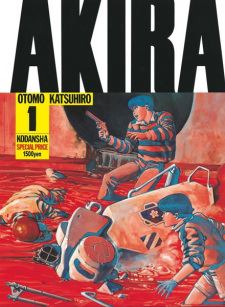
Akira
- Genre: action award winning sci-fi
- Author: otomo katsuhiro
- Artist(s):
- Year: Dec 6, 1982 to Jun 11, 1990
- Original Publisher:
- Status: Finished
...
Show More
Rating(4.1 / 5.0, 35 votes)
5 stars
12(34%)
4 stars
14(40%)
3 stars
9(26%)
2 stars
0(0%)
1 stars
0(0%)
Popular Reviews
Oh boy. Re-reading this was eye-opening. It's been on my personal favorite list for decades, it was the first anime and manga I ever saw, so it'll always have a special place in my heart. I rewatched the movie on 4K Blu-ray recently and it holds up well. The Akira Club artbook is also gorgeous. The manga though...
I'd recently bought all 6 volumes (the long-selling English ones by Kodansha), and was excited to re-read them for the first time since the late 1990s, but after reading one volume I was shocked to feel that nothing meaningful had happened. Despite the fact that the story is 99% fast-moving plot. But that crucial and paltry 1% dedicated to characterization is what's upsetting me.
It reminds me of a golden rule of storytelling that I believe in: you can have the most amazing plot ever, but if you don't have engaging characters, your story isn't worth a damn. People will barely rewatch movies with good plots with unmemorable characters, but people will always rewatch movies with mediocre plots just because the characters are awesome. Character is everything in storytelling.
The movie adaptation works because it's streamlined and razor-focused. The characters are not deep, but they're coherent. There is a palpable relationship between Kaneda and Tetsuo. Also, unlike the manga, Kaneda is not a repugnant piece of shit in the movie (who likely impregnated a random girl in the manga and abandoned her!). There's a clear rite of passage involved in the movie, set against a broiling backdrop that is rich in symbolism. I even wrote a university dissertation on the movie and its thematic commentary on Japan's relationship to technology. I cited my theories with numerous references to behind-the-scenes interviews with Otomo and the staff.
Akira the manga, however, has almost no characterization whatsoever. Most characters are either just dumping exposition or reacting to explosions and gunfire. If you asked me to tell you something personal about Kei, I honestly couldn't. In the movie, she takes a life for the first time and is clearly shaken by it, but in the manga, there's no reaction whatsoever during the same moment. It's weird how the movie can take the time to depict such a small character moment, but a 6-volume manga rarely stops to take a breath.
I sense no thematic exploration despite the deep cyberpunk atmosphere in the beginning and the post-apocalyptic tropes in the second half; there's barely any character arcs despite the lengthy tale. Every character except for Tetsuo is exactly the same personality-wise at the end as they were at the beginning. There's no growth or development to be seen. There's barely any subtext or metaphor to chew on. What is this story actually about? I'm not talking about the plot, I'm talking about subtext and theme, why Otomo decided to put pencil to paper all those years ago.
For some reason, Akira and Tetsuo are trying to kill each other almost immediately in the manga. At least in the movie, Kaneda's immediate reasoning is revenge for the death of a friend, but in the manga, Kaneda is trying to kill Tetsuo despite him not having done anything to Kaneda yet! Literally, the only reason implied is that Tetsuo is running his own gang. That's it. That's the reason Kaneda and his friends want to kill Tetsuo. It's beyond stupid.
In volume 2, Tetsuo is intent on finding Akira, and then once he does, there's zero conversation, zero insight into his motivation, absolutely nothing. It's just "ok, let's get out of here."
It's shocking how shallow this manga is. Comments online are always praising the manga as having "such a better story than the anime." What story? There's no story! It's nothing but chase scenes for 6 whole volumes.
The art remains iconic and one of my favorites of the medium, and Otomo's ambition is infectious, which is why I've rated the manga so highly, but I find myself stunned by how little I care for anything that's happening from panel to panel.
As a digression, the popular and long-in-print English volumes of Akira are terrible. I was stunned. There are so many typos that Kodansha has left in all these years. The left-to-right format had no effort put into it, so all characters are left-handed, etc. In fact, I'm uncertain whether my next issue is because of the flipping or because of Otomo himself, but I was profoundly baffled by the panel progression in this manga. Traditionally, you want big reveals or dramatic panels on a new page, so as not to spoil a reader's wandering eye, or even their peripheral vision. But in this translation, all the dramatic panels are on the second (right-hand) page. I kept getting spoiled on big moments constantly. Then when you flip the page over, the start of the left-hand page just has mundane things going on.
If you get this manga, get the 35th Anniversary boxset because it's unflipped for the first time ever.
So yeah, I found this re-reading experience sadly disappointing. Akira has a propulsive plot that has so much stuff happening, so much violence, and characters running down corridors, and yet...it feels like nothing meaningful actually happens. The ending is also another huge question mark. No, I'm not talking about what on Earth happened in the climax (which again, is much clearer in the movie than in the manga), but why the main characters behave the way they do. I won't spoil their inexplicable actions, but suffice to say some characters decide to exhibit emotions resembling nationalism for the first time ever, which almost made me angry with how nonsensical it is. This is not a character arc, this is not thematic exploration, it's just pulling shit out of thin air.
It's been a profoundly disappointing experience rediscovering this manga. I will try to cling on to my memories of the 1990s, reading Manga Mania magazine and learning to draw by tracing the manga as a teenager.
I almost feel guilty admitting that, upon revisiting it, I found the classic "Akira" to be quite flawed. The source material for the first anime I ever watched, I vividly remember devouring these volumes when Dark Horse initially re-released them in their hefty compendiums. While my evolving tastes haven't rendered "Akira" unreadable by any means, I can't help but sense a vast potential that was ultimately unfulfilled.
Let's start with the positives:
The artwork throughout this series is impeccable. The character designs are spot-on, but what truly impresses me are the background renderings. Painstaking detail is invested into every crack, stain, dent, shattered window, demolished tenement, obliterated office tower, and speck of rubble in this world that transitions from mere dystopia to full-blown post-apocalyptic chaos. I cannot fathom this level of desolation or destruction being captured in live action. Every frame is well-composed and concise, and the action sequences are always clear and fluid. Visually, this remains a landmark in manga.
Now for the negatives:
The story is a sci-fi narrative, extremely graphic in content, touching on themes common in adolescent fiction and adult narratives. At times, it's reminiscent of a Japanese sci-fi version of S.E. Hinton. It straddles cyberpunk territory with its cast of drug-addled biker misfits, but where it fails as "hard" sci-fi is also a major downfall of the narrative. Make no mistake, it's fundamentally about psychic powers. But the way these powers are explained and manifest often seems more like "magic." Otomo clearly wasn't a science buff. "Energy" is supposed to explain away many phenomena, such as why a human with psychic abilities can fly into space and carve up the moon.
The extent of Akira and Tetsuo's powers is absurd and never adequately explained. This would be fine if there were some metaphysical subtext making it seem surreal or part of magical realism, but there isn't. It becomes page after page of psychic blasts and objects flying around people, and that's all it feels like. Re-reading the books, I gave up halfway through volume 5. I'd just had enough. It stops telling any meaningful story and almost turns into a Shonen manga. The focus shifts from government intrigue or youth rebellion to "Tetsuo is really powerful, look at his awesome displays of power, man, the good guys better stop him."
Further, while the character designs themselves were good, their arcs and development left much to be desired.
Take main character Kaneda. He's a bad-ass biker boy who tries to grope your breasts, steals your gun, and doesn't get killed because he's a bad-ass, end of story. Oh, and he can't stop finding reasons why "this time Tetsuo's gone too far," hilariously even long after Tetsuo has obliterated the entire city.
Kei, his sidekick; she's a nonentity. Literally, at one point. She lacks so much characterization that the little psychic kids possess her body in a last-ditch effort to battle Tetsuo. Unlike Kaneda, she's presumably intelligent and cunning enough to be a pivotal member of an underground terrorist cell (whose goals are never really explained). Despite this, she ends up helpless and useless in just about every key moment of the story. Brash biker badassery trumps all the womanly cunning you can muster in Neo Tokyo.
Tetsuo: Your basic school shooter type. He's actually the only character anyone would bother remembering from this book, because there are moments early on when his instability and anger are genuinely scary. His psychic powers are grotesque, reflecting his own mind. In the real origin story of Kaori, who in the film is a meaningless plot device, she is the lone survivor of a drug orgy he conducts, a scene that is honestly chilling. At the same time, you find him somewhat sympathetic, so obviously unable to control his power. Once again, the Shonen-like final chapters squander this potential with endless psychic blasts and whatnot.
The rest of the cast are typical ensemble characters existing to help the main characters navigate the story. They have flashes of interest; Ryu and the Biker Clown alone have more dynamic storylines, downfalls, and revelations than the aforementioned characters. But the story isn't about them. They're used as tools. Not much more.
So I just criticized the seemingly immortal "Akira." Why a rating of 7? Because of the ambition, however misguided, and the detail in the artwork. With proper writing (which is hinted at early on, especially in the first couple of books), "Akira" could have had a story matching its amazing visuals. As it stands, it's just a kinetic jumble of great imagery that doesn't withstand much scrutiny as a whole.
I genuinely cannot find anything negative to say about Akira.
Without delving into too much detail, the plot begins by introducing a group of unruly teens in a bike gang living in futuristic Neo-Tokyo, 30 years after World War III, during which a massive, mysterious bomb exploded in Japan. One of them crashes due to an odd kid with psychic powers. Their lives are thoroughly disrupted by this incident in the long term.
The story was incredibly engaging and fast-paced. Kudos to Otomo for making all the characters look distinct and behave uniquely. Even if you forget someone's name, you can still recognize who they are. This is particularly noteworthy because it’s something missing from other manga I've read recently, and it really helps keep the story clear and not confusing.
The settings are vividly portrayed, with each scenario telling its own mini-story. It brings back memories of watching Blade Runner or playing sections of Deus Ex: HR, though Neo-Tokyo never feels as oppressive and dystopian as those settings. Perhaps it's due to the youthfulness of many characters or the sunny weather. No one ever considered giving up; everyone strode forward without much complaint.
The art style is stunning, even in plain black and white. Many comics benefit from color versions, but Otomo demonstrates excellent use of contrast, lines of action, and spatial awareness here, so I never felt the need for colors to enhance my reading experience. Some might argue that the colored version detracts from the original feel of the manga. It certainly doesn’t feel the same. But you should look at both versions and decide for yourself.
Returning to Otomo’s exceptional composition skills, it has been a long time since I read a comic where I wasn’t once confused about the action scenes! Everything flows incredibly well, not just for close-quarters combat but also during the bike chase scenes, even when the characters were navigating like rats in a maze.
He also excels at storytelling without text. Granted, this is an action story, but the various climaxes are very well conveyed through visuals alone.
I know I’ve rambled on quite a bit about the art, but I want to emphasize that Akira has a definite cinematic quality to it. It’s not a story that should be told solely through text. It’s one of those works that can't be separated from its medium. It’s not truly Akira without the pacing of turning pages, and it’s not Akira without the visual impact of two-page landscapes depicting eerily silent destruction.
Wow, I'm probably going to catch some flak for this one. Recently, I reread Akira, and if I'm being honest, it hasn't aged well.
Especially considering many people consider the anime inferior, it actually did a lot of things better than the manga.
Story: 5/10
The story feels quite dated and stale, nothing particularly special since much of the time is spent on action and exposition in the early volumes rather than developing the overall plot. The narrative drags on too long with the whole Akira storyline getting overly messy, and the ending felt out of place. The fights were intense, filled with blood and gore here and there, but that's about it. The plot isn't ambiguous or completely straightforward; it just hangs in the middle because most of the time we don’t understand how someone could even gain psychic powers. It eventually explains it, but not sufficiently. If you can't explain something, just leave it out like they did in the movie.
There's not much to explore in the plot. The world isn't as immersive as Eden, nor is the plot.
Honestly, the plot is like a complete joke. One moment, Tetsuo is so powerful he can go through space and make a hole in the moon or teleport to a military ship and destroy everything in his path. But in the next scene, he gets beaten by minor characters like Kei, whose psychic powers aren't as destructive as Tetsuo's but still give him a hard time. Even Kaneda, who has no powers, somehow beats Tetsuo’s ass for some reason. The main characters have insane plot armor. How does Kaneda survive most conflicts thrown at him? No one knows what happened during the Neo-Tokyo incident, and no one questions it because none of them are smart enough. The story is obnoxiously inconsistent.
Art: 9/10
The art is genuinely excellent, in its own league. It's a great classical hand-drawn manga.
Characters: 4/10
They're as one-dimensional and comical as you'd find in many other media. Most characters seem like they're straight out of Western movies: Kaneda, the hard-headed guy; Kei, the cool martial artist who borrows psychic abilities from others; Chiyoko, the Japanese female Arnold Schwarzenegger. There are more, but they're poorly written. The character relationships are underdeveloped, which is baffling.
Take Kaori’s relationship with Tetsuo in the manga. Otomo tried really hard to make Tetsuo look like a broken villain, but it backfired. At first, he was killing people left and right, then suddenly finds Kaori and uses her as a lab rat to test her pain tolerance and psychic power. Out of nowhere, Tetsuo falls in love with Kaori, which doesn't make sense. In the anime, at least it made some sense because Tetsuo was always a jerk. Him cold-shouldering Kaori then caring about her later was a better decision. Otomo is bad at handling romantic relationships, so it's better just to leave it alone.
And in Kei’s case, it's even worse. He used to be attracted to Ryu for some reason, then suddenly cares about Kaneda. It's totally weird and out of place. The romantic relationships are completely unrealistic and nonsensical.
Overall, it's not worth reading. Just watch the anime unless you enjoy mindless action with no substance or a cartoonishly dragged-out story. You’re welcome.
I would rate this a 5/10.
I really didn't enjoy it and found it somewhat overrated. Despite the impressive artwork, the storyline left much to be desired, feeling rather mediocre. The main characters seemed one-dimensional with no real character development. Kaneda and Tetsuo were irritating from start to finish, though I did appreciate some characters like Kei, the Colonel, Chiyako, and even Ryu. Even Akira, the titular character, felt boring and merely served as a plot device; the other children were far more intriguing. Perhaps my expectations were too high given its reputation as one of the best. It may be influential and nostalgic for many, but reading it now feels off for me. If you're into post-apocalyptic cyberpunk art with a weak story, then this manga is for you.
Akira is arguably one of the most influential manga ever created. It turned Otomo into a legendary figure in the world of manga, even though he never again produced something of similar magnitude. This work stands as his masterpiece, and rightly so. The groundbreaking film adaptation, one of the most significant anime releases ever and a key player in popularizing anime in America, is nothing short of an achievement. However, what many people might not realize is that while the two-hour movie stays true to the original for the most part, it only covers less than two volumes of the manga before essentially skipping to the end. It's almost comical to think Hollywood once thought they could turn this masterpiece into a live-action, star-studded film trilogy set in Manhattan.
The artwork in the book is stunning. Otomo has a very distinctive style that not only makes his work instantly recognizable but also brimming with incredible detail. I never doubted the emotions depicted on the characters' faces. I vividly recall a fight scene between Kaneda and an overpowered Tetsuo where their fear was almost palpable. The wide shots of Neo-Tokyo and the Great Tokyo Empire are breathtaking. Every panel is filled with elements that make the world of Akira feel so real, I felt like I could have boarded a plane and taken pictures of the place.
Katsuhiro Otomo has directed two feature-length animated films, along with several shorts. Both Akira and Steamboy showcase Otomo's impeccable eye for composition. The manga reads like a movie, with its panel layout guiding the reader smoothly through the story in a way that is more cinematic than much of actual cinema. There are no true breaks in the narrative, except for natural pauses and scene transitions. While reading, I often wondered how the manga was originally split up when first published or later reprinted by Marvel in the late 80s.
The story itself is captivating. The writing is clever and well-executed, with every piece of dialogue serving to advance the plot while also deepening our understanding of each character's personality. At times, it can get a bit confusing. There's a lot happening simultaneously, and some of the similarities between character names can cause initial confusion. Nevertheless, the tale of psychic teenagers and children and the impending destruction of the world around us—or society as we know it—is portrayed exceptionally well. While the scale of events may seem ridiculous when viewed from afar, the writing is so strong that it all fits seamlessly within the book.
Akira is one of the most important manga ever written. It's a piece that everyone should read. If you're lucky enough to pick up all six volumes at once (which I highly recommend), I can almost guarantee you'll finish the entire thing in a day. However, the book is deeply rooted in Japanese culture and post-WW2 ideology, which might be a slight barrier if you're unfamiliar or unwilling to try to understand it. That said, if you haven't read this book, you're doing yourself a great disservice.
For more of my reviews, visit tuesdaysdusk.tumblr.com/tagged/review
Story:
The narrative is nothing short of incredible, masterfully crafted with impressive consistency. It unfolds beautifully across the six volumes, culminating in a satisfying conclusion. There's very little to criticize, and it's clear why this work is considered a masterpiece. However, the pacing does slow down a bit in the middle, especially in volume three, but this doesn't detract from the overall impact of the story. Additionally, I have mixed feelings about the prominence of the bikes within the plot; they seem overly significant at times.
Art:
There's nothing negative to say here. The artwork pleased me throughout, whether during action scenes or more subdued moments. The character designs were fantastic, and the panoramic views were utterly breathtaking.
Character:
The characters are exceptionally well-developed, with the titular character standing out (no spoilers, but he was genuinely cool). Kei and Kaori are also well fleshed out, perhaps even more so than in the anime. Most other characters are developed intriguingly, with plenty of mysteries and intrigues. However, the protagonist, Kaneda, occasionally got on my nerves, as many male leads tend to do. I can't quite explain why, but I didn't connect with him as much as I did with the other characters.
Enjoyment:
Enjoyment is crucial, and that's where Akira truly shines. I finished it in about five days, finding it incredibly thrilling and impossible to put down until I reached the end. It was highly entertaining, and I relished every moment spent reading. I couldn't help but read just a bit more each time. Conversely, it never felt too long, making it nearly perfect.
Overall:
I stumbled upon it by chance, and I'm glad I did. It's the best manga I've ever read, by far, and I wholeheartedly recommend it to everyone. It was genuinely remarkable.
First of all, the length of this manga is misleading. I would say the average manga volume is about 200 pages long. Akira's manga volumes are around 400 pages, so don't think you'll be able to rush through it. It will take time.
STORY: 8/10
The main plot revolves around stopping a newly escaped child psychic named "Akira" from destroying Japan and the rest of the world. For the most part, we follow Kaneda, a motorcycle gang member who gets entangled in a government psychic conspiracy. Kaneda isn't particularly concerned about Akira; he's more focused on his best friend Tetsuo, who has recently become a psychic and started behaving erratically. So, Kaneda teams up with the female lead, Kei, hoping to kill Tetsuo, the powerful psychic, with his bare hands. Meanwhile, Tetsuo forges an alliance with Akira as they share a similar psychic "frequency."
The story isn't your typical linear adventure tale, but I wouldn't call it anything extraordinary. You have the best-friend-turned-enemy and save-the-world plots all within the first volume. At times, this is executed brilliantly, leaving you either cheering for Kaneda's revenge or for Tetsuo to wreak havoc with his entertaining powers. However, volume 3 is quite weak, reminiscent of a Scooby-Doo chase scene where everyone runs in and out of doors without accomplishing much. Considering that volume 3 makes up one-sixth of the entire manga, I can't rate the story any higher.
ART: 8/10
This is an 80s manga, and it shows at first glance. The characters have that 80s look and don't particularly stand out artistically. However, the backgrounds more than make up for what the character designs lack. There are stunning two-page layouts throughout Akira. The background artwork delivers on a level rarely seen in modern manga. Returning to the character designs, I had difficulty distinguishing Kaneda from Kei due to their nearly identical haircuts and facial structures. That definitely lowers the overall art score a bit.
CHARACTER: 8/10
I appreciate the damsel-in-distress character as much as anyone, but it's refreshing to see a female lead who isn't a whiny pushover. Kei is both mentally and physically as strong, if not stronger, than any other character in the manga. Kudos to the mangaka for trying something different. Then there's Kaneda, the typical hot-headed hero. I tried comparing him to Naruto without much success until he walked out of a room, stopped, turned around, gave Kei a big smile and a thumbs-up, and said, "Believe it!" If that doesn't explain Kaneda's character, I don't know what will.
ENJOYMENT: 6/10
I rate enjoyment rather low because there were many dead spots in the manga where I just wanted the meaningless side stories to end so I could focus on the main plot. This manga could have easily shed a couple hundred pages without losing anything. Also, the psychic powers were inconsistent, which confused me for a while. For example, Tetsuo is shown to have the ability to teleport, explode things with his mind, fly through space, deflect bullets, and generally do whatever he wants with his powers. Then, at full strength, he starts getting beaten up by Kaneda, who has no powers whatsoever. He gets his ass kicked for some unexplained reason. First, they say he's powered down, but then literally one second after being punched in the face, he teleports into space and destroys an aircraft carrier. I was left scratching my head wondering what just happened. There were too many power inconsistencies and boring side plots for me to enjoy this manga any more than I did.
OVERALL: 7/10
There were times when I couldn't wait to turn the page to find out what happens next, but there were also times when I just wanted to skip ahead 20 pages to read something halfway interesting. It also didn't help that the ending was open-ended. Many questions went unanswered, and the fate of a few important characters is never addressed. There was also a bit at the beginning where Kei's partner is described as her "sort-of brother," but their relationship goes unexplained for the rest of the series. There are many small problems in Akira that build up throughout the manga. I set high standards for this one considering its rank on MAL. It also didn't help that at the end of each volume, there was a blurb about how much of a masterpiece Akira is. So, is this a masterpiece? Maybe it was in the 80s, but by today's standards, it's nothing more than a slightly above-average story manga with a lot of hype.
Akira is a thrilling ride from start to finish, boasting an engaging narrative and exceptional artwork. Fans of the film adaptation or science fiction enthusiasts should absolutely dive into this manga. Without giving anything away, I must note that the manga's storyline is much more detailed. While the movie is fantastic, the manga somehow outshines it in storytelling. The art is superb, particularly during action sequences where various explosions take place or with the intricately drawn cityscapes featuring motorcycles – pure sci-fi eye candy. However, the characters aren't particularly inspiring; when someone mentions "Akira," my initial thoughts are more about their physical portrayal rather than their personalities. There is some character development, but ultimately, it's the overarching story and stunning artwork that make this a true masterpiece.
I don't think I've ever written a review for something I liked as much as this, making this quite unusual for me. But yes, the Akira manga is excellent.
I had previously watched the movie and loved it. It was an aesthetic masterpiece, though the story felt rushed, skipping important details. Despite raising interesting questions about society and technological development, it felt incomplete.
After finally reading the manga, I must say that even that issue is resolved.
The story initially revolves around a group of juvenile delinquents who stumble upon a shriveled kid with psychic powers while speeding on Neo Tokyo's highway. One accident later, chaos ensues.
The plot progresses brilliantly. It paints a society with loose morals; violent authorities, troubled kids, and rampant street gangs. Add politics, secret organizations, psychic powers, intriguing sci-fi concepts, and post-WWII Japanese anxieties, and you get a unique mix unlike anything in 1982—or today.
The characters in Akira are decent. Some criticize their lack of development, but honestly, I don't think Akira needed that. Kaneda, the morally ambiguous shounen protagonist, may be too brave and an ass, Kei is bland, and while the colonel grows likable for his principles, Chiyoko is a war-machine. Tetsuo, with godlike powers and psychological complexities, might be the most relatable character. However, what truly shines is the world-building, bringing Neo Tokyo vividly to life, even if you wouldn't want to hang out with any of the characters.
Aesthetically, it's great. Sure, Tetsuo looks like he's in a "who can make his face smallest?" challenge, and some characters look alike, but they're always dynamic. The machinery designs are excellent, and backgrounds are detailed and pleasing, especially during pages of devastation and explosions.
All things considered, it's only fair to give this the best rating.
In the 1980s, a visionary with grand dreams poured his imagination into a masterpiece that would soon be recognized globally. This visionary is Katsuhiro Otomo, and the masterpiece is Akira.
Akira unfolds in a future setting called Neo-Tokyo. The "Neo" signifies that Tokyo was previously destroyed by someone named Akira. Akira possessed this destructive capability as he was part of a government experiment codenamed Number 28, focusing on brainwave and mental research (not my area of expertise).
What happened to the other numbers? This question forms the crux of the story.
Kaneda and Tetsuo are leaders of a typical gang-rider group in Neo-Tokyo. They get involved in an unusual accident where Tetsuo gets injured and subsequently taken away by what seems like the police. If you can't guess what happens next, I'd slap you twice.
The beginning of the story was both bewildering and astonishing, but its greatness lies in what follows. It's grounded in reality. Why could the numbers do such things? Why is Tetsuo behaving that way? Who or what is Akira? These questions receive answers rooted in realism, albeit within a sci-fi framework, demanding your imagination. Who knows, perhaps by 2038, Tokyo might resemble Akira’s depiction—hopefully better, not worse. Philosophically, Akira stands close to 2001: A Space Odyssey and Evangelion. Yet, it’s more enjoyable than both. While reading, I found myself craving more from Akira, unlike the others.
Akira truly shines through its background and surrounding art—it's exceptionally good. Despite being created in the '80s, the artwork remains superior to many contemporary series. Explosions are meticulously crafted, detailing everything from glass shards to foundational debris. Admittedly, character designs aren’t aesthetically pleasing at first glance, but upon closer inspection, they seem vividly real. Every wrinkle on the Colonel and curve on Kei’s body feels lifelike.
Here’s hoping the movie adaptation matches the manga’s magnitude. If not, remember how epic this manga truly is.
Akira, the classic, the masterpiece—or so they say...
To be honest, I was pretty sure Akira wouldn't live up to its reputation. But I still held out hope that it might change my mind—and it didn't.
The story wasn’t terrible, but it wasn’t great either. In my opinion, it was rather uninteresting. The final chapters did improve somewhat, though.
The art was probably its strongest point. Few manga from that era had such impressive visuals.
As for the characters, they were downright boring. I couldn’t connect with any of them; they just weren’t likeable. I couldn’t care less about what happened to Tetsuo, Kaneda, or anyone else.
One positive note is that it was easy to read. The chapters never felt overwhelming.
I also have to say that the phrase "it was good for its time" is kind of silly. If something is truly good, it will always be good. It might feel dated, but that doesn’t make it bad. Devilman is still a fantastic manga, as are Tezuka Osamu’s works.
In conclusion, I wouldn’t recommend it, I suppose. But if you enjoy series like Cowboy Bebop, then maybe give it a try.
Leave a Review