
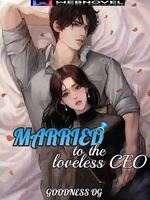
Married to the loveless CEO
- Genre: Urban
- Author: _Shining_Soul_001
- Translator:
- Status: Ongoing
- Rating(4.3 / 5.0) ★
In a society where marriage has lost its true essence and has been distorted, reducing it to a transaction devoid of love and commitment, a mere agreement for personal benefits.
Silvia Reyes found herself caught up in the chaos as she was about to be forced by her parents into marrying a man she despises.
She was able to bail herself out of her dilemma as she offered a marriage of convenience to Davian Randell, who in turn needed it too to solve his dire situation.
But life rarely goes as planned, does it? Will they find a way to reclaim love and commitment in their own lives, or will they succumb to the societal pressures that have tarnished the institution of marriage?
Excerpt:-
"If you think I'm gonna marry that man, then sorry, I'm not!" She said to her father.
"You are, Silvia." Her father declared.
"I have a man!" She said.
"What?" Her parents chorused.
"You have a man. You should have told us earlier instead of letting us go through all that trouble." Alan said.
"We've been dating for some while now and he proposed to me recently and I accepted it." She showed them an engagement ring on her finger, which she bought before coming to the mansion.
"It's beautiful. How come you weren't wearing it yesterday?" Her mother asked.
"I didn't wear it yesterday." She answered simply.
"Then why did you go through the trouble of attending the dinner date?, you could have just told us," Her mother added.
"I wanted to see the man you were setting me up with. I was so angry because I knew I was taken already. I didn't want to tell you guys yet, I didn't want to introduce him to you guys till a couple of days time. You spoilt the surprise." Silvia explained.
"Oh I see. So when can we meet this lucky man?, do we know him?" Alan said.
"Uh-Uhm...no you don't. You'll meet him in a couple of days time, he's a really busy man." She almost shuttered.
"Okay, dear. We'll be waiting." Her mother said. What has she done?, how was she going to get a man that will be willing to marry her in just a couple of days time.
Recommendation Lists
These are recommendation lists which contains《Married to the loveless CEO》You should give them a visit if you're looking for similar novels to read. Alternatively,
you can also
create your own list.

As noted earlier, the storyline is straightforward, even to the point where some might call it unremarkable if they fail to emotionally connect with the characters. Flashback chapters frequently delve into specific individuals' situations and motivations, significantly enriching character development over time.
The artwork is impeccable, immediately drawing you in and encapsulating the manga's feelings and themes. The characters are highly appealing and cute, their designs featuring rounded curves and oval shapes complemented by subtle shadows and instantly recognizable expressions that evoke a sense of honesty and acceptance. Additionally, Kou Yaginuma masterfully simplifies character faces when depicted from a distance; despite minimal strokes, their emotions resonate powerfully, enhancing relatability and empathy. The background art is equally stunning, evoking strong emotions through meticulously crafted cityscapes, forests, and skies. Each chapter begins with city shots that vividly portray the main group's urban setting.
Character-wise, the story’s relatability hinges on the empathetic portrayal of every character. Most main characters, along with many minor ones, are likable, with their sorrows and aspirations revealed gradually. While some side characters remain underdeveloped, their roles primarily serve to reinforce key themes. Distinct personalities shine through, such as Shu's relaxed gentleness, Fuchiyama's stoic dependability, Marika's shyness and introversion, Kei's emotional leadership, and Asumi, who sparkles like a tiny star herself.
Though not directly tied to the story, the author includes short autobiographical pieces titled "Another Spica" at the end of each volume. Here, he shares his own life struggles, inspirations, and the idea that these fictional characters could exist in real life. His candid reflections on melancholy and hardship deepen empathy for both him and his work.
Each individual element of this creation is excellent, but together they create something extraordinary. The narrative is easy to follow, gripping, and leaves readers eager for the next chapter. Despite addressing heavy topics—such as technological advancements potentially replacing human labor or national tragedies leaving lasting scars—the manga retains its romantic and idealistic spirit. The theme of dreams dominates, explored through the eyes of all characters. For some, dreams serve as a final beacon of hope; others abandoned theirs long ago yet still feel their weight daily.
This work feels intensely personal, born out of considerable effort but infused with immense love and affection. Its sincerity may come across as excessive or overly sentimental, yet it shattered my cynical realism momentarily, prompting reflection. Perhaps after experiencing this masterpiece, you too will be inspired to pursue your dreams despite the difficulties ahead.
The narrative setup might seem overly familiar, potentially stifling any tension: the ultimate underdog rising to greatness through sheer determination. She has a troubled past. There are those intent on sabotaging her. She's diminutive and lacks any standout natural talent. But this story never feels tired or contrived.
What is truly remarkable about Asumi is her perseverance. I don't mean occasional triumph over monumental challenges. Asumi surpasses all expectations because she adheres to the same grueling routine day after day, for years, without immediate reward. That is the essence of perseverance. It's relatively easy to rally oneself occasionally for significant moments. What's extraordinary is waking up daily and pushing through monotonous, taxing tasks. Tamora Pierce's portrayal of Alanna in the Song of the Lioness series resonates strongly here. Despite their differing personalities, both Alanna and Asumi are tenacious and driven, working tirelessly for their achievements. They're both petite women striving toward goals demanding substantial physical strength and endurance. Both stories candidly acknowledge their initial disadvantages and the hard work required just to meet expectations. Yet, they push far beyond average—becoming exceptional, even if starting on equal footing. Most wouldn't exert the effort needed merely to catch up, let alone excel. Their accomplishments are all the more impressive given their starting points. And, indeed, women—or members of any minority group—often must be better-than-average to be perceived as merely adequate, even in fields where no inherent disadvantage exists.
We also observe a world with far more qualified applicants than available positions, a scenario familiar in recent times, and witness an administration's ruthless attempt to select the most 'worthy' candidates. The rationale: those who want it most will endure the greatest hardships to achieve it, thereby deserving a spot as an astronaut.
While contemporary Japan, and thus near-future Japan, cannot be labeled feminist, Twin Spica stands out as one of the most gender-egalitarian works I've encountered. Tokyo Space School boasts an equal number of female and male students. Moreover, it presents a feminine-feminist narrative. Asumi embodies traits often deemed feminine—and therefore weak—by society: cooperative, humble, affectionate, soft-spoken, shy, fond of cute things, fluttery blouses, and wispy skirts. She expresses a desire to teach elementary school students. None of this ever conflicts with her ambition.
This is a genuine example of magical realism executed with subtle finesse, a feat few would dare attempt. There's a ghostly mentor-companion and a visit to the River Styx, yet these elements lie beneath a world grounded in hard science fiction. The indignities and realities of astronaut training are integral to this world. Its paper stars pastel aesthetic evokes a storybook charm, likely contributing to its poor sales in the U.S. Many potential buyers probably dismissed it as shallow moe nonsense. In truth, it couldn't be further from that. As an atmosphere-setting technique, the art style functions effectively. Whether character deaths from a romantically depicted blood-coughing disease qualify as magical realism is debatable. Though not tuberculosis, the condition described could plausibly emerge as a drug-resistant strain given current trends of antibiotic misuse and research neglect. It's a vaguely defined genetic disorder causing crimson coughs during stress or exertion, symbolizing relentless persistence against overwhelming odds—a recurring theme throughout the story.
I was disheartened to learn Vertical had to cease print distribution due to poor sales. Many casual manga browsers are missing out on a true gem. I suspect people misjudged the work based solely on its art style and covers. Given the abundance of moe-centric content in recent years, this misunderstanding is understandable. Nonetheless, Vertical continues to release the English version in ebook format, ensuring accessibility while supporting the publisher. I highly recommend it.
Our protagonist, Asumi, is a beacon of resilience, having faced life's challenges yet never giving up. Her dream is to become an astronaut. From the very start, it's evident that this isn't just a dream—she has all the potential to achieve it. She also possesses a unique gift: the ability to see deceased astronauts. The story unfolds from two distinct perspectives. On one hand, it becomes an awe-inspiring, heartwarming adventure chronicling Asumi's journey toward her dream. Simultaneously, it offers a profound exploration of the melancholy surrounding the dead.
"The numbers aren't random; they are distances from stars in light years."
For nearly half of its run, the manga follows the path it ought to. It delves into the typical astronaut training regimen: being confined in rooms with teams, working underwater to repair electronics. At the same time, relationships and the main character herself are developed in a manner reminiscent of coming-of-age narratives. But then things take a turn.
It turns out that every single one of the countless side characters has either one or two of the following issues: the death of someone close to them, unrequited love, or a terminal illness. And by "every single one," I mean exactly that—each and every character. For the remainder of the series, the focus shifts to crafting identical dramas for these identical characters. One is distraught because people die, another because she is dying, and a third because she might as well die since he doesn't love her. It's truly disheartening. Moreover, the series no longer has anything to do with astronauts. Instead, the central theme has morphed into something along the lines of "let's learn to let go, but make sure to complain excessively before doing so." Perhaps I failed to grasp the point of this series, but I'm fairly certain the author didn't have one either.
Kou Yaginuma's art captivates readers, drawing them into every detail of the manga panels to fully immerse themselves in the story's environment. Subtle shifts in the atmosphere are mirrored in the evolving art style, offering a refreshing change that keeps readers engaged rather than accustomed to a singular aesthetic. The storytelling flows seamlessly, complemented perfectly by the artwork, which vividly captures the dramatic highs and lows. One might only wish for the entire series to be rendered in color, but the black-and-white art is already breathtaking.
Character development is central to Twin Spica's narrative, with every interaction between main and supporting characters serving a purpose. Readers follow five ambitious teenagers striving to become astronauts at a prestigious national space academy. Each character is initially introduced with distinct traits, yet as the story unfolds, hidden secrets come to light. Together and individually, they confront their challenges, shaped significantly by moments of tragedy. Flashbacks, timed with precision, delve into the characters' backgrounds, clarifying their motivations and actions within the plot.
It's hard not to be drawn into the series' nostalgic charm. Twin Spica encapsulates the bittersweet emotions of young adulthood, particularly in Japan. Readers can empathize with the characters through the primary storyline and connect with the author through semi-autobiographical sketches at the end of each volume. The numerous references to historical events, figures, and milestones in space exploration lend the story a sense of realism with a touch of fantasy. While it doesn't aim to educate, it encourages readers to face their experiences with optimism, acknowledging the inevitable obstacles ahead.
Twin Spica was nominated for the 49th Japanese National Science Fiction Convention Award for Best Comic Series, akin to the Hugo Awards, in 2010. It was also recognized by the U.S. Young Adult Library Services Association as one of the Great Graphic Novels for Teens in 2011.
Yes, the narrative does rely heavily on the "follow your dreams no matter what" trope, but it's presented in an earnest, realistic, and sincere manner. The characters encounter genuine challenges as they strive to become astronauts, allowing for meaningful character growth. The story spans from elementary school to high school graduation, and it's deeply satisfying to witness how Asumi, Kei, Marika, Fuchuya, and Shu develop into mature young adults.
Moreover, the artwork is stunning. Yaginuma's style of drawing people is quite distinctive, with each character being uniquely identifiable and highly expressive. However, the true highlight is the scenery. There are breathtaking one- and two-page spreads showcasing the night sky, forests, the sea, sunsets, all beautifully rendered. Even smaller panels of landscapes are visually striking.
I believe this manga might be difficult to find, but if you can get your hands on it, do read it. It's profoundly touching and uplifting.
<p>
Leave a Review
Part 1. Rate (click Star to vote)
Part 2. Login to account
Part 3. Write your review
Directory of Novels. where you can find Novels
Copyright novel cool © 2018–2024 — All rights reserved