
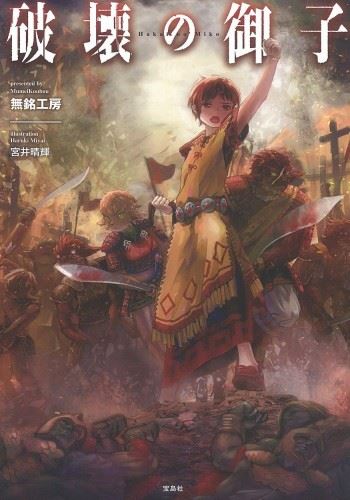
A very ordinary high school student in modern Japan, Kizaki Souma, was summoned to a different world by someone.
In that world that oppressed demi humans, Souma decides to fight against the human countries for the sake of saving the beastmen, who helped him, by using his knowledge from manga and games.
This is the story of a boy that becomes 「 Soma Kisaki, the Divine Son of Death and Destruction 」who is going to be called a slaughterer and the history’s worst destroyer in the future

I have to admit, the story had me hooked. I was invested in the fate of the main character. Unfortunately, this is not what the novel is primarily about. The one intriguing storyline is abandoned after the first few volumes. I kept reading, hoping that this story would continue, but as I got closer to the latest volume, I realized all I'd be getting were some occasional cameos with no satisfying conclusion.
Juuni Kokuki turns into a disordered mess of stories that would fit much better as a spin-off. "Disorder" is the biggest flaw of this novel. First, it suffers from an excessive amount of infodumping. Now, I'm not against some nice worldbuilding here and there, but when most of the volume consists of useless side information that serves only to create an illusion of a well-thought-out fictional world, that's where I draw the line. And yes, infodumping can be made entertaining. For example, Legend of the Galactic Heroes reads like historical fiction, and its occasional infodumps are very much in character for the narration and don't distract from the story's progression.
Another aspect that makes Juuni Kokuki more of a chore to read is the confusion surrounding names and terms. The cast of this novel is enormous, but aside from some of the main protagonists, they all blend together too much. This isn't helped by the fact that the naming system uses words that sound so similar, making the characters forgettable both in personality and name. As a result, you'll often lose track of who's who, what's happening, and why you should even care. Let me give you an example: "Sekki, Seishuu, Shoukou, Suzu, Shisui." These are all names that appear within a single page of text. Good luck keeping track. Up until reading this novel, I found character summaries at the beginning of books unnecessary. Take Baccano, for instance, which does include these summaries. Baccano has a large cast, and the story jumps from one storyline to another even more frequently than Juuni Kokuki. Yet, the characters are memorable individuals that readers have no trouble distinguishing. Oh, how I wish Juuni Kokuki had the character summaries that Baccano provides—it might make more sense.
And of course, this isn't just a matter of character names but also in-universe terminology. Most of it seems to be based on Chinese, and I'm not sure if I should blame the translator, but the terms remain untranslated. So not only do you have to keep track of the characters, but you also have to keep track of the world's terminology, which only grows more tangled as the story progresses. Indeed, later volumes feel less like reading fiction and more like reading a boring history textbook. I'm sorry, but I don't enjoy having to take notes just to have any hope of following along. And certainly, this ends up with you forgetting some of the terms and becoming increasingly confused as the story goes on, with the burden of cramming terminology to "enjoy" the story growing heavier.
This becomes even more ridiculous in the latest novel, where the translation opts to hyperlink names, redirecting the reader from the ebook to the translator's notes, while also keeping the name in kanji in parentheses after the romanized version every time it appears in the text. While hyperlinking the terms is probably the most viable method to make this slightly understandable, it also highlights how close to reading a random Wikipedia article it feels to read Juuni Kokuki. Keep in mind, it didn't take me *that* long to get through the volumes (and when I paused, it was because I was too bored to keep going, not because I had to wait for more releases). Those who started reading Juuni Kokuki when it began now have to keep their memory fresh for almost thirty years while new volumes were sporadically released. I have no idea how this series still has any fanbase.
To elaborate on the latest (current) volume, it's a collection of three short stories. Yes, a coherent storyline was apparently given up on. Though one of them has at least an interesting theme—whether or not to allow a death sentence. Now, this should, at least in theory, be an interesting short story to read. But no, the points and takes you could find in this novel amount to what you'd find in any randomly picked internet discussion of this dilemma. Juuni Kokuki has long outlived its lifespan. Again, I'm not against including short stories as part of longer novels. In fact, Spice and Wolf does this very well with the Spring Log volumes. The difference might be that those stories feel like they still belong as part of the overall story.
It's no coincidence that I've mentioned multiple light novels that do something similar to Juuni Kokuki but execute it much better. That's exactly what you should be doing instead of wasting time with this title—read some different, better novels instead.
Published by: Tokyopop
English translation by Alexander O. Smith
Yoko is a high school girl with fiery red hair, navigating life while trying to please everyone, yet invariably falling short. She is timid, deceitful, and sometimes even cruel, longing only to be liked and remain unnoticed. Unfortunately, this approach leaves her without genuine friends, and her red hair leads teachers to mistakenly believe she's a party girl who stays out all night. Suddenly, a mysterious man accompanied by numerous monstrous creatures arrives, upending her life and whisking her away to an unfamiliar place before vanishing just as abruptly. Left with a strange sword, Yoko must fight for survival in a world where most want her dead. Forced to interact with people without the comfort of social conventions, her struggles deepen, compounded by the appearances of a peculiar, blue, demonic monkey that preys on her fears and despair.
The fantasy world into which Yoko is thrust draws inspiration from modern realism, Japanese and Chinese mythology, and history. The sword Yoko receives contains a jewel functioning as a mirror, referencing the three treasures of Japanese mythology. Chinese mythology contributes concepts like the Mandate of Heaven and its cosmographic framework.
Japanese literature in translation often feels sparse compared to the elaborate descriptions familiar to Western readers, largely due to the use of kanji, which convey multiple meanings rather than English's focus on precise word choices. However, Ono's work here provides sufficient detail to bring the rich world of *The Twelve Kingdoms* vividly to life. Few characters or plot points lose their vibrancy, and I frequently felt transported into the novel. The anime adaptation was often criticized for its overwhelming array of invented terms, but Tokyopop's localization strikes a balance, ensuring that when readers are bewildered by the terminology, it mirrors Yoko's own confusion. The book remains accessible to both those unfamiliar with the Japanese language and enthusiasts, achieved through the inclusion of kanji during explanations of unfamiliar concepts. I'm uncertain about Tokyopop's decision to release this as a hardcover, as it may not appeal to the broader young adult fiction market as they anticipate.
Ono does not appear intent on critiquing modern life or governance by advocating for a return to simpler times. This is neither allegory nor tirade against contemporary society. If there is a message, it centers on personal growth—Shoryu's assertion that one must first master oneself before becoming a king—or indeed anything meaningful in life. Through interactions with the blue monkey, Yoko contemplates moral questions and religion's influence on people at one point. One notable weakness of the novel is its somewhat anticlimactic ending, though this stems from its status as the first installment in a planned series of at least six books by Tokyopop.
Comparisons to the anime are inevitable, and I couldn't entirely disassociate the TV series' imagery while reading, with its original soundtrack frequently surfacing in my mind. Much has been noted about how Asano's character isn't developed in the novel and Sugimoto plays a minor role early on, never reappearing. This enhances Yoko's isolation, amplifying the dramatic weight of her experiences. Beyond these differences, the story aligns closely with the anime, shifting the question for fans from "What happens next?" to "How will Ono guide us there?" Personally, I found the journey captivating.
Whether you're an anime fan or new to the story with no interest in the series, I believe you'll thoroughly enjoy this book. In my view, the protagonist being female does not diminish the story's appeal to readers of all genders.
[Read this and other reviews at http://www.manganews.net/forums/index.php !]
Unfortunately, Juuni Kokuki is not a complete series. But according to recent tweets on the author’s Twitter account, Ono Fuyumi is working on another novel, which is exciting as the last one in the series, released in 2001, ended with a cliffhanger of sorts. Don’t let its incomplete status deter you from reading it, though—Juuni Kokuki is a truly excellent series. In some ways, it reminds me of the Narnia series, as it is a kind of spiritual fantasy, but instead of promoting a Christian worldview, it explains the Buddhist/Daoist worldview of Chinese religions. Unlike Narnia, the characters have to undergo intense personal trials to reach their goals, and the novels ask the question, "What is the meaning of human suffering?" Youko, the main character for much of the series, is one of the most dynamic characters I have ever read, and it is amazing to watch her transform from a self-centered schoolgirl into a powerful leader who listens to others.
The first novel, Sea of Shadow, follows Youko Nakajima, a Japanese schoolgirl, as she enters the fantastical world of the Twelve Kingdoms. Unfamiliar with the world and entirely alone after being abandoned by Keiki, the one who brought her to the world, Youko must fight to survive from the many creatures chasing her, as well as attempt to find her way home. Along the way, Youko discovers her true destiny and grows into an admirable character.
I don’t want to spoil too much, so I won’t go into depth about the later novels about Youko. My favorite parts of the series are the novels about Taiki, the kirin of Tai. Taiki isn’t human, and Ono makes it clear that he isn’t, yet she still draws the reader into identifying with him as a character. Sea of Shadow is a good choice for beginning the series, but it is also possible to begin with Demon Child, the first novel published in the series, or Sea of Wind, which explains how Taiki came to the Twelve Kingdoms. Don't feel constrained to keep to the order used in the anime when you begin the series.
Demon Child was originally written as a standalone horror novel but was later worked into the series. It is told from the point of view of Hirose, a student teacher who has returned to his alma mater to teach before he graduates. On his first day teaching, Hirose notices that one of the students, Kaname Takasato, is different from the others. The other students believe he is cursed and never speak to him. As Hirose begins to learn more about Takasato and becomes closer to him, the strange occurrences around Takasato begin to strike more fiercely and rapidly toward those connected to him. As Hirose tries to understand Takasato, he begins to identify with him as someone who feels he does not belong in this world.
Both Youko’s and Taiki’s arcs coincide in the most recent novel, The Shore at Twilight, The Sky at Daybreak, which explains what happens after the end of Demon Child.
If you have any interest in Asian fantasy, 'another world' fantasy, or just fantasy with personal growth, you’ll enjoy Juuni Kokuki.
Leave a Review
Part 1. Rate (click Star to vote)
Part 2. Login to account
Part 3. Write your review
Directory of Novels. where you can find Novels
Copyright novel cool © 2018–2024 — All rights reserved