
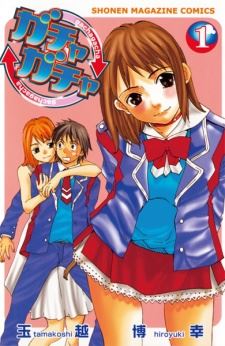
Part.2: "Secret" Arc (The Next Revolution; Volumes 6-16) Hatsushiba Akira, an awkward high school senior, has a major crush on his classmate Sakuraba Yurika. However, every time he gets close to her, he ends up saying or doing something embarrassing. One day, on the advice of his best friend Kikuchi, Akira plays a game in a GachaGacha machine, but it malfunctions. That night, after sneezing before bed, he wakes up looking like the female avatar he saw in the machine. He soon learns that sneezing switches him between his normal male form and a female form. As a girl, Akira-chan manages to get closer to Sakuraba and even befriends her.
Included one-shot: Volume 13: Miniature
The first five volumes of Gachagacha were published in English as Gacha Gacha by Del Rey Manga from August 30, 2005, to August 29, 2006. The publisher released volumes six through sixteen as Gacha Gacha: The Next Revolution from December 26, 2006, to March 23, 2010.




Mod Note: This review was originally posted for Gachagacha Part 2: "Secret" Arc and has since been merged into the main Gachagacha series.
This is truly a masterpiece. It might be because it was one of the few manga I had read in the past three years, but it kept me up until 1 AM every night. The characters are lovable, and I appreciate the artwork immensely. The storyline revolves around a boy who has feelings for a girl (not exactly groundbreaking, right?), but he tends to act overly manly around her and ends up embarrassed. The humor really shines when he unexpectedly turns into a girl due to a game glitch. Gacha Gacha serves as the starting point for this narrative, where they visit a capsule video game machine and encounter an unexpected malfunction. Some of the most outrageous moments occur when he discovers that consuming certain foods causes his female form to mature rapidly. The art style is fantastic, particularly appealing to those who enjoy meticulously detailed backgrounds. I would compare the girls' hair designs to those found in "To LOVE-Ru." I recommend this manga to anyone looking for a delightful comic with occasional glimpses of nudity.
Gacha Gacha features two distinct storylines, both of which primarily revolve around peculiar situations depicted in a humorous manner. The artwork is quite commendable, although, in my view, the character development could have been more refined. Additionally, I feel that certain chapters lean excessively towards fan service. Nonetheless, it remains an enjoyable manga overall.
Gachagacha: The Next Revolution begins with a promising idea but quickly stagnates. The characters initially lack any depth, except for Akira, whose personality only serves to highlight his inadequacies. In many respects, he truly is as worthless as he seems. Yurika, the main female love interest, falls into the classic trap of being hard to like despite the protagonist's affection. She starts off as merely "The Pretty Girl" with no other defining traits, existing solely to be loved by the main character. Even halfway through the manga when some characters begin to develop personalities, Yurika remains disappointingly one-dimensional. The storyline in Gachagacha: The Next Revolution is mediocre at best and progresses at a snail's pace. The romantic subplots are as stagnant as those in Ranma 1/2, meaning they hardly advance at all. While Gachagacha: The Next Revolution may not be top-tier, it still offers enough entertainment value. If you approach this expecting a light-hearted romance, that’s what you'll get. It does have elements of gender-bending, which might appeal to some readers. However, if you're hoping for a masterpiece, you will likely feel let down. I give Gachagacha: The Next Revolution a rating of 3 out of 5.
Gacha Gacha has two distinct storylines: Capsule, spanning chapters 1-41, and Secret, covering chapters 42-96. (Note: This review focuses solely on the first part, with Secret being its sequel.)
[Capsule]
[Mood: Light - medium-heavy]
[Notable pickings: Multiple personalities: 6 | Plot consistency: 6 | Romance: 7 | Fanservice: 6 | Sci-fi: 3 | Ending: 3 | Harem: 2 (poorly formed, some unresolved or abandoned)]
Story: 6
To be honest, the Capsule series began impressively, reminiscent of Mahabora but with broader similarities. In my opinion, it started well but declined from the second arc.
This series appears to have three parts: Introduction of main characters, Normal AI change and its consequences in school, and finally, the Original 4 and ending arc.
I particularly enjoyed the first arc due to the thoughtful development of various personalities. The resulting consequences, whether at school or elsewhere, were realistic, touching, and most importantly, humorous. The school life genre is evident in the first arc.
The second arc, including the ending, diverged significantly from the first. It all commenced with the discovery of the Original 4 (O4). Subsequently, previous characters were entirely abandoned, and no further AI characters appeared nor were mentioned. The second arc seemed to focus on harem rivalry, consuming many pages that could have been better utilized.
The O4 concept was poorly developed, differing considerably from the AI personality change idea. Specifically, three of the O4 characters were scarcely featured in the series.
The ending felt rushed, leaving many things unexplained, seemingly happening out of nowhere. Indeed, the conclusion was so confusing I couldn't comprehend what transpired.
One relationship within the series had a commendable romance aspect.
Art: 10
The art is intricate, emotions are depicted skillfully, and there are numerous background drawings (like fish) enhancing the panel's mood. This boosts the enjoyment/entertainment value.
This is the first manga where I took notice of the characters' costumes. There appeared to be a vast array of outfits, all drawn proficiently.
Most panels were very clear.
Character: 6
Well-defined for the introduction and first arc, which was VERY solid.
Sloppy and underdeveloped for the second arc. Many actions and behaviors remained unexplained and unaccounted for.
I disapprove of the overall poor personality development in this series, especially from the O4 arc onward. It held much potential but evolved into a typical romance-harem narrative.
Enjoyment: 7
I'd give a 10 for the first arc, as it was incredibly hilarious and enjoyable.
For the second arc (including the ending), probably a 4.
Anyone who enjoys comedy, romance, or multiple personalities would likely appreciate this series.
Overall: 7
Overall, it's a good series, although the second arc was predictable and somewhat weak, and the ending was a significant letdown.
Thanks for reading this review! Please feel free to comment constructively on my profile page! ^_^