
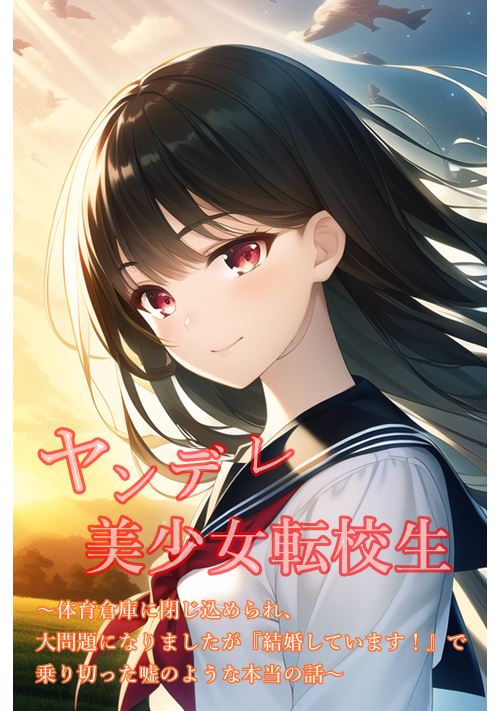
A passionate, sweet, and sometimes yandere love story that begins with marriage.
–We are married!
It’s a secret between just the two of them.
Haruka and Haruto got married in their second year of high school.
In recent years, the law has changed and even high school students (16 years old) can now get married. So there was no problem.
It all started with an incident where they were locked in the gymnasium. When he was questioned by the principal, he immediately lied. The two decided to get married in order to overcome the danger of expulsion.
He begins his “newlywed life” with “Haruka Kozakura”, a beautiful yandere transfer student with a reason.
*Contains marriage elements
*Contains yandere elements

Story (10/10):
Nobita Nobi is a young boy plagued by poor academic performance and bullying. From the future, one of Nobi's descendants sends Doraemon, a robotic blue cat, back in time to safeguard and support Nobi. Equipped with an extensive array of gadgets hidden in his pouch, Doraemon aids Nobi in overcoming his challenges. The ultimate goal is to improve Nobi's present circumstances so that his future becomes brighter than the one Doraemon has witnessed. The story is fantastic and highly captivating, particularly for younger audiences.
Art (10/10):
Fujiko F. Fujio is a remarkable Mangaka, and this work is his crowning achievement. Doraemon showcases the best art he has ever created in any of his Manga. The design and quality are impeccable.
Characters (10/10):
Each character is endearing in their unique way. Nobita embodies the struggles of failure, making him relatable to many. Shizuka represents kindness and friendliness, reflecting personalities we encounter in real life. Suneo and Takeshi serve as typical bullies, resonating with those who have either experienced bullying or been bullies themselves. These characters ensure universal appeal, transcending age and personal traits.
Enjoyment (10/10):
Doraemon was the first Manga I ever read, and it continues to amaze me. Every reading session brings immense joy, and I've revisited this series half a dozen times. That's a testament to how much I adore it.
Overall (10/10):
Doraemon isn't solely for children; it's for everyone. Packed with valuable morals, it encourages all readers to learn and grow into better individuals by addressing mistakes. In my opinion, it's a masterpiece and ranks among the greatest Manga of all time. 10/10.
Here is one of the biggest classics and my first manga I have ever read and completed all volumes, Doraemon. While it's not widely known outside of Asia/Japan, it's a franchise that truly deserves its high popularity and reputation over the years. If Dragon Ball popularized manga, Doraemon is also one of those series and is really close in impact. Even nowadays, it still stands as one of the greatest successes as a manga franchise with about 50+ volumes, thousands of episodes from 3 anime series, and a mass-produced merchandise line since 1970—so more than 50 years ago.
You might initially think that Doraemon is just a kids' show, and therefore not good or interesting because it isn't made for adults. What I can say about that is sure, demographically, it's a kid's show, but you're mistaken. The art may look cute, the protagonists are children, and the story isn't overly complex, but it's far more than what you might expect. I will explain now in detail why this franchise is exceptional and why I would recommend it to anyone.
Story: 8
The story of Doraemon can be easily described without much introduction and can be watched in almost any order, appealing to anyone who can start anytime, anywhere. Each chapter is one story, usually about 10 pages long, sometimes longer. That's why it's easy and common to include fillers in this series, which is the reason why the anime is so extensive! Sadly, since the main author passed away, the manga serialization ended and shifted focus more towards the anime side afterwards, which is still running with a lot of chapter remakes and episodes. I will focus this review on the manga side.
The introduction is quite simple. An elementary schooler named Nobi Nobita is a lazy kid with almost nothing going for him—bad luck, bad grades, and weak against others—until Doraemon, a Cat Robot (without ears) arrives from the 22nd century with a time machine from his desk drawer, aiming to fix his mistakes and change him. Although Doraemon isn't as competent as you might think, he has a plethora of Sci-Fi gadgets, each with a special effect to help him in any situation.
You might wonder, well, it's simple as that. However, what is truly amazing in this manga is the amount and various degrees of themes, comedy, and creativity. You might initially expect something absolutely normal, but with the help of Doraemon, it turns out to be something completely different and surprisingly entertaining. If you are a fan of any popular known comedy shows, such as Saiki K. and especially Gintama, you will definitely understand what I mean and find something similar in your tastes, with its episodic, funny, diverse, and imaginative situations and characters. Just like those comedy series, Doraemon has some great classic parodies from the old era, such as Star Wars, E.T., Ginga Tetsudou, and Uchuu Senkan Yamato. It was rather ahead of its time with these ideas and should be considered among the ancestors of many popular series today.
The situations in Doraemon are diverse, fun, and hilarious. Never in any other show I've seen does it throw simple kids into an attack by extraterrestrials that don't exist and end up contacting the prime minister for help, sometimes even depositing money in a bank and going 100 years into the future to claim this money with 1000 times more interest, children paying taxes to buy a soccer ball, going back during World War II and telling a Japanese war officer that Japan will lose, searching a dictionary for specific homework questions and answers, or even a manga author unable to figure out how to write the rest of the story, which ends up buying his unwritten volumes in the future and criticizing himself for being a lazy author.
Enough said, these examples should amuse you; the possibilities are so vast and creative that I can't describe all of them in 800+ chapters. However, reading a few chapters, if not 2-3 volumes, is enough to understand its strength and potential. Some chapters can be unexpectedly emotional and heartwarming, possibly making you cry or teaching you important morals and ethics in society.
On the other hand, there are some small flaws in the story. If you scrutinize the story too deeply, you might find some plot-holes or inconsistencies, because this story is simplistic and the author occasionally forgets about complex, out-of-range details. However, that was already expected in my case, since it's not a story where you care about details but for fun and mostly as a slice-of-life/comedy. For those who may have concerns with that, just think that after every chapter, the world resets to normal and the characters won't age, even after hundreds of chapters. It's just like thinking that RPG Games have some high-level inconsistencies or almost no logic compared to the real world, so that shouldn't be something critical or disturbing.
Some may also find inconsistencies or concerns about the overall narrative of the manga, since it's an old manga. Just read a few volumes, and you will mostly forget about it. Fortunately, I didn’t notice much of a progressive drop in quality in this manga, so there shouldn't be any issues about that.
Art: 7
The art itself is pretty simple and works well for this kind of series. However, I noticed inconsistencies during some chapters, where the tone didn't match or sometimes lacked a lot of detail. Knowing that the author serialized a lot of series at the same time, this was also expected. Fortunately, it's rather solid overall, and simple designs won't ruin anything—it's not a story that needs complex details, after all.
Characters: 9
The characters are really simple, distinguishable, and well-defined with their purpose in a slice-of-life, adventure, comedy, Sci-Fi, and episodic series. You can find a lot of these stereotypes in recent comedy series, so you should be familiar with them.
Doraemon and Nobita are primarily the main characters of this story. Mostly always together, they explore various situations. Even though sometimes they aren't the focus, they are always related to the focused characters and always appear in the story as usual.
Doraemon is the cat robot, and his personality is often similar to a human one, or something like a robot or even a cat one, which is rather funny and absurd. Although he is a robot, he is somewhat defective and inferior to other robots, and a bit like Nobita, which makes him weak against others. There are some surprisingly touching chapters that represent him, and most of them explore his gadgets and develop amazing and creative situations.
Nobita, on the other hand, is weak, lazy, and sometimes behaves badly, but in the end, he is highly likable and relatable, representing a great impression of a failed guy. Still, he excels in a few areas and remains really entertaining to me.
The rest of the main characters represent mostly their friends or family, most notably three others: Shizuka, Suneo, and Gian (Takeshi). Shizuka is the only girl of the five and Nobita's classmate and love interest. She appears in most chapters, in really good or sometimes accidentally bad ways in multiple situations.
Suneo, on the other hand, defines a stereotypical rich guy with somewhat tricky behavior. He is one of Nobita's biggest friends and also one of his two bullies at times. Since his family is rich and Nobita's family is poor, he often represents the reason why Nobita wants to outstand him.
Gian is primarily Nobita's biggest bully and sometimes an amazing friend (Watch a movie for fun, you will know what I mean). He is the kind of guy who says "Your things are mine, My things are mine." What I find really funny and entertaining about this character is when his behavior changes greatly at times and when he sings or cooks something, things get interesting and stressful at the same time.
What is also really funny in the manga is that no matter where you go in time and place, you can always find someone like Nobita (weak one) against other bullies who look a lot like his friends/bullies. Also, (almost) every character doesn’t have a perfect personality and they have a lot of strengths and weaknesses, giving them many possibilities during various situations. They may seem linear, but they are more than that.
On the other side, there are some characters I see a lot of the time, but they aren't much explained, like their name or don't have much distinctive connections between the main characters. Again, that's not much of a thing, but as a slice-of-life series, expect yourself to see a lot of characters that may appear one or two times in the entire manga.
Enjoyment: 9
I highly enjoyed it most of the time and was impressed by its comedy, creativity, episodic storytelling, high variety of emotions, likable characters, and unique situations. I can definitely agree that as for its genre and demographic, Doraemon is clearly above average in this aspect too. The chapters are really memorable, and you will remember them for years to come, sometimes as a morality lesson.
Although not every chapter was a hit for me, since it has various themes that I wasn't interested in much, such as romance. Of course, with more than 800 chapters, there can be some weak ones, but also stronger and much more memorable ones.
Overall: 9
A true classic and a must-watch, despite its demographic that may turn off some people. Give it a chance for a few chapters or volumes, and you won't regret it.
Recommendations, references!
Gintama (A lot of similar aspects, like its episodic nature, plus a lot of Doraemon references)
Jojo (Stand abilities are similar to Doraemon gadgets and some crazy, funny situations)
Saiki K. (Psychic Powers are the substitute for Doraemon gadgets, likable characters)
Seto no Hanayome (A few gadgets, species jokes, and similar kind of humor, really funny. Also some references to Doraemon)
Dragon Ball (Serialized around the same time, was a bit inspired by Doraemon’s Sci-Fi settings)
Osomatsu-san (Similar artstyle and narrative, even though it's not by the same author, lots of Doraemon references and similar comedy situations)