
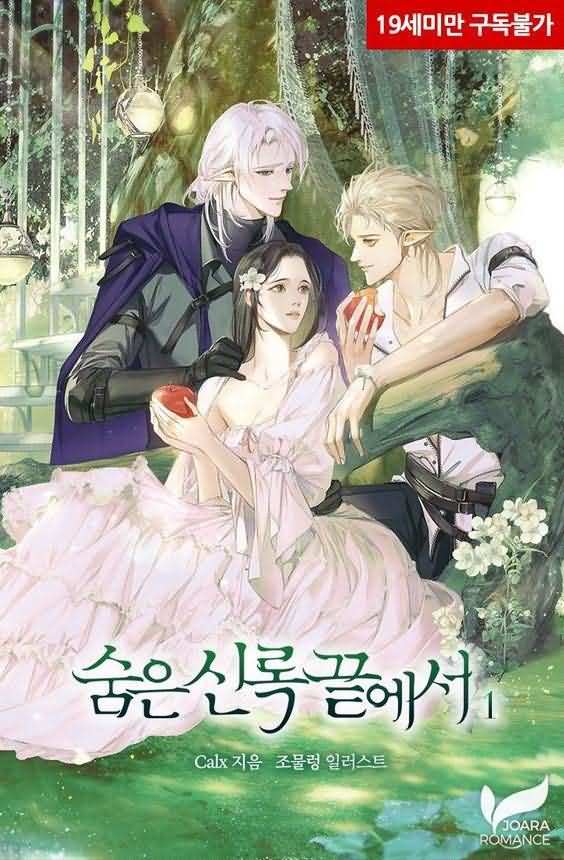
She dedicated five years of her life serving as the Akarna of the temple while she was the crown prince’s lover.
“Do you not understand? If you cannot give birth to an heir, then you can’t become the empress. It’s just… It’s just a political marriage. But you must understand that I love only you.”
And yet, it’s as if he gave her something that’s perhaps nothing more than alms—the position of a concubine.
‘Are you telling me that you’re going to marry another woman and make me a concubine? And you’re expecting me to just accept that?’
When the carriage she was riding in rushed towards a cliff, she impulsively let herself fall. And when she opened her eyes again, she found herself at that place.
The forest where the empire’s most despised species lived.

STORY: This story is actually a collection of various tales, all crafted by Taiyo Matsumoto, who is best known for his work "Black and White." It revolves around a group of students experiencing a Blue Spring, a dreary and uneventful spring. These kids exist on the fringes of society, primarily consisting of punks and thugs, and it delves into their issues, many of which are quite dark and unsettling.
That being said, while some of the stories are absolutely breathtaking (If You're Happy and You Know It Clap Your Hands, Mahjong Summer), others range from mediocre (Revolver: 1-3) to downright poor (Peace). These narratives are dark and, for the most part, thought-provoking, much like his previous work B&W, but some are merely fillers that won't leave a lasting impression. This is why I had to give it a 5 in this category, although I consider some individual stories as 9s or 10s.
ART: Similar to Taiyo Matsumoto's other works, the art here is somewhat unconventional. It doesn't adhere to the standard manga-style seen in many Shounen Jump publications; instead, it's more cartoonish and slightly less realistic. Some people might be put off by it, and it took me some time to get accustomed to it, but others will embrace it from the start and adore it until the end.
CHARACTER: As with many manga compilations, the characters can be difficult to connect with because they only appear in one story or chapter. Another issue with the characters is what I mentioned earlier; they are tough to relate to since they are mostly punks and thugs. None of them are truly driven by their own desires and generally belong to a group, following the demands and needs of the groups. Essentially, they are followers.
The only positive aspect is that some of the other characters in the manga, for the most part minor ones, seem to have more impact on the story than the main characters. Especially in the "If You're Happy and You Know It..." story. These characters are, for the most part, not followers like the main characters and thus much more likable. They truly make it worth reading.
ENJOYMENT: For the most part, I enjoyed this manga. As I mentioned before, there were a few stories that I didn't care for, but then again, there were some that I absolutely loved and frequently reread. A couple have even inspired the way I write my own stories. Overall, I genuinely enjoyed it.
OVERALL: As stated earlier, there are a few subpar stories, the art might not appeal to everyone, and some of the characters are rather weak. BUT (And this is a significant but.) some of the stories are simply masterpieces, as one would expect from a master storyteller like Taiyo Matsumoto. It's just a shame that he couldn't maintain the quality throughout.
Despite all its flaws, the positives outweigh the negatives, and it is certainly worth checking out, especially if you enjoyed Black and White. As mentioned before, it is one of the lesser-known great mangas. Definitely worth the read.
There are no clear moral lessons here; it's more akin to sheer realism. You might even term it the conveyance of youthful boredom. As such, it doesn't aim for excitement, but the mood is masterfully crafted to maintain your interest. A positive aspect is the implementation of surreal slapstick, which Matsumoto doesn't even attempt to introduce subtly.
Character development is entirely discarded; these characters simply live their empty and purposeless lives. No justification is given for their actions, nor are there any indications of a brighter future. You'll either detest their dull existence or find it comically realistic.
It may feel quite heavy, particularly due to the abundance of Japanese pop-cultural references, the lack of vibrancy, the apparent incoherence shown through erratic presentation, and simply because Matsumoto refuses to make it easily digestible. I'm also certain that his artwork won't appeal to many, especially since it's inconsistent, though it does shine in some places.
Aoi Haru is a dichotomic creation; it's perfect in its imperfection. It's certainly not a masterpiece in every sense of the word, but for its bold attempt to address such a risky theme and present it in such an experimental manner, one could consider it a masterpiece by its own standards.
<p>
<p>
These short stories aren't remarkable on their own in terms of plot or character development. They are purely tone-driven pieces. The artwork isn't particularly refined, but it exudes charm and perfectly captures the punk rock essence that permeates the book. I loved the abundance of graffiti, so much so that the bottom of the pages were filled with translator annotations. The music references (Jimi Hendrix, The Beatles, Sex Pistols) were also great—they really help establish the tone Matsumoto is aiming for. Overall, this manga serves as a perfect portrayal of teenage delinquency in 1980s and 1990s Japan, and the blues that fueled it.
I'll leave you with two quotes from Matsumoto's afterthoughts at the end of the book:
[talking about teenage delinquents] "Looking back, I realize that for these youths, whose present was already the past, the camera was a significant item. But at the time, when their actions didn't quite make sense, I was inexplicably drawn to them. They responded to reason with their fists and never questioned their excessive passions. Their honesty and commitment to being true to themselves won me over. They were my heroes."
[after discussing how those delinquents now have families and responsibilities] "No matter how passionate you were, no matter how much your blood boiled, I believe youth is a blue time. Blue - that vague blue that colors the town just before sunrise. Winter is coming."
As you'd expect from Taiyo Matsumoto, the presentation is unconventional in both its visuals and style. Matsumoto's art is visually appealing and effectively conveys the gritty reality he explores. The stories are comprehensible, but I believe much of their depth eludes me due to a lack of cultural context. I suspect that with some research and time, a re-reading would enable me to provide a more insightful analysis.
Leave a Review
Part 1. Rate (click Star to vote)
Part 2. Login to account
Part 3. Write your review
Directory of Novels. where you can find Novels
Copyright novel cool © 2018–2024 — All rights reserved