
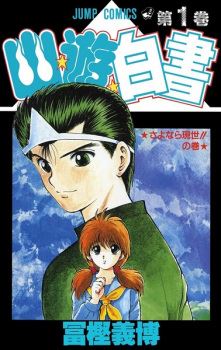
Yuu☆Yuu☆Hakusho
- Genre: action award winning comedy drama supernatural
- Author: togashi yoshihiro
- Artist(s):
- Year: Nov 20, 1990 to Jul 12, 1994
- Original Publisher:
- Status: Finished
...
Show More
Rating(4.2 / 5.0, 24 votes)
5 stars
10(42%)
4 stars
8(33%)
3 stars
6(25%)
2 stars
0(0%)
1 stars
0(0%)
Popular Reviews
High school troublemaker Yusuke Urameshi kicks off Yu Yu Hakusho by saving a child, only to lose his own life in the process. Fortunately for both Yusuke and us, this isn't the end of the tale. Instead, Yusuke finds himself in the spirit world with a shot at reclaiming his existence. Brimming with action and humor, the series has plenty to offer but also comes with its fair share of shortcomings. It's hard not to feel that it had the potential for greatness, yet those opportunities were never fully grasped.
The art style is cartoonish, functional but not particularly dazzling. However, it’s easy on the eyes and complements the exaggerated nature of the series' action and comedy well. Over time, the artwork improves significantly in certain spots, but near the end, it suffers due to the mangaka's stress. Since much of the manga revolves around tournaments, there's often a lack of interesting settings and backgrounds. The character designs, though, are intriguing and diverse, especially among the demons.
Luckily, the characters themselves are as colorful as their designs, with engaging personalities that develop quite nicely. Yusuke initially requires some suspension of disbelief because he's described as an extremely evil delinquent, despite barely looking or acting the part. Regardless, Yusuke is a likable protagonist, similar to other shonen leads who are blunt and prefer settling things with fists (e.g., Monkey D. Luffy). The supporting cast is even more fascinating, though they tend to be straightforward. The antagonists have the most backstory, and we gradually realize that nearly everyone believes they fight for just causes, although genuinely despicable characters still exist for those who enjoy such roles.
Yu Yu Hakusho lacks an overarching story connecting its arcs, which are surprisingly few. While this isn’t necessarily negative, having something driving the main characters towards their goals would make more sense. Even Yusuke's desire to grow stronger fades within specific arcs.
The story begins with standalone tales where Yusuke solves miscellaneous problems using solutions only a delinquent could think up. These stories, while somewhat predictable, deliver great narratives with shonen flair. After two volumes, the story quickly turns into a battle manga, and here, quality takes a nosedive. The plot becomes formulaic, and fights often employ nonsensical, arbitrary rules. Strangely, protagonists easily accept these constraints even if winning. Despite focusing on battles, characters rarely train, so when someone becomes stronger, it seems abrupt and lacks payoff.
Even worse is Yoshihiro Togashi’s frequent use of deus ex machina to resolve conflicts. Characters often remark that good luck follows those with strong powers, but it grows tiresome when solutions appear out of nowhere without logical progression. In almost every situation, conflict arises, the protagonist struggles, and suddenly a random event allows them to overpower their opponent.
The true tragedy is that the story has much going for it. Revelations about antagonists and the spiritual world defy traditional one-dimensional depictions found in similar manga. However, these points come too late and receive too little attention to make a significant impact. For instance, an important development about King Enma arrives at the very end through hearsay during an offhand remark.
This would be acceptable if the mangaka focused energy appropriately. Yet, the fights, which should be the main attraction, quickly disappoint. They usually involve one person dominating the other, with little ingenuity. When fights should be interesting, they're glossed over. For example, the highly anticipated fight between Yusuke and Hiei starts, then is disregarded in a single panel reading, "And many hours later." The entire final arc cuts off before the most interesting fights begin and never picks up again.
Even significant improvements to characters’ abilities are ignored. Kurama, a demon fox trapped as a human, finally masters switching forms at will but uses it once against an insignificant enemy. Yomi’s son’s development focuses heavily on the final arc, only to be quickly removed from the plot, never fighting any protagonists. This unfortunate pattern plagues almost every character’s finishing moves and even characters themselves. The series misplaces its focus, leaving too many issues unresolved.
While Yu Yu Hakusho’s style and genre suggest a younger audience, some themes aren't suitable for young children. Yusuke’s mother apparently gave birth at fourteen, and it’s implied she works as a prostitute. Some characters turn to evil due to disturbing pasts, like being sex slaves or watching extreme torture videos. Alcohol is even given to children under ten. Though never extremely dark or graphic, these themes exist in the story.
While my review may seem overly critical, I did enjoy Yu Yu Hakusho, especially the first half. Despite setbacks, the series can still be tons of fun. For those craving a good shonen manga, I’d say “go for it.” Given its popularity and acclaim, it’s clear many enjoy it. If story quality matters greatly to you, you might want to look elsewhere.
Yuu Yuu Hakusho.
The creator of Hunter x Hunter is also the creator of this series.
Therefore, you know or at least can have a good idea of what to expect from this series.
Yu Yu Hakusho has an overall good story.
It features the typical Shounen Tournament Arc (They might have even invented that since this manga is over 30 years old).
Yusuke Urameshi is one of the most easily recognized Shounen main characters; he has a rather unique personality, complemented by a very good supporting cast of other memorable characters.
Regarding the ending of the manga,
I believe (and many people, if not the vast majority of fans agree) it was better depicted in the Anime.
Nevertheless, it's a story that you can enjoy.
If you like or are a fan of Shounen Action Supernatural oriented series and would like to find a classic for your completionist score, you should give this one a try.
YYH is a classic manga for numerous reasons, boasting well-developed characters, an eerie atmosphere reminiscent of slasher films, and monumental battles that make you feel the entire world hangs in the balance, just as any good shounen should. However, it also has its fair share of issues. The beginning of this manga feels disjointed, not even transitioning into a fighting series until the third volume, which is somewhat tolerable. Yet, from there, you encounter plot holes and unimaginative conflict setups until midway through the Dark Tournament arc. In my view, this is when Togashi truly became the renowned mangaka he is today, setting the stage for his future masterpiece, HXH. Around this point, he matures significantly as a storyteller.
Following the Dark Tournament Arc, we are introduced to Chapter Black, featuring a memorable and unhinged villain in Sensui, while also touching on themes later explored in HXH's Chimera Ant arc. Here, it probes questions about humanity—is it inherently good or bad? What defines a person, and where do we draw the line between human and demon? What similarities and differences exist between them? These themes would be further examined using Chimera Ants and humans in HXH.
However, it's crucial to note that this relatively short manga includes not one, not two, but three tournament arcs—a lazy trope often found in shounen manga. While the first third of the manga is somewhat scattered, it shines compared to the chaos of the final few volumes. The buildup for the Three Kings arc holds immense story potential that Togashi squanders (for reasons beyond his control, illustrating how publishers exploit their mangaka, diminishing product quality). After the Three Kings Arc, the series devolves into an unreadable mess for about one painful volume before Togashi mercifully ended it. Do yourself a favor and watch the English dub of the anime instead, as it addresses many (though not all) of these issues and enriches the series overall.
I have always loved this series, and its strengths are undeniable and memorable. The elements that make it GOOD are so compelling that despite my criticisms, I can't rate it lower than 7/10. Nonetheless, the manga leaves me feeling a bit melancholic due to its lost potential.
Yu Yu Hakusho stands as one of the most influential and significant Shounen Manga ever created. Unfortunately, many younger viewers or readers nowadays see it merely as another series by the same creator of Hunter X Hunter.
With 47 million total volume sales and only 19 volumes long, that translates to an impressive ratio of 2.47 million copies per volume—one of the highest sales per volume in history!
Now, let's delve into the review. I'll also compare the anime version and discuss the Viz release.
Story: The narrative revolves around Yusuke Urameshi, a delinquent junior high school student who eventually becomes a Spirit Detective. Essentially, he has to "solve cases" (read: beat up demons). Early on, the series has a genuine detective vibe, but it soon evolves into a battle manga, featuring what I consider the best tournament arc ever. While it might sound cliché now, Yu Yu Hakusho set the foundation for future stereotypes. The story serves as a vehicle for the characters, which are the true heart of the series.
The story is divided into four arcs. Sadly, the final arc is not well executed and feels rushed.
Art: If you're familiar with Togashi's other work, Hunter X Hunter, you know how wildly inconsistent his art can be. Sometimes it's excellent, other times it's shockingly bad. It took Togashi a few chapters to develop his style in this series, but once he did, it was quite good for a weekly Shounen manga. You can even spot some Shojo influences. However, towards the end, the art quality drops significantly. In fact, Togashi himself seemed to falter, making the end of the series its weakest part.
Characters: Easily the best aspect of the series. With numerous side characters, great villains, and arguably the best main cast out there, two of my top ten favorite characters come from Yu Yu Hakusho. Characters approach battles in vastly different ways, adding diversity to the fights. One character will astonish you with their intellect, while another will make you laugh at their stubbornness.
Enjoyment: Overall, Yu Yu Hakusho is a must-see Shounen manga. It laid the groundwork for many future works and is simply fun. It'll make you laugh, tug at your emotions, and feature plenty of epic battles.
ANIME: How does the manga compare to the anime? This is one of those rare instances where the anime clearly surpasses the manga. If you haven't watched or read Yu Yu Hakusho, just go watch the anime. To me, the manga feels like a rough draft, while the anime is the polished final product. The stories are nearly identical until the very end. The anime boasts one of the best dubs, great music, superior art, better fight scenes, and it cuts unnecessary parts from the manga while adding better scenes. The anime is more serious, whereas the manga includes more comedy. At times, this enhances the manga but can be distracting during critical moments. Thankfully, the anime maintains the comedic nature of the series while keeping serious moments appropriately intense.
Viz: Supporting the industry is important, and I hope you agree. The manga has been fully released in English by Viz. Unfortunately, their translation may be one of their weaker efforts. Whether they were trying to censor certain words or directly translate Japanese to English, the translation sometimes feels off. Being one of Viz's earlier translations, this is somewhat understandable. Still worth buying; most of the time, the translation is fine, with just a few mistakes here and there, including grammatical errors. Togashi's extras between chapters and volumes are hilarious, though.
Overall: I gave this series an 8/10, with some points added for its immense influence on future Shounen manga. Remember, this is a 90s series. At times, it's frankly great, but at others, it falls short of its peak. That said, every Shounen fan must experience this series, either through reading or watching. It's a timeless classic. Yu Yu Hakusho isn't just 'that other series' by the Hunter X Hunter creator; it paved the way for HxH, many other battle manga, and in many ways, remains superior to newer content.
I hope this review was helpful!
YYH is one of the more popular 'old school' 90's mangas. It might not be the deepest or most complex shonen of its time, but it doesn't need to be—it has fitting artwork and an intriguing (if basic) premise that is followed up on with easy-to-love characters.
[Story - 6]
The story has two parts to it, really—a supernatural detective part and a typical battle-royale part. We start with the former: Our protagonist, rowdy middle schooler Yuusuke Urameshi, dies in a freak accident and promptly journeys to rejoin the living. Along the way, he becomes a 'Spirit Detective,' and thus investigates cases of that sort. This is admittedly enjoyable, if slightly generic, thanks to the writing.
.....But then the second part happens. Suddenly we have martial-arts tournaments, and epic DBZ-type fights, and it's just fists flying everywhere. I wouldn't mind this every once in a while, but it got a bit unbearable towards the end with how frequent this became for every chapter. Like, come on, TWO tournaments? I do admit that these fights can be written rather proficiently (especially the closing fight for the first tournament + the Black Chapter showdown), with tons of detail in both manuscript and panelwork, but the prioritization of quantity over quality makes the impact less strong.
Speaking of the end, it was so blatantly rushed. SO blatantly rushed. I can't get too mad because it appears that the mangaka, Yoshihiro Togashi, has suffered from chronic health issues due to the brutal schedule he was put under while writing this manga, but it's still really irksome. It just felt like a lot was skipped in favor of completing this project, which came at the sacrifice of truly fulfilling the final arcs and possibly having even more material.
[Art - 7]
The art style here isn't too great, but it fits the title well. It emulates the general vibe (somewhat serious/spooky, but definitely more childish) sufficiently, from the background designs to the shading palettes. The character design isn't too terribly unique for EVERYONE, but the core players in each arc get their well-due artwork. This is really all I have to say, LOL.
[Character - 7]
The characters are what will make this title stick around in your head for a while, if I'm gonna be blunt. They might not be the most well fleshed-out characters in a shonen, but they're one of the more enjoyable casts at least!
Urameshi is perpetually an edgy trickster who is always raring for a fight, yet it's clear that he goes through a substantial amount of development. From first learning of how to handle responsibility to arriving at the conclusion that taking lives can be extremely taxing if you're not prepared enough, it is rather enjoyable to see how he matures. Again, the latter portion + ending marred this quite a bit, but for what we got it was pretty solid.
The other characters surrounding him (mostly) get substantial exploration—his sometimes-friend sometimes-rival Kuwabara goes from a fellow troublemaker to a fine young man (even if not the brightest), Kurama and Hiei go from enemies to comrades to treasured friends (each having their own struggles, due to their heritage), and Genkai is a typical, yet memorable, sh*tlord of a master who hides her own tragic past.
The antagonists are really hit-or-miss. We have the memorable ones, such as Toguro and Sensui (darker reflections of Urameshi's future), and then we have the.....others, who I can't even name. They usually look really goofy and the bulk of the latter appear in the 'tournament' arcs for very short periods of time, which explains why I won't even bother to remember them.
Other members of the supporting cast also receive the short end of the stick—we have Botan, Urameshi's guide in the beginning who appears to be a mainstay but gets shafted aside for the boys mentioned earlier; Keiko, who is supposed to be the love interest for our protag but barely receives enough paneltime to make me truly care about the romance, and so on/forth. I could say something about how it seems to be mostly women who got this end, but I'll leave that for someone more qualified to speak.
[Enjoyment/Overall - 8/7]
While I am rather critical of this title, I actually enjoyed it quite a bit! It's not too horrid to immerse yourself in some mindless, good ol' fashioned battle shonen as long as you know it isn't Great Material + recognize why exactly that is. If you keep that in mind, this is a great read that is worth the amount of time you sink into it. I highly recommend it to people who are looking for what I /just/ mentioned!
Togashi at his finest. His evolution as a storyteller and world-builder in HunterxHunter is evident, but by Yu Yu Hakusho (YYH), he was already a master of everything else. This story, it's incredibly simple yet so beautifully told. It has the "Dragon Ball effect," where something seems obvious now due to many shows and series following a similar path, but this was the original influence.
A must-read for fans of action and the supernatural. Despite its obvious flaws, the charisma with which it's executed makes it hard to criticize. I simply can't forget the amazing Dark Tournament, which, along with the Tenkaichi Budokai, set the standard for what a tournament arc should be like. The Sensui arc took the series into some seriously profound subject matter and tone, and these are just two of its major arcs.
This series is incredible, but it takes a significant hit in its final arc. The character dynamics that were well-established in the earlier volumes and chapters become entirely irrelevant. DO NOT READ THIS! Instead, watch the anime. It still has many flaws, but it handles them better than the manga. I wish I could give this a 10 out of 10. I really do. I love Togashi's work, and this was such an important part of my teenage years. Now that I'm more critical of what I read and watch, I still think the anime suffers greatly after the first encounter of the "Chapter Black" arc or "Black Chapter" if you're reading the English manga.
While Togashi was working on this, he essentially gave up on writing and drawing it after the beginning of the Chapter Black arc. There are many positives to Yu Yu Hakusho; it's basically the exact opposite of HxH while being very similar. If you have any interest in it, please watch the anime instead. It fixes and extends the story to some extent, although the last arc is still trash. This is just my opinion, but I also think the arc before it significantly suffers in quality. Just don't let the manga define your opinion on the anime.
Reading this manga offers an intriguing experience if you're familiar with Hunter x Hunter, another fighting shounen by Yoshihiro Togashi. Several powers, plot elements, and character archetypes from this series are repurposed in Hunter x Hunter but with added depth and exploration.
Don't anticipate much action in the initial chapters as the first twenty or so focus on the protagonist Yuuske acting as a ghost detective, helping spirits resolve their issues to move on. Most of these stories were surprisingly poignant, evoking strong emotions that made them harder to get through compared to other parts of the manga. After this introductory segment, it transforms into a traditional fighting shounen featuring an excellent tournament saga that maintains its intensity throughout.
Yu Yu Hakusho excels within its genre, boasting well-developed characters who undergo significant growth. It features compelling antagonists and spectacular fight scenes. The series has the wisdom to conclude before becoming overly long and bloated (though its ending is rushed and unsatisfactory, with only three substantial arcs). Its relatively early conclusion prevented it from growing formulaic like many subsequent fighting shounen series; each arc feels unique and experiments with new ideas.
While it may not have achieved the same level of popularity as Dragon Ball, I believe Yu Yu Hakusho surpasses it in quality and should be recognized as one of the finest examples of action-adventure shounen manga.
Yu Yu Hakusho: A True Masterpiece
Story: 9/10
The narrative centers on Yusuke Urameshi, a rebellious high school student who dies while attempting to save a child. This premise might not seem remarkable at first, but it evolves into an enthralling journey that delves deep into the manga's universe.
Characters: 9.5/10
This series boasts one of the finest ensemble casts in anime and manga. The protagonist, Yusuke, is incredibly likable. Hiei, the deuteragonist, stands out as another fascinating character in his unique way. Kurama, the female lead, surpasses many failed female leads in other shounen manga. Yusuke’s rival, Kuwabara, sometimes feels like a side character, yet he still gets ample screen time, just not as much as the others.
Arcs: 10/10
The arcs are undoubtedly the series' strongest aspect. It begins with a somewhat slow-paced detective saga but rapidly escalates to the best tournament arc in anime, and one of the finest shounen arcs overall. After a brief slowdown of about 15 chapters, the series reaches its peak in the final two sagas.
Fights: 10/10
The fight choreography is genuinely among the best you'll ever see.
Overall: 10/10
Yu Yu Hakusho remains a must-watch series even today, despite its seemingly dated appearance. Trust me, it isn’t. The influence this manga has had on the genre is simply astounding.
As much as it pains me to give the manga a 7/10, having watched the anime first, I simply wasn't impressed. The anime adaptation is my all-time favorite, but the manga has its share of issues.
Let's start with the negatives:
1. The English translation feels somewhat odd. Fortunately, being a 90s kid, I could understand it, but younger readers today might be put off by the dated language. It's not offensive, just old-fashioned.
2. The beginning drags on too much with other ghost stories. It takes two whole volumes before the protagonist gets back into his body in this shounen fighting series! I wonder if Togashi wasn't quite sure what direction he wanted for the series at that point.
3. The final few volumes are both rushed and padded with unnecessary content. Without knowing all the behind-the-scenes details, it's clear that the pacing suffered due to rushing. The Demon World arc (I'm not sure if that's the official name) is condensed into just a few chapters. It's not the worst thing ever, but cramming an entire arc into two volumes is unsatisfying.
4. It's nice to see all characters' stories wrapped up at the end, but some parts feel like a waste of time. Yusuke’s mom barely qualifies as a character (which is fine), but we find out his dad was physically abusive and they're still friendly? What? There's one last mission right at the end that serves no purpose. Maybe Togashi intended the Demon World arc and that last mission to be full arcs, but that's not what we got, and I can only judge based on what's there.
Now for the positives:
1. First and foremost, the Dark Tournament arc is fantastic and, as everyone always says, sets the gold standard for tournament arcs.
2. The main characters are diverse and well-developed. We have Yusuke, the socially awkward yet great fighter—a typical shounen MC, but it works. Botan is fun and delightful. Kuabara, the idiot friend with a heart of gold who wants to prove himself. Hiei, the outwardly cruel demon who secretly cares about his friends (though he'd never admit it) and follows his own twisted code of honor. Kurama, a demon reborn as a human baby who became a loving person with a dark past and a ruthless attitude towards threats. Genkai, the aging master who is tough yet a caring mentor. All the main cast members are excellent.
I'm better at pointing out flaws than praising things. Don't worry that I listed more negatives than positives; overall, I enjoyed reading it. The positives outweigh the flaws.
Honestly, I would recommend watching the anime instead. The manga isn't as good as the anime, but it's still a decent read. Just go in knowing that the beginning and end are rough.
Story 6/10
The story began quite simply, like any other. Getting through the character introductions was a bit of a struggle for me. Once the initial setup was done and the characters were well-established, it became more enjoyable. The Dark Tournament arc was really good and fun to read. There was one aspect I didn't like about it, but I won't spoil that here. The Chapter Black arc was disappointing because I expected it to continue the greatness, but I found it rather silly. The final arc was even worse, though it did offer some nice character development for a few characters. The ending felt like fan service, but it was what it was.
Characters 9/10
The characters are the best part of this manga. Their friendships made the whole experience enjoyable. If it weren't for the characters, I would have dropped Yu Yu Hakusho during the Chapter Black arc.
I think Yu Yu Hakusho is the most overrated manga ever. Many fans watched the anime and are blinded by nostalgia, but the story itself undermines its own potential. Still, respect to Togashi for his efforts.
The story revolves around a 14-year-old boy named Yusuke Urameshi. He dies in a car accident while attempting to save a little boy. Following his death, he becomes a Spirit Detective, someone tasked with hunting down demons in the human world and solving supernatural cases. Throughout the series, we witness him tackling various cases and battling enemies.
Things get particularly intriguing during the Dark Tournament Arc, where some of the most spectacular moves are showcased (Dragon of the Darkness Flame, anyone?). The third arc, known as the Chapter Black Arc, introduces a villain who aims to eradicate humanity. As expected, this antagonist also faces defeat.
Regrettably, the author fell ill during the third arc, leading to a decline in the quality of the artwork (which is why I had to give it an 8 :/). Despite this, the illustrations remained excellently crafted. The Three Kings Arc is the most intense part of the series, and you'll have to see for yourself just how incredible it is.
If you've watched the anime, you should definitely read this!
Leave a Review