
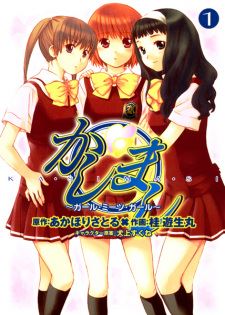
Kashimashi: Girl Meets Girl
- Genre: comedy drama girls love
- Author: akahori satoru katsura yukimaru
- Artist(s):
- Year: May 21, 2004 to Apr 21, 2007
- Original Publisher:
- Status: Finished
Rating(4 / 5.0, 5 votes)
5 stars
1(20%)
4 stars
3(60%)
3 stars
1(20%)
2 stars
0(0%)
1 stars
0(0%)
Popular Reviews
So I was delighted to come across a gender-bender story that boldly declares no gimmicks or tricks; the transformation is happening, and everyone has to deal with it. The ending was actually quite strong, albeit a bit melodramatic.
I was fully invested in this series up until the plot development at the end of volume 3/beginning of volume 4, which steered the rest of the narrative (and not for the better, driving it off a cliff into overwrought melodrama). It just didn't resonate with me. Don't get me wrong, I couldn't put it down, but I found myself rolling my eyes frequently.
The art style remains solid, though not as exquisite as some other manga I've read recently. Still, it shines through its consistent use of interesting and diverse clothing. I appreciate when artists regularly dress characters in new outfits.
As for the characters, we are both inside and outside cliché territory. Our protagonist, Hazumu, is a type I haven't encountered much before, though that might be due to my own limited exposure. The "femme boy" who isn't exploited for BL purposes or used as comic relief is refreshingly original. Watching her adapt to and embrace her new biological female status is the strongest part of the story. Beyond that, we have what seems to be a yamato nadeshiko (though it's more bizarre, frankly), a tsundere childhood best friend, an unsubtly named character reminiscent of Nagato Yuki, and the classic Dumb Best Guy Friend. None of the side characters are deeply developed, but I enjoyed moments in the first two books where all parts of the love triangle grappled with girls liking girls.
Let's talk about trans issues. I appreciate that this story takes gender switching seriously and shows how characters adjust to someone expressing a new gender identity. Obviously, it's overly simplistic, but oh well. We do see pronouns shift as characters accept reality, and it's surprising to see Hazumu misgendered in later volumes—though I'm puzzled why one character continues using "-Kun" for her until the end. That said, while the work nods toward gender expression, it doesn't delve too deeply. This makes sense in a way since Hazumu never explicitly identifies as transgender; her gender change is involuntary, and she discovers being female is more comfortable than being male. But given the book's attempt to take this seriously, a bit more acknowledgment would have been nice. The manga seems indecisive on this point.
The issue of homosexuality is similarly handled. My reviews might suggest I've been reading a lot of yuri lately. Some books idealize relationships, while others offer more realistic portrayals, with characters struggling with their sexuality and societal acceptance. After the first volume, it mostly stops being an issue here. On one hand, this logically follows from the setup—everyone knows Hazumu was interested in girls before The Event, and potential love interests were already in love with him (or close to it) beforehand. But it's also a cop-out, which I'd overlook if everyone was cool with it, but less so in a book trying to address the complexities of this change. Like Hazumu's gender identity, it gets raised, somewhat addressed, then sidelined by silliness involving a Crazy Alien. There's a significant tonal shift between volume 1 and 2, moving away from identity issues to conventional love-triangle drama. I don't need 600 pages of angst, but if you're going to brush it off, why bring it up at all?
Overall, though, this gave me mostly what I wanted, even if the quality slipped around the middle. I might reconsider my rating downward.
There's a lot working beneath the carefree surface of Kashimashi if you stop to think about it. I'm going to try to dig into nuances that might be easy to miss if you're just a casual watcher/reader, and try to keep SPOILERS to a minimum (but there WILL BE SPOILERS you should watch the series for yourself first if you mind spoilers, and if you don't the ones here shouldn't affect your enjoyment). Also, it's gonna get pretty long. (I wrote this for the anime first but I read the manga before I watched the anime, so I feel comfortable crossposting it haha) Let's start by saying Kashimashi is one of my favorite yuri works. The manga is slightly preferable but only slightly; overall, both it and the anime are great stuff, sweet and earnest and with some true drama that never feels like they simply slammed the Drama Button. I won't go into a lot of detail up front about the basic plot, since I think the synopsis at the top covers that: Hazumu was a boy, now she's a girl, and all of her relationships change. Chaos ensues. Before we get into the meat of my review, I want to take a moment to mention the title: "Kashimashi" is an onomatopoeia that basically means "blah blah blah" or "noisy", but is only in reference to three or more women gossiping. Specifically, three or more. That it's used for a series that focuses on a love triangle between three young ladies is a stroke of brilliance that should be appreciated. Names are important. First, I'd like to address the issue of Hazumu's transition. Of course, this transition is ridiculous; it's a science-fictional version of suddenly being flipped to one gender from the other. Coming to this expecting an earnest, realistic portrayal of transitioning genders is like going to McDonald's and expecting a Michelin 3-star restaurant. For that, you might want to read the Hourou Musuko manga. Keep in mind that the overall attitudes toward gender and sexuality in Japan are complex, and not the same as those of the Western world; that tends to color every anime in ways that are hard to define. But that's too deep to get into for this one review. Let's look at our main character, Dude-Hazumu, at the beginning of the story. He's a boy who's always been highly feminine in the ways most people would view femininity. His best friend is a girl (and I mean Tomari; I think we can agree that his friendship with Asuta is mostly a survival mechanism for him, since he's not very masculine and he needs a "guy buddy" for support), his only thriving interest is in flowers and horticulture, and he has no desire to do anything sports-related, or ogle women with Asuta, or anything else typical of the average high school boy. Ayuki (another girl) is his only other friend, though not close as he is to Tomari or Asuta. Yasuna, the girl he's flower-buddies with but has a crush on, presents something he doesn't quite know how to navigate because (here's a red flag) HE DOESN'T QUITE RELATE TO HER IN THE USUAL BOY-HAVING-A-CRUSH WAY. His confession to her in the first episode can be seen as just a really awkward love-declaration from a boy, but by the same token, it could be because he feels a little guilty for trying to change their important friendship, which is why he blurts it out like he's confessing to a crime - and only after encouragement to do so. Basically, the point I'm trying to make is that Hazumu was always a closeted, blissfully-unaware trans woman. Because of Japanese attitudes towards gender (and let's face it, the same goes for a lot of the rest of the world, too), it's completely conceivable that she could have gone all that time without ever having considered the possibility that maybe her lack of masculinity is because she's not actually a man at all. There's sort of this unspoken expectation that anyone who's trans should have figured it out all on their own during early childhood, but without any queer friends or other transgender/transsexual examples to look to, she's content with being a feminine boy because she simply never thought about any alternative. It's a very "it's something I can't change, so why worry about it?" attitude. This carries over to her body being transformed, as well; she's shocked, but doesn't spend a great deal of time fretting over it since it's beyond her control. Now... about the crash itself and the transition. The ludicrous premise of the aliens landing is actually beautifully brilliant in an oblique way. Why would the aliens remake her body to be female? It's never stated openly, but considering how she was before the accident, her demeanor, and the fact that Yasuna could almost see her (I'll get into her Male Blindness later), it can be assumed that since her body was eradicated, they reconstructed it in the way that best matched her soul. Her brain chemistry seemed more "girly" to them, so they naturally constructed her that way. Later on, they reveal (spoiler!!) that their entire purpose on earth was to learn about love; it makes sense their instruments would be finely tuned into emotion and other spiritual aspects like those. Again, not realistic at all, but in a series that already has a spaceship that can transform into a cute, floating, "-puu!" exclaiming, pink-haired "mascot", let's not get TOO wrapped up in realism. On to Hazumu-The-Girl. There have been comments from other reviewers that "common sense" should have helped Hazumu's adapting to her new body be more smooth than it's portrayed, but would it really? Considering that her spirit was feminine but she has literally never been encouraged to EMBRACE that femininity throughout her entire life (during a flashback, when Lil Haz asks Lil Tomari if he can be her "bride", she immediately crushes that dream and says he has to be the groom. It's a pattern of gender reinforcement that probably came at her from all sides), of COURSE she wouldn't know things women take for granted, such as "hold the back of your skirt as you walk upstairs so the boys won't see your panties". How would someone who's never worn a skirt know that? The fanning of her skirt, thinking "hey, it's nice that I can have a breeze in here, pants really suck apparently" is such a pure, innocent moment of self-discovery; it's up to her friends to remind her that no, you can't do things like that in a world full of male gazes. So I think this period of adjustment is not only totally understandable, but also serves to add some needed whimsy to offset some of the more serious themes and keep it a fairly light-hearted anime/manga. Most of the character's attitudes and reactions feel completely natural for me, even if the premise itself isn't at all natural. That some moments do serve as very mild fanservice is understandable, but to be honest, the fanservice in this series is pretty negligible and doesn't even come CLOSE to ecchi levels. Thank God. One final thing about Hazumu, and this is a BIG SPOILER but too important to leave out. It's my opinion that, when later offered the option of de-transitioning by the aliens, the fact that she turns it down cements that she was always a woman from the very beginning. She's happier as a girl, things FIT for her now, and her friends have accepted her (some more reluctantly than others, as is normal; it helps that it's an accident that she couldn't control, otherwise there would be more realistic negative reactions from them if it were her choice to "come out" from the beginning). There's a lot of subtlety that could go unappreciated if you don't know to look for it, or if your mind is closed to spotting it. Let's move along to the other characters. It's tempting to write them off as two-dimensional or "tropes," but tropes are tropes for a reason; they represent real people, and they work. Besides, I think they defy their own tropes on multiple occasions. Yasuna presents an interesting challenge for the viewer/reader. How are we supposed to accept this girl doesn't see men? Well, actually... it's scientifically possible, even if used a little fantastically in this case. The condition is known as "prosopagnosia," and there are multiple variations and multiple causes. Whereas most patients suffering with face blindness never recover, some do, which especially in a case like Yasuna's that seems to be caused by a feeling of detachment from the male gender, seems as possible as her having the condition in the first place. Think about this from her perspective: she's never been able to see men, so she very naturally is only interested in women (whether or not she would have been from the beginning WITHOUT prosopagnosia is debatable; maybe the condition is a result of her sexuality, or maybe they're unrelated. Who knows? But it's fun to speculate). The first boy she can actually ALMOST-see is an immediate fascination for her, but she can't fully accept his confession of love, because he's not her type; she likes him as a friend, of course, but how could a romantic relationship develop if she can't even recognize his face? Hence her clear frustration and sadness with having to turn him down. The transition solves that for her in a wish-come-true fashion; how many of us have ever had thoughts such as "Oh I like this girl a lot, if only she weren't my coworker/teacher/student/barista/cousin/driving instructor"? There are endless examples. If you take one of them, such as a barista where hitting on her at her job just makes you a douche, and then you run into her outside of work and strike up a conversation, the relief at that barrier being removed is HUGE, and something most of us can relate to (even if we've never been that lucky haha). That's where Yasuna is living from episode 2 onward; a little bit stuck up yet lonely, because she's artistic and clearly affluent, but getting closer to Hazumu through her eager gratitude that she CAN helps her open up to other friendships, as well. Really, she's a very tragic character once they start exploring her more deeply. Though some could write it off as "convenient," personally, I'm a fan of where she is in the end of the series (but I won't get into that for spoiler reasons); it's a fitting and satisfying, optimistic point for her to end on. Tomari hits the classic childhood friend category, but I love her to pieces. Absolutely my favorite character. While mostly accurate, I think writing her off as "tomboy tsundere" does her a huge disservice. She's used to protecting Hazumu because she's always had to; that's what you do for friends. Of course, it also frustrates her, as it does most people who have friends who seem to constantly need protection, and it actually becomes a point of contention between them often. She clearly cares deeply for everyone in her social circle (except maybe Asuta, though I think she doesn't mind him as much as she lets on). Her acceptance of Hazumu's transition is a long and twisted road; she's the one that misgenders her the most often in the beginning of the series. Even after her parents, Asuta, Yasuna, and everyone else have already come to accept it, Tomari still struggles, because under her surface annoyance with his "wimpiness," she's always harbored a deep affection for Hazumu and secretly been hoping they could be closer. Initially, she rejects this gender change because (as she's been told by a largely homophobic society - meaning ALL human society, not just Japan) this means they can't be together. Two women don't get married, right? That just doesn't happen. So she's understandably angry, frustrated, resistant. On top of that, sometimes people just really have a hard time with change. Still, even through this process she helps Hazumu buy a bra, protects her "dignity" on many occasions, tries to help even while she's irritated at having to help. Jealous of how Hazumu still flocks to Yasuna, but never wants to admit it. I won't go into spoilers about how that eventually resolves, but it moves me to tears. The side characters, I will say, aren't explored much but I don't find them as colorless as a lot of other reviewers seem to. Asuta is an idiot boy who suddenly wants to bang his best friend now that she's turned into a woman; we can safely assume that he might be a closeted bisexual who always felt some attraction to Hazumu, or that he simply really likes how Hazumu looks as a woman. Either/or. Ayuki is the most forgettable, but she's very quiet, always thinking more than she's talking; it would take a lot of metagaming to display anything more for her, though they do take an episode to show what's going on in her head a little better. The aliens are the plot foil, though I think they're both fun comic relief (when Hitoshi isn't outlining some of the deeper plot elements, such as why it was important for them to understand love by turning a hetero love triangle into a lesbian one. I mean, have you ever seen a shipper so intense they literally CREATED yuri?! But I'm kidding). Namiko-sensei is hilarious, and she always makes me laugh even if she's pure comic relief. In closing, the side characters definitely stay on the sidelines, and I think that was smart; I'm always annoyed at series that waste too much time on them when they aren't meant to be the focus in the first place. But they're pretty clearly defined and help round out the cast, so they do their job. One of my few caveats, and one a lot of people could have with the series, is the pervy father. It's nasty and I greatly dislike him for sexualizing his "new daughter," HOWEVER... I think this is actually very clever satire; they show him being pervy, just enough to make your skin crawl (if you aren't equally pervy as the father haha), and then right afterward show the mom literally physically accost him for doing so. Seems more like a pot shot at other anime/manga with "take a bath with Daddy" scenes than anything. Plus it never goes TOO far. Now I'd like to talk about Yasuna and Tomari. This could easily have gotten as Betty-And-Veronica ugly as most love triangles do, but this series was able to stay away from that. Yes, there's definitely some strife between them, but it's pretty minimal when all is said and done; and understandable. Also, Hazumu, the object of desire, is actually held accountable for her indecisiveness, which is something that rarely happens in a triangle. There are multiple occasions where it's made clear Yasuna and Tomari do care about each other, even if they are frustrated with losing Hazumu's attentions to the other sometimes. Everyone treats each other with care and at least SOME respect, and they are clearly struggling with their emotions; at no point does it feel like any of them views the others as a mere object or obstacle, even when jealousy rears its ugly head. (Quick side note, even Asuta, who does begin to objectify Hazumu, struggles with it because he realizes she's still a PERSON; a lesser series probably wouldn't bother.) The resolution at the end is amenable, and I think is fair to all parties. The ending shocked me, because I thought I saw exactly how it would play out. It didn't; similar, sure, but it took a twist that made me quite happy. The manga version is a little more emotionally-charged (and I prefer it), but both it and the anime have a very satisfying, sappy, end point. That's why I've read the manga twice and watched the series a few times, and would love to play the game. I'm a sucker for a happy ending. Since this is already super long, I'll be brief with technical aspects: art style is beautiful, I always liked it, though the anime version can seem a little stock at times - like Naruto for the first season or two, where it took the GORGEOUS manga art and boiled it down into something easy to animate. The length is just right; any longer and it would have dragged, and any shorter and it would feel rushed. Simply put, well done and worth reading. STORY/PLOT: 10/10 CHARACTERS: 10/10 ART STYLE: 10/10 OVERALL: 10/10 Before I wrap this up, I do want to mention that this is a review by a trans woman. While I can definitely understand how MOST trans women dismiss it as too fantastical, not realistic enough and thereby think it's damaging to the overall "societal narrative," I think if there was ever going to be a (for lack of a better term) silly, light-hearted, sci-fi story about a high schooler being turned into a girl by aliens, this is about the best you could hope for. It manages to convey a sweet, endearing yuri tale AND portrays a cursory glimpse into transitioning, despite the many pitfalls it could have fallen into along the way. Maybe in another ten years we could have anime deeply delving into gender and sexuality (I'd love to see yuri NOT set in high school, or trans men and women living out their lives - especially if they aren't even the focal point of the series but merely shown as a regular person), but given the social climate at the time Kashimashi was made, I think it handled the subject with care and finesse. "These feelings in my heart" will always have a place there.
It's better than the anime, at least. Still not that great, but the gender-bending elements are pretty funny, and I liked the alien characters. The art is decent, and overall it's a short, easy read. A certain character's "disability" (if you'd call it that) is pretty absurd and stupid, but I can't really get into it without spoilers. It seems like the author wanted some drama to toss in to make things more "interesting" or give some "depth" to the character, but man, it's just so silly I could never take it seriously. If you really like yuri series, you might enjoy this, but if you're someone who doesn't care either way about it, I can't honestly say you'd find much to like about this manga.
Just by reading the synopsis of this manga, you might think it’s not worth your time. But you’d be mistaken. Before diving into it, ensure two things: you’re not offended by girls in love with other girls or boys who transform into girls. In this book's favor, the protagonist is genuinely a girl, not a boy in disguise.
The overall premise of the story is rather silly. A boy rejected by his crush gets accidentally killed by aliens while wandering in the forest. For reasons never logically explained, he is brought back to life – but as a girl. Yeah, it took me a few pages to digest that too. Anyway, Hazumu (our hero/heroine) was already somewhat girly from the start and seems to accept her fate pretty well. From these goofy beginnings emerges a very charming romance filled with teenage angst and nosebleeds. Hazumu must deal with her new feelings as a girl and navigate relationships with Yasuna, the crush who rejected him, and Tomari, her lifelong friend. A major twist halfway through adds urgency to the plot. By the end, I was very pleased; I got the happy ending I wanted and was left guessing until the last page.
The characters are well-crafted, though none are particularly original. They fit typical archetypes, which is somewhat disappointing since a bit of novelty would be nice. Hazumu is well-developed and likable. If the story hadn’t mentioned she used to be a he, you wouldn’t have noticed. The emotions of love, confusion, and conflict they all experience are relatable. It doesn't matter that the love interest is between girls. Tomari and Yasuna are also fun characters, although Yasuna comes off as a bit bland to me. Tomari is definitely the more intriguing of the two. Personality-wise, they are complete opposites, making for a nice contrast. The supporting cast is good and provides much of the comedy. Asuta, Hazumu’s best friend from when he was a boy, is particularly funny. He finds himself conflicted over his feelings for the now very cute and female Hazumu, often resulting in nosebleeds and hilarity, though he never becomes a serious love rival.
Overall, the art is solid but occasionally inconsistent. The main characters are very cute and appealing to look at, though some minor characters, like Hazumu’s parents, are a bit dull and boring-looking. The backgrounds are also quite sparse.
I must say my enjoyment of this series was very high. The ending was emotionally satisfying, and all major plot lines were resolved. I recommend this series for anyone looking for a sweet romance. It’s yuri, but nothing here should offend anyone.
The tale of a boy who transforms into a girl and must choose between two women, potentially entering a Yuri relationship. As far as I'm aware, the anime and manga endings differ significantly. Personally, I vastly prefer the manga's conclusion—it's a hundred times better in my opinion. The narrative, with its unique take on gender-bending within a Yuri context, feels refreshingly original and avoids clichés. The artwork is commendable, yet it's the character interactions that truly stand out, coming across as genuinely heartfelt. This genre of manga particularly resonates with me, and I had an immensely enjoyable experience reading it.