The greatest aspect of Ichigo 100% is its indescribable essence. It's nearly impossible to articulate what makes it so exceptional; you just have to dive into the story and experience it firsthand. By the end, your emotions will reveal how impactful it truly was.
Various plot elements deeply resonated with me, but the standout feature is undoubtedly the ending. It's arguably the finest conclusion that could have been crafted for this manga. While many people criticize Ichigo 100% due to its ending, I personally found it fitting. I believe Manaka made the right decision.
There were some flaws, such as the overuse of cliché ecchi scenes, although they appear less frequently compared to other romance manga like Love Hina.
Nonetheless, the unique and heartfelt storyline more than compensates for these minor shortcomings. This is why I rate this manga a perfect 10.
I haven't really read any other reviews here on MAL, and this is going to be my first ever review.
Major Comparison: Love Hina
Story: This manga had a lot of fanservice. Most people who see fanservice usually see weak plotlines. This was not the case. Some of the really silly things that happened in the first chapter were used as the driving force behind the story. And surprisingly, she made it work well!
Many scenes in the story had moments where you predict something was going to happen but something else does, and you go, "WTF?" This is how she keeps readers interested. I never figured out who the female lead was until I read the last chapter. However, it seems like she rushed the ending.
Art: Another way she keeps (most male readers) people interested is with the fanservice. Skirt flip-ups, girls getting wet, and Manaka getting into an "interesting position" happens quite often in the manga, but most of these are purely accidental save for a few over-clingy characters in the manga.
The art style is simply phenomenal. The artist draws the facial expressions of the girls so well that you don't have to look at the dialogue bubbles anymore at times. The smiles from the girls will make you smile, and their tears will make you teary-eyed.
Character: For the main character, we have the typical "loser" character who can't ever decide anything for himself. Then we have multiple females that each have their own personalities. These females were, in a way, "fated" to meet the main character. Each of them has moments with the character. The entrance of each female character somewhat comes in a sequence when a relationship ends. This keeps the main character satisfied and disgusted with himself every time. Props to that guy for keeping his cool under those "interesting" moments.
Enjoyment: How could I not enjoy this piece of work when it took me less than 24 hours to complete the entire series? There were many times where I kept laughing, other times that made me teary-eyed, and parts that made me feel good inside.
The only other manga that did this to me was Love Hina.
Overall: When I first opened the first page of this series, I was like, "Not again... will this be loaded more on fanservice instead of actual plot this time?" But instead, I found the more modern, high school version of Love Hina, but this time, you don't know who he's going to end up with. Sure, you will see the usual panty reveals, the main character getting his ass kicked, and the random trips. I think the way that "Suzuka" and "Kimi no Iru Machi" presented itself in a non-perverted way will be much more effective in drawing out the storyline instead of loading it with fanservice. All in all, one of the best manga I've read.
I feel kind of ashamed that I read this "scanlated" and not on an actual book. I might have to buy both the Love Hina and Ichigo 100% series.
Ichigo 100% perfectly fits into the classic Shounen, Harem, Ecchi, Romantic, Comedy manga genre, often reminding me of works like Love Hina (though there are no real similarities besides a loser surrounded by many girls).
The story isn't really that great at first. A huge amount of ecchi was incorporated and detracted from the narrative. The protagonist Manaka falls in love with a girl wearing strawberry panties (hence the series is also called Strawberry 100%). Although the story definitely starts off poorly, it eventually transforms into a full-blown romance that I found very enjoyable. There are numerous emotional moments that make you go "aww..." which elevate this manga. By chapter 81, I am already rooting for my favorite girl Satsuki to win Manaka's heart.
The art wasn't anything special at first, but I thoroughly enjoyed the artwork throughout the rest of the series. There were so many moments where I was blown away by the cuteness of a character. I love the artist's style and way of drawing such pretty female characters (the guys are also drawn quite well).
If you like Ichigo 100%, it's because of the characters. The main hook to this series is the development of each character, making you connect with them in some way. Every girl is distinctly different, and their relationship with Manaka is unique. You end up rooting for the girl that suits your own personality, and the manga keeps you guessing about who Manaka will choose at the very end. I only regret that Manaka has to be such a pervert at times, but I guess guys can all relate to that.
With the brilliant blend of comedy and romance minus an addition of ecchiness and fan service, I give this a 10 overall.
When I first saw strawberries after reading Ichigo (Strawberry) 100%, I couldn't help but laugh, remembering Manaka Junpei and his strawberry-filled dilemmas. This is the longest manga I've finished and one of the first ones. First off, I must say, the anime doesn't do the manga justice. While the former might be more flashy, it's ruined by poor artwork, voice acting, soundtrack, and overall portrayal. On the other hand, the latter might be less colorful, but it compensates with good length, character designs, drama, and romance. Definitely read the manga first; it has the complete story from the author, Kawashita Mizuki, who also did works like Hatsukoi Limited., Lilim Kiss, and Ane Doki. It should be noted that the story evolves over time.
A boy named Manaka Junpei likes to go to the school roof for a nice view. One day, he's surprised by a girl falling and her shoe greeting him. The wind blows her middle-school uniform, revealing her strawberry panties. Embarrassed, she runs away screaming. Junpei becomes fascinated with the strawberry-panties girl, wanting to film what just happened as it would make a great scene. The problem is, he has no idea who she is, being surprised there was such a cute girl at school. After inspecting the roof, Junpei finds a notebook belonging to a girl named Toujou Aya, whom he later discovers is in the same class as him. When Manaka meets her, though, it seems highly improbable that the strawberry-panties girl could be plain, glasses-wearing Toujou. His friends, Oukusa and Komiyama Rikiya, convince the protagonist there aren't many cute girls in Izumizaka middle school, so there's only one person he could be searching for: School idol Nishino Tsukasa. Surprisingly, Manaka has no clue who that girl is, annoying Komiyama, who is in love with her and talks about her all the time. As they fight, Tsukasa overhears some of their conversation, abruptly turns down Rikiya, and tells Junpei she wears strawberry panties. After lecturing them and leaving, a depressed Komiyama forces Manaka to confess to Nishino, now presumed to be the girl on the roof. However, she's known to have rejected every guy who asked her to be his girlfriend. Will Manaka simply be the next to get shot down like his friend hopes?
The pacing is not bad, and while at first it seems like the story will be about finding the girl with the strawberry panties, with a predictable ending of the protagonist discovering it in the last few chapters, the author surprises us by revealing her identity early on, both to readers and Manaka, avoiding slice-of-life expectations. Many twists occur quickly, and important characters are introduced steadily. Just when you think all girls fall for him, you'll see one who hates his indecisive nature, another who only wants boyfriends who buy her presents, and so on.
The characters are funny and likable; they are not shallow (at least later). Manaka Junpei dreams of making movies someday, so he intends to apply to Izumizaka high school, which is hard for him because they have a film studies club. Shy and quiet, Toujou Aya secretly writes novels she doesn't show anyone, planning to apply to the difficult-to-get-into Oumi's all-girl high school, which should be easy for her since she's at the top of her third-year class; her personality changes around her little brother, who is in love with her. Popular Nishino Tsukasa likes to cook pastries and recently cut her hair. Oukusa is considered a handsome boy who is good at soccer; he has a secret crush on Tsukasa. Komiyama Rikiya is a perverted, large, strong man who looks like a monster and has no luck with girls. A sexy girl named Kitaouji ("kita" means "north") Satsuki later appears, applying to the same high school as Manaka; she is feisty, energetic, and likes to have fun. Junpei’s childhood friend, Minamito ("minami" means "south") Yui, is a childish girl who used to protect "crybaby" Manaka when he got bullied, but they haven't seen each other in years since her family moved; she likes to sleep nude. Also, Amachi is a tall, good-looking guy who feels obligated to help any girl in need, even if they don't want to. Hiroshi likes taking pictures of girls, especially in certain positions, and has a bit of a sister complex. His little sister is Misuzu, a hard-headed girl who likes watching movies and giving straightforward opinions on directing. Chinami is a cute girl who likes hustling guys for gifts. Much like Aya, Kozue is a girl who doesn't talk much and fears boys except she has dirty fantasies regarding them. Manaka’s sensei in high school is a big-breasted woman who likes getting drunk, especially when she gets dumped; she used to act with a now-well-known director.
The art here is pretty good, though at some angles, especially profiles, the characters look similar, even to those of a different gender. Nevertheless, the serious moments are left alone without inappropriate faces (or jokes), as they should be. They are done brilliantly, I might add. Ichigo 100% is the artist’s most successful work for a reason.
A great manga that keeps getting interesting, Strawberry 100% is one you don't want to miss. There are both funny and touching moments as the main character tries to avoid hurting the girls who like him. This takes school adventures to a new level. Look forward to the school/filming trips these guys will have in high school and Manaka’s endless girl trouble.
"The War between Kita (the North) and Minami (the South)"
I watched the anime and didn't really enjoy it that much. However, after reading the manga, I completely fell in love with the story of Manaka and the other girls. The romantic plot was deeply touching and unpredictable.
Nishino quickly became one of my favorite characters! I wish someone like her actually existed in the real world. This isn't an ecchi type of story; it's purely romantic and dramatic.
Most harem manga follow familiar plot patterns: a handsome but somewhat clueless male protagonist, beautiful female characters who seem unable to find love elsewhere, and a group of friends for the lead to hang out with when no women are around. "Ichigo 100%" follows this formula but does so with style. While many harems fall short in various aspects, "Ichigo 100%" excels particularly in the development of its male lead.
I'm not saying other harem manga don't develop their protagonists—they do—but it usually ends up being the "I was indecisive before, now I'm decisive" kind of growth. These male leads often start off as someone without dreams or goals, lacking ambition. In contrast, "Ichigo 100%" presents a male lead with an actual personality (aside from his kindness, which somehow attracts the girls regardless). Manaka Junpei aspires to be a movie director, a unique dream even by today's standards. This, along with other key elements, makes "Ichigo 100%" worth reading.
Another standout feature is the female characters—the harem members. For once, we see a childhood friend who isn’t a central part of the harem; she’s just a childhood friend with mild interest in our protagonist. What truly distinguishes these beauties is their character development. Each girl has a distinct personality that sets her apart and intertwines with our lead's dream of becoming a movie director.
The author focuses on three main female characters throughout the story, which I appreciate. One is encountered by chance and shares the same dream as the lead; another is confessed to by mistake but ends up as a friend; and the last one is sporty and believes she’s met her dream man. The author explores the girls' backgrounds and personalities so well that sometimes I forget I’m reading a harem manga—it feels more like a regular romance manga, just with more partners.
The use of ecchi elements in "Ichigo 100%" is also noteworthy. Other harems use ecchi moments to create awkward situations between the male lead and multiple girls. Here, the ecchi elements deepen connections between the lead (Manaka Junpei) and the girl involved. Basic accidents leading to ecchi moments do occur occasionally but are used sparingly. Personally, I don’t find the ecchi element prominent here—the strength of the story and its characters overshadows a few panty shots.
Overall, "Ichigo 100%" surpasses recent harem manga in several ways. It’s impressive considering the series concluded years ago. The story develops well, culminating in a definite ending that doesn’t feel rushed or open-ended—a rarity in harems where the lead rarely chooses someone. It’s also the first manga I’ve read (and cried over), adding significantly to its impact on me. With attractive art, a heartwarming story, sensible characters, and a sense of closure, "Ichigo 100%" is a successful harem manga and will always hold a special place in my heart.
Story: 10/10 It’s a heartwarming tale that encourages readers to root for a specific girl, typical of a harem manga. What’s different is how the story evokes various emotions, something challenging to achieve with text and drawings but done masterfully here, moving me to tears.
Art: 7/10 The art isn’t the best I’ve seen, but it effectively conveys the characters’ emotions. I quickly grew fond of it.
Character: 10/10 This is "Ichigo 100%"'s strong suit. The author skillfully brings out each character’s traits. Even supporting characters get their moments in the spotlight. I found myself hooked, eager to see how the characters would develop.
Enjoyment: 10/10 I thoroughly enjoyed this series. Despite reading many more manga since then, I can’t forget the stories in this one; it inspired me to read even more. Honestly, no other manga has moved me to tears since this one.
Overall: 9/10 Few manga leave lasting impressions on me, despite having read hundreds. "Ichigo 100%" will always be special, not just as the first manga I read but as the first piece of literature that brought me to tears.
Such a beautiful story, I got teary-eyed near the end. It's about a young boy who has three beautiful girls fall deeply in love with him. His first love, Aya, should have been the one. This series was so good, but that ending... That ending. It shouldn't have ended like that at all. The author who wrote that ending—I just want to ask why. It was going so perfectly. I am utterly disappointed and upset. I really want to give him a good kick in the groin just so he knows how every single fan of this series feels.
Everything deserves a 10/10, but that ending really killed it. I had to bring it down to an 8. So disappointed, I kind of wish I didn’t waste my time reading it. Don't take this as if I sound like a complete fool, but rather in a way that sympathizes with everyone's feelings towards the main characters.
Junpei is a fucking idiot who clearly had it written out who he should be with. And while I understand what he’s feeling, he went against everything. He was basically destined to fall in love with Aya, but he chose that bitch instead. Everyone had a backup person to fall back on, but Aya should have been with Junpei.
This is perhaps one of the few series that I feel compelled to elaborate about. Featuring both lighthearted and dark elements, there were many parts that had me enthralled and emotional.
I began reading this manga while searching for a series that matched my taste. Ichigo 100% turned out to be one that marginally suited my preferences (though I did pause it for a while due to excessive fan service and an annoying male protagonist). Initially, I expected to read this manga merely to pass time, but its darker aspects drew me in deeply.
Each female protagonist has her own sorrowful tale. They are unique, each carrying a different story, even though they all share the common situation of being victims of love. The methods they use to express their affection can evoke a range of emotions, from fan service to heart-wrenching moments. If you have experienced love and heartbreak before, chances are you might identify with or empathize with one of them since their situations reflect realistic scenarios. (If you haven't, it's still a good read if you want a preview of what such feelings might be like)
The compelling parts lie within each female protagonist’s heart as we uncover their individual feelings beneath their facades. It is both profound and dark as they grapple with their inner emotions while realizing and understanding that they are not the only one in the male protagonist’s heart. Few series portray such emotions as successfully as this one does, leaving readers uncertain about the ending even when they know who they would choose if they were in such a situation.
Of course, the series is not without its flaws. Like almost every other harem series, new characters seem to find their way into the story throughout, but thankfully, the core protagonists remain consistent. It was quite disappointing to introduce new characters who were barely developed and mostly used as fan service characters.
Partly because of that, the story drags on and gets boring at certain points when the irritating male protagonist finally gets on your nerves. There were sections with no substantial progress in relationship development, essentially beating around the bush.
And I see only two possible reactions male readers might have towards the male protagonist. Either you imagine yourself as him and feel utterly content, or you get frustrated by his incompetence. For me, it's the latter.
This series now ranks high on my favorites list, and I would definitely recommend it if you enjoy relationship conflicts, given that it contains both light and heavy moments. Hmm, would you rather love or be loved?
My primary recommendation: Give it a read, you won't be disappointed.
Perhaps at first glance, you might assume this is just another run-of-the-mill high school harem romance. However, I am confident your perspective will shift dramatically once you reach the conclusion. In my experience, many harem manga or anime tend to either leave things open-ended or follow predictable paths. Ichigo 100 breaks away from these conventions. The story maintains an element of unpredictability regarding who the protagonist ultimately chooses, which sets it apart. It's also noteworthy that Ichigo 100 isn't solely focused on love. Each character has their own aspirations and dreams they strive to achieve. For example, the protagonist is determined to become a director, showcasing his passion and dedication for filmmaking vividly. I must commend the craftsmanship evident in all 167 chapters of this manga. The evolving relationships between the protagonist and the girls around him, along with each character's personal growth and maturity, are beautifully illustrated. Unlike many harem genres, this one boasts much greater depth, making it far more engaging to read.
All characters are endearing, and the artwork is superb as well. Once again, let me emphasize, Ichigo 100 distinguishes itself from the crowd. It offers both depth and character development that most other harem/romance manga lack.
A simple yet daring sentence that encapsulates the start of Ichigo 100%. What more could a guy ask for? Perhaps used panties in his face, which almost happens at the beginning of the series since the girl hadn't taken them off and was still wearing them. But hey, our hero is already having a nosebleed and couldn't be happier. Yet, we can be even more delighted.
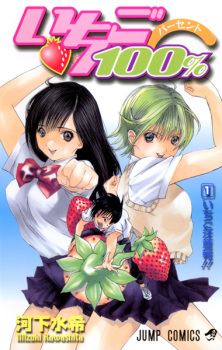
Ichigo 100% is an extensive manga (for a romantic comedy) about Manaka Junpei, who seeks the girl with strawberry panties. That's the entire premise of the manga—at least initially. Manaka sneaks up to the rooftop of the school and finds a pretty girl falling flat on her face right in front of him. Naturally, the first thing a boy does in such a situation—requiring self-respect, motivation to help, and well-trained hand-eye coordination—is... staring at her panties. Specifically, strawberry panties. The beautiful sunset lighting up the panties, the gentle breeze moving her skirt just enough to reveal what's underneath, and the intense eye contact between the two. No clichés are spared in this fateful encounter on the very first pages of the series. The girl then runs away, leaving Manaka in complete shock after experiencing the moment of his life. Who is this mysterious girl? Why did she fall so hard on her face? How much do a pair of strawberry panties cost?
First: Ichigo 100% is a shounen manga. Second: Kawashita Mizuki is the writer of the series. Third: She’s a genius.
This might come as a surprise, but the writer is indeed female. As a shounen manga, the protagonist is naturally male, keeping the story's perspective focused on males. This is where Mizuki excels. She knows what she wants to convey in a story. She understands what readers want from their stories. It’s no small feat to achieve high popularity rankings in Shounen Jump with a romantic comedy. Ichigo 100% stands and will continue to stand as a classic ecchi manga. Its success can be explained in several steps.
For starters, the eyes look beautiful. This may seem like a minor detail, but it builds up the whole art style of Ichigo 100%. The drawings by the writer are amazing. Most of the time, drawing focuses on the character’s face, starting with the eyes. No detail is overlooked. The size of the mouth complements the situation. Soft and hard strokes create blushes.
Most importantly: the depth of the eyes. This cannot be overstated as this series demonstrates how crucial it is to draw eyes correctly. For example, two characters sitting in a dark room with a small light bulb on, and one of the characters is feeling sad. This is perfectly reflected in the eyes. The somber look gently drawn with carefully placed strokes, together with the reflection of the light bulb in the back of the iris. You have to see it in action. This adds a whole new dimension to conveying emotion in manga—a skill only talented artists who understand emotional storytelling on paper can master.
But the true selling point of this series is the characters. Initially, they appear one-dimensional, with little background information provided. Manaka is the average next-door kid getting lucky with girls and unable to decide which one he wants. The panties-girl lacks depth in her personality too. To make matters worse, Ichigo 100% is a harem manga with four hot girls who would make any reader focus solely on their bodies. Whether this is good or bad is subjective. However, after several dozen chapters, the manga changes. Something happens with the characters and how they are presented. They slowly grow and become more likable. None of them has dramatic histories but are believable characters with different experiences. These experiences come together as the characters meet, greet, eat, and talk together.
It’s progressive, adventurous, yet realistic. People fall in love, get heartbroken, stumble but keep trying, never stopping to believe. It is this human touch that makes this story so compelling. They mature in body and mind, reflected in their relationships and manner of talking. One hundred chapters later, every major character gains a whole dimension of depth and personality, making them completely different from when the story started. The author manages to give a realistic portrayal of real-life relationships—with all the pain, happiness, luck, and work involved… on paper. Even if there are some half-naked bodies scattered around in chapters, consider this as an extra. It’s initially eye-candy but eventually becomes valuable to the story.
And that brings me to the biggest drawback this series has: "later on." This phrase will appear in almost every opinion of those who’ve read this manga. The beginning is so uninviting that most won’t feel compelled to read further. Many will probably read a chapter or two in their spare time but won’t rush home from school or work to read the next one. Everything is calm in the first chapters. No big bangs, no major events—all but a preparation for the amazing storytelling and character development later on.
Who would've guessed that one of the best harem mangas in a boys’ magazine would be written by a woman? The details in the drawings are amazing, especially the girls. One might wonder where the writer gets the source material needed for such details and discovers that the author is female and can obtain the source material herself. But Ichigo 100% has something. Something hard to pinpoint. It has to do with the characters, developing so naturally that they grow on you. Like a friend you’ve known for a long time, you can't remember the time before meeting. It was already there. It’s like the characters communicate directly with you, and you instantly understand their situation, feeling sorry, happy, or sad when the story ends. The series has its drawbacks like cliché ecchi moments and tedious chapters in the beginning, but it’s all worth it for the later parts of the manga—when the build-up shows its fruits.
One of the best manga you'll ever come across is Mizuki Kawashita's work. It tells a fantastic story about Manaka Junpei, who falls in love with the first girl he meets, Aya Toujo. However, three more girls also fall for him, making his decision incredibly difficult.
The narrative is exceptional and amazing as Manaka gets entangled in various situations with the main female characters named Nishino, Satsuki, and Kozoue. If you're into romance, this is an excellent manga to read, albeit a lengthy one. It’s arguably the best romance manga out there.
The art style of how Mizuki draws her female characters is particularly attractive and adds a unique charm to the story. As you progress through each chapter, the story only gets better and better. So, if you're on the lookout for a romantic manga, this is the one you'll definitely want to dive into.
The initial novels are primarily a blend of comedy and romance, but as the manga advances, the storyline becomes more serious, with all the characters developing deeper narratives.
By the last two chapters, you're fully engrossed in the series, holding your breath until the very last page.
I wish the anime had been modeled after this series instead of the typical romantic comedy fare, but there's not much we can do about that.
In any case, I highly recommend reading this series to its conclusion. It’s absolutely worth going through all 166 chapters.

Popular Reviews
The greatest aspect of Ichigo 100% is its indescribable essence. It's nearly impossible to articulate what makes it so exceptional; you just have to dive into the story and experience it firsthand. By the end, your emotions will reveal how impactful it truly was.
Various plot elements deeply resonated with me, but the standout feature is undoubtedly the ending. It's arguably the finest conclusion that could have been crafted for this manga. While many people criticize Ichigo 100% due to its ending, I personally found it fitting. I believe Manaka made the right decision.
There were some flaws, such as the overuse of cliché ecchi scenes, although they appear less frequently compared to other romance manga like Love Hina.
Nonetheless, the unique and heartfelt storyline more than compensates for these minor shortcomings. This is why I rate this manga a perfect 10.
I haven't really read any other reviews here on MAL, and this is going to be my first ever review.
Major Comparison: Love Hina
Story: This manga had a lot of fanservice. Most people who see fanservice usually see weak plotlines. This was not the case. Some of the really silly things that happened in the first chapter were used as the driving force behind the story. And surprisingly, she made it work well!
Many scenes in the story had moments where you predict something was going to happen but something else does, and you go, "WTF?" This is how she keeps readers interested. I never figured out who the female lead was until I read the last chapter. However, it seems like she rushed the ending.
Art: Another way she keeps (most male readers) people interested is with the fanservice. Skirt flip-ups, girls getting wet, and Manaka getting into an "interesting position" happens quite often in the manga, but most of these are purely accidental save for a few over-clingy characters in the manga.
The art style is simply phenomenal. The artist draws the facial expressions of the girls so well that you don't have to look at the dialogue bubbles anymore at times. The smiles from the girls will make you smile, and their tears will make you teary-eyed.
Character: For the main character, we have the typical "loser" character who can't ever decide anything for himself. Then we have multiple females that each have their own personalities. These females were, in a way, "fated" to meet the main character. Each of them has moments with the character. The entrance of each female character somewhat comes in a sequence when a relationship ends. This keeps the main character satisfied and disgusted with himself every time. Props to that guy for keeping his cool under those "interesting" moments.
Enjoyment: How could I not enjoy this piece of work when it took me less than 24 hours to complete the entire series? There were many times where I kept laughing, other times that made me teary-eyed, and parts that made me feel good inside.
The only other manga that did this to me was Love Hina.
Overall: When I first opened the first page of this series, I was like, "Not again... will this be loaded more on fanservice instead of actual plot this time?" But instead, I found the more modern, high school version of Love Hina, but this time, you don't know who he's going to end up with. Sure, you will see the usual panty reveals, the main character getting his ass kicked, and the random trips. I think the way that "Suzuka" and "Kimi no Iru Machi" presented itself in a non-perverted way will be much more effective in drawing out the storyline instead of loading it with fanservice. All in all, one of the best manga I've read.
I feel kind of ashamed that I read this "scanlated" and not on an actual book. I might have to buy both the Love Hina and Ichigo 100% series.
Ichigo 100% perfectly fits into the classic Shounen, Harem, Ecchi, Romantic, Comedy manga genre, often reminding me of works like Love Hina (though there are no real similarities besides a loser surrounded by many girls).
The story isn't really that great at first. A huge amount of ecchi was incorporated and detracted from the narrative. The protagonist Manaka falls in love with a girl wearing strawberry panties (hence the series is also called Strawberry 100%). Although the story definitely starts off poorly, it eventually transforms into a full-blown romance that I found very enjoyable. There are numerous emotional moments that make you go "aww..." which elevate this manga. By chapter 81, I am already rooting for my favorite girl Satsuki to win Manaka's heart.
The art wasn't anything special at first, but I thoroughly enjoyed the artwork throughout the rest of the series. There were so many moments where I was blown away by the cuteness of a character. I love the artist's style and way of drawing such pretty female characters (the guys are also drawn quite well).
If you like Ichigo 100%, it's because of the characters. The main hook to this series is the development of each character, making you connect with them in some way. Every girl is distinctly different, and their relationship with Manaka is unique. You end up rooting for the girl that suits your own personality, and the manga keeps you guessing about who Manaka will choose at the very end. I only regret that Manaka has to be such a pervert at times, but I guess guys can all relate to that.
With the brilliant blend of comedy and romance minus an addition of ecchiness and fan service, I give this a 10 overall.
Story: 9 Art: 10 Character: 10 Enjoyment: 10 Overall: 10
"The Times, They Are A-Changin'"
When I first saw strawberries after reading Ichigo (Strawberry) 100%, I couldn't help but laugh, remembering Manaka Junpei and his strawberry-filled dilemmas. This is the longest manga I've finished and one of the first ones. First off, I must say, the anime doesn't do the manga justice. While the former might be more flashy, it's ruined by poor artwork, voice acting, soundtrack, and overall portrayal. On the other hand, the latter might be less colorful, but it compensates with good length, character designs, drama, and romance. Definitely read the manga first; it has the complete story from the author, Kawashita Mizuki, who also did works like Hatsukoi Limited., Lilim Kiss, and Ane Doki. It should be noted that the story evolves over time.
A boy named Manaka Junpei likes to go to the school roof for a nice view. One day, he's surprised by a girl falling and her shoe greeting him. The wind blows her middle-school uniform, revealing her strawberry panties. Embarrassed, she runs away screaming. Junpei becomes fascinated with the strawberry-panties girl, wanting to film what just happened as it would make a great scene. The problem is, he has no idea who she is, being surprised there was such a cute girl at school. After inspecting the roof, Junpei finds a notebook belonging to a girl named Toujou Aya, whom he later discovers is in the same class as him. When Manaka meets her, though, it seems highly improbable that the strawberry-panties girl could be plain, glasses-wearing Toujou. His friends, Oukusa and Komiyama Rikiya, convince the protagonist there aren't many cute girls in Izumizaka middle school, so there's only one person he could be searching for: School idol Nishino Tsukasa. Surprisingly, Manaka has no clue who that girl is, annoying Komiyama, who is in love with her and talks about her all the time. As they fight, Tsukasa overhears some of their conversation, abruptly turns down Rikiya, and tells Junpei she wears strawberry panties. After lecturing them and leaving, a depressed Komiyama forces Manaka to confess to Nishino, now presumed to be the girl on the roof. However, she's known to have rejected every guy who asked her to be his girlfriend. Will Manaka simply be the next to get shot down like his friend hopes?
The pacing is not bad, and while at first it seems like the story will be about finding the girl with the strawberry panties, with a predictable ending of the protagonist discovering it in the last few chapters, the author surprises us by revealing her identity early on, both to readers and Manaka, avoiding slice-of-life expectations. Many twists occur quickly, and important characters are introduced steadily. Just when you think all girls fall for him, you'll see one who hates his indecisive nature, another who only wants boyfriends who buy her presents, and so on.
The characters are funny and likable; they are not shallow (at least later). Manaka Junpei dreams of making movies someday, so he intends to apply to Izumizaka high school, which is hard for him because they have a film studies club. Shy and quiet, Toujou Aya secretly writes novels she doesn't show anyone, planning to apply to the difficult-to-get-into Oumi's all-girl high school, which should be easy for her since she's at the top of her third-year class; her personality changes around her little brother, who is in love with her. Popular Nishino Tsukasa likes to cook pastries and recently cut her hair. Oukusa is considered a handsome boy who is good at soccer; he has a secret crush on Tsukasa. Komiyama Rikiya is a perverted, large, strong man who looks like a monster and has no luck with girls. A sexy girl named Kitaouji ("kita" means "north") Satsuki later appears, applying to the same high school as Manaka; she is feisty, energetic, and likes to have fun. Junpei’s childhood friend, Minamito ("minami" means "south") Yui, is a childish girl who used to protect "crybaby" Manaka when he got bullied, but they haven't seen each other in years since her family moved; she likes to sleep nude. Also, Amachi is a tall, good-looking guy who feels obligated to help any girl in need, even if they don't want to. Hiroshi likes taking pictures of girls, especially in certain positions, and has a bit of a sister complex. His little sister is Misuzu, a hard-headed girl who likes watching movies and giving straightforward opinions on directing. Chinami is a cute girl who likes hustling guys for gifts. Much like Aya, Kozue is a girl who doesn't talk much and fears boys except she has dirty fantasies regarding them. Manaka’s sensei in high school is a big-breasted woman who likes getting drunk, especially when she gets dumped; she used to act with a now-well-known director.
The art here is pretty good, though at some angles, especially profiles, the characters look similar, even to those of a different gender. Nevertheless, the serious moments are left alone without inappropriate faces (or jokes), as they should be. They are done brilliantly, I might add. Ichigo 100% is the artist’s most successful work for a reason.
A great manga that keeps getting interesting, Strawberry 100% is one you don't want to miss. There are both funny and touching moments as the main character tries to avoid hurting the girls who like him. This takes school adventures to a new level. Look forward to the school/filming trips these guys will have in high school and Manaka’s endless girl trouble.
"The War between Kita (the North) and Minami (the South)"
I watched the anime and didn't really enjoy it that much. However, after reading the manga, I completely fell in love with the story of Manaka and the other girls. The romantic plot was deeply touching and unpredictable.
Nishino quickly became one of my favorite characters! I wish someone like her actually existed in the real world. This isn't an ecchi type of story; it's purely romantic and dramatic.
Most harem manga follow familiar plot patterns: a handsome but somewhat clueless male protagonist, beautiful female characters who seem unable to find love elsewhere, and a group of friends for the lead to hang out with when no women are around. "Ichigo 100%" follows this formula but does so with style. While many harems fall short in various aspects, "Ichigo 100%" excels particularly in the development of its male lead.
I'm not saying other harem manga don't develop their protagonists—they do—but it usually ends up being the "I was indecisive before, now I'm decisive" kind of growth. These male leads often start off as someone without dreams or goals, lacking ambition. In contrast, "Ichigo 100%" presents a male lead with an actual personality (aside from his kindness, which somehow attracts the girls regardless). Manaka Junpei aspires to be a movie director, a unique dream even by today's standards. This, along with other key elements, makes "Ichigo 100%" worth reading.
Another standout feature is the female characters—the harem members. For once, we see a childhood friend who isn’t a central part of the harem; she’s just a childhood friend with mild interest in our protagonist. What truly distinguishes these beauties is their character development. Each girl has a distinct personality that sets her apart and intertwines with our lead's dream of becoming a movie director.
The author focuses on three main female characters throughout the story, which I appreciate. One is encountered by chance and shares the same dream as the lead; another is confessed to by mistake but ends up as a friend; and the last one is sporty and believes she’s met her dream man. The author explores the girls' backgrounds and personalities so well that sometimes I forget I’m reading a harem manga—it feels more like a regular romance manga, just with more partners.
The use of ecchi elements in "Ichigo 100%" is also noteworthy. Other harems use ecchi moments to create awkward situations between the male lead and multiple girls. Here, the ecchi elements deepen connections between the lead (Manaka Junpei) and the girl involved. Basic accidents leading to ecchi moments do occur occasionally but are used sparingly. Personally, I don’t find the ecchi element prominent here—the strength of the story and its characters overshadows a few panty shots.
Overall, "Ichigo 100%" surpasses recent harem manga in several ways. It’s impressive considering the series concluded years ago. The story develops well, culminating in a definite ending that doesn’t feel rushed or open-ended—a rarity in harems where the lead rarely chooses someone. It’s also the first manga I’ve read (and cried over), adding significantly to its impact on me. With attractive art, a heartwarming story, sensible characters, and a sense of closure, "Ichigo 100%" is a successful harem manga and will always hold a special place in my heart.
Story: 10/10
It’s a heartwarming tale that encourages readers to root for a specific girl, typical of a harem manga. What’s different is how the story evokes various emotions, something challenging to achieve with text and drawings but done masterfully here, moving me to tears.
Art: 7/10
The art isn’t the best I’ve seen, but it effectively conveys the characters’ emotions. I quickly grew fond of it.
Character: 10/10
This is "Ichigo 100%"'s strong suit. The author skillfully brings out each character’s traits. Even supporting characters get their moments in the spotlight. I found myself hooked, eager to see how the characters would develop.
Enjoyment: 10/10
I thoroughly enjoyed this series. Despite reading many more manga since then, I can’t forget the stories in this one; it inspired me to read even more. Honestly, no other manga has moved me to tears since this one.
Overall: 9/10
Few manga leave lasting impressions on me, despite having read hundreds. "Ichigo 100%" will always be special, not just as the first manga I read but as the first piece of literature that brought me to tears.
Such a beautiful story, I got teary-eyed near the end. It's about a young boy who has three beautiful girls fall deeply in love with him. His first love, Aya, should have been the one. This series was so good, but that ending... That ending. It shouldn't have ended like that at all. The author who wrote that ending—I just want to ask why. It was going so perfectly. I am utterly disappointed and upset. I really want to give him a good kick in the groin just so he knows how every single fan of this series feels.
Everything deserves a 10/10, but that ending really killed it. I had to bring it down to an 8. So disappointed, I kind of wish I didn’t waste my time reading it. Don't take this as if I sound like a complete fool, but rather in a way that sympathizes with everyone's feelings towards the main characters.
Junpei is a fucking idiot who clearly had it written out who he should be with. And while I understand what he’s feeling, he went against everything. He was basically destined to fall in love with Aya, but he chose that bitch instead. Everyone had a backup person to fall back on, but Aya should have been with Junpei.
This is perhaps one of the few series that I feel compelled to elaborate about. Featuring both lighthearted and dark elements, there were many parts that had me enthralled and emotional.
I began reading this manga while searching for a series that matched my taste. Ichigo 100% turned out to be one that marginally suited my preferences (though I did pause it for a while due to excessive fan service and an annoying male protagonist). Initially, I expected to read this manga merely to pass time, but its darker aspects drew me in deeply.
Each female protagonist has her own sorrowful tale. They are unique, each carrying a different story, even though they all share the common situation of being victims of love. The methods they use to express their affection can evoke a range of emotions, from fan service to heart-wrenching moments. If you have experienced love and heartbreak before, chances are you might identify with or empathize with one of them since their situations reflect realistic scenarios. (If you haven't, it's still a good read if you want a preview of what such feelings might be like)
The compelling parts lie within each female protagonist’s heart as we uncover their individual feelings beneath their facades. It is both profound and dark as they grapple with their inner emotions while realizing and understanding that they are not the only one in the male protagonist’s heart. Few series portray such emotions as successfully as this one does, leaving readers uncertain about the ending even when they know who they would choose if they were in such a situation.
Of course, the series is not without its flaws. Like almost every other harem series, new characters seem to find their way into the story throughout, but thankfully, the core protagonists remain consistent. It was quite disappointing to introduce new characters who were barely developed and mostly used as fan service characters.
Partly because of that, the story drags on and gets boring at certain points when the irritating male protagonist finally gets on your nerves. There were sections with no substantial progress in relationship development, essentially beating around the bush.
And I see only two possible reactions male readers might have towards the male protagonist. Either you imagine yourself as him and feel utterly content, or you get frustrated by his incompetence. For me, it's the latter.
This series now ranks high on my favorites list, and I would definitely recommend it if you enjoy relationship conflicts, given that it contains both light and heavy moments. Hmm, would you rather love or be loved?
My primary recommendation: Give it a read, you won't be disappointed. Perhaps at first glance, you might assume this is just another run-of-the-mill high school harem romance. However, I am confident your perspective will shift dramatically once you reach the conclusion. In my experience, many harem manga or anime tend to either leave things open-ended or follow predictable paths. Ichigo 100 breaks away from these conventions. The story maintains an element of unpredictability regarding who the protagonist ultimately chooses, which sets it apart. It's also noteworthy that Ichigo 100 isn't solely focused on love. Each character has their own aspirations and dreams they strive to achieve. For example, the protagonist is determined to become a director, showcasing his passion and dedication for filmmaking vividly. I must commend the craftsmanship evident in all 167 chapters of this manga. The evolving relationships between the protagonist and the girls around him, along with each character's personal growth and maturity, are beautifully illustrated. Unlike many harem genres, this one boasts much greater depth, making it far more engaging to read. All characters are endearing, and the artwork is superb as well. Once again, let me emphasize, Ichigo 100 distinguishes itself from the crowd. It offers both depth and character development that most other harem/romance manga lack.
Panties in your face.
A simple yet daring sentence that encapsulates the start of Ichigo 100%. What more could a guy ask for? Perhaps used panties in his face, which almost happens at the beginning of the series since the girl hadn't taken them off and was still wearing them. But hey, our hero is already having a nosebleed and couldn't be happier. Yet, we can be even more delighted.
Ichigo 100% is an extensive manga (for a romantic comedy) about Manaka Junpei, who seeks the girl with strawberry panties. That's the entire premise of the manga—at least initially. Manaka sneaks up to the rooftop of the school and finds a pretty girl falling flat on her face right in front of him. Naturally, the first thing a boy does in such a situation—requiring self-respect, motivation to help, and well-trained hand-eye coordination—is... staring at her panties. Specifically, strawberry panties. The beautiful sunset lighting up the panties, the gentle breeze moving her skirt just enough to reveal what's underneath, and the intense eye contact between the two. No clichés are spared in this fateful encounter on the very first pages of the series. The girl then runs away, leaving Manaka in complete shock after experiencing the moment of his life. Who is this mysterious girl? Why did she fall so hard on her face? How much do a pair of strawberry panties cost?
First: Ichigo 100% is a shounen manga. Second: Kawashita Mizuki is the writer of the series. Third: She’s a genius.
This might come as a surprise, but the writer is indeed female. As a shounen manga, the protagonist is naturally male, keeping the story's perspective focused on males. This is where Mizuki excels. She knows what she wants to convey in a story. She understands what readers want from their stories. It’s no small feat to achieve high popularity rankings in Shounen Jump with a romantic comedy. Ichigo 100% stands and will continue to stand as a classic ecchi manga. Its success can be explained in several steps.
For starters, the eyes look beautiful. This may seem like a minor detail, but it builds up the whole art style of Ichigo 100%. The drawings by the writer are amazing. Most of the time, drawing focuses on the character’s face, starting with the eyes. No detail is overlooked. The size of the mouth complements the situation. Soft and hard strokes create blushes.
Most importantly: the depth of the eyes. This cannot be overstated as this series demonstrates how crucial it is to draw eyes correctly. For example, two characters sitting in a dark room with a small light bulb on, and one of the characters is feeling sad. This is perfectly reflected in the eyes. The somber look gently drawn with carefully placed strokes, together with the reflection of the light bulb in the back of the iris. You have to see it in action. This adds a whole new dimension to conveying emotion in manga—a skill only talented artists who understand emotional storytelling on paper can master.
But the true selling point of this series is the characters. Initially, they appear one-dimensional, with little background information provided. Manaka is the average next-door kid getting lucky with girls and unable to decide which one he wants. The panties-girl lacks depth in her personality too. To make matters worse, Ichigo 100% is a harem manga with four hot girls who would make any reader focus solely on their bodies. Whether this is good or bad is subjective. However, after several dozen chapters, the manga changes. Something happens with the characters and how they are presented. They slowly grow and become more likable. None of them has dramatic histories but are believable characters with different experiences. These experiences come together as the characters meet, greet, eat, and talk together.
It’s progressive, adventurous, yet realistic. People fall in love, get heartbroken, stumble but keep trying, never stopping to believe. It is this human touch that makes this story so compelling. They mature in body and mind, reflected in their relationships and manner of talking. One hundred chapters later, every major character gains a whole dimension of depth and personality, making them completely different from when the story started. The author manages to give a realistic portrayal of real-life relationships—with all the pain, happiness, luck, and work involved… on paper. Even if there are some half-naked bodies scattered around in chapters, consider this as an extra. It’s initially eye-candy but eventually becomes valuable to the story.
And that brings me to the biggest drawback this series has: "later on." This phrase will appear in almost every opinion of those who’ve read this manga. The beginning is so uninviting that most won’t feel compelled to read further. Many will probably read a chapter or two in their spare time but won’t rush home from school or work to read the next one. Everything is calm in the first chapters. No big bangs, no major events—all but a preparation for the amazing storytelling and character development later on.
Who would've guessed that one of the best harem mangas in a boys’ magazine would be written by a woman? The details in the drawings are amazing, especially the girls. One might wonder where the writer gets the source material needed for such details and discovers that the author is female and can obtain the source material herself. But Ichigo 100% has something. Something hard to pinpoint. It has to do with the characters, developing so naturally that they grow on you. Like a friend you’ve known for a long time, you can't remember the time before meeting. It was already there. It’s like the characters communicate directly with you, and you instantly understand their situation, feeling sorry, happy, or sad when the story ends. The series has its drawbacks like cliché ecchi moments and tedious chapters in the beginning, but it’s all worth it for the later parts of the manga—when the build-up shows its fruits.
Just like a real relationship.
One of the best manga you'll ever come across is Mizuki Kawashita's work. It tells a fantastic story about Manaka Junpei, who falls in love with the first girl he meets, Aya Toujo. However, three more girls also fall for him, making his decision incredibly difficult.
The narrative is exceptional and amazing as Manaka gets entangled in various situations with the main female characters named Nishino, Satsuki, and Kozoue. If you're into romance, this is an excellent manga to read, albeit a lengthy one. It’s arguably the best romance manga out there.
The art style of how Mizuki draws her female characters is particularly attractive and adds a unique charm to the story. As you progress through each chapter, the story only gets better and better. So, if you're on the lookout for a romantic manga, this is the one you'll definitely want to dive into.
The initial novels are primarily a blend of comedy and romance, but as the manga advances, the storyline becomes more serious, with all the characters developing deeper narratives.
By the last two chapters, you're fully engrossed in the series, holding your breath until the very last page.
I wish the anime had been modeled after this series instead of the typical romantic comedy fare, but there's not much we can do about that.
In any case, I highly recommend reading this series to its conclusion. It’s absolutely worth going through all 166 chapters.
Leave a Review