
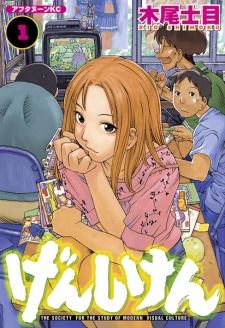
Genshiken
- Genre: comedy drama slice of life
- Author: kio shimoku
- Artist(s):
- Year: Apr 25, 2002 to Aug 25, 2016
- Original Publisher:
- Status: Finished
Rating(4.1 / 5.0, 16 votes)
5 stars
6(38%)
4 stars
5(31%)
3 stars
5(31%)
2 stars
0(0%)
1 stars
0(0%)
Popular Reviews
Genshiken: A story concept that is relatively straightforward yet yields impressively profound outcomes. This narrative revolves around a loosely organized club of otakus and the various challenges its members face. While none of the show's plots are entirely novel, the characters' experiences with realistic otaku problems (coupled with the likelihood that many readers are themselves otakus) make it an enjoyable and occasionally emotional manga.
Characters: There's Sasahara, a freshman who starts as introverted but gradually opens up as he gets to know the other club members. Kohsaka, also a freshman, embodies the hardcore otaku spirit despite looking like an average person. Madarame proudly wears his otaku identity on his sleeve but struggles with ordinary emotions when they arise; I find his story particularly heart-wrenching. Saki, a non-otaku, faces difficulties relating to her otaku boyfriend. Ogiue, a disgruntled artist, grapples with her conflicting feelings towards otakudom—she is one but despises others. The other cast members are well-developed, making the group dynamic highly believable.
Art: It's fairly expressive and very cute in a non-moe way. One of the first things I loved about this manga was Shimoku's unique twist on the classic "blood vessel pop," especially when used with female characters.
Story: The plot follows various club members through their four years of growth as both otakus and individuals. The overall premises aren't spectacular, but they are sufficient to propel the group dynamics forward.
Overall: A very pleasant, relaxed, funny, and heartfelt manga. Definitely worth checking out.
Let me just say upfront: I believe Genshiken is a must-read for any anime/manga enthusiast with even a slight interest in otaku/fujoshi culture and how it has evolved from the 90s to today. It's essentially a social study in many respects. If this piques your interest or if you're fairly familiar with the anime/manga scene, you absolutely should dive into this manga. Seriously, do it if you haven't already.
Turning to the review itself, it was a strong conclusion to both the manga series and the first anime season. The original Genshiken remains my favorite version, but Nidaime also had its standout moments, particularly focusing on an often overlooked hero, Madarame. Both he and Saki embody the spirit of Genshiken; thus, giving Madarame more attention was a much-needed narrative development that was barely touched upon in the original manga. For this reason alone, reading Nidaime was worthwhile as it effectively rounded out Madarame's character arc. Madarame epitomizes what Genshiken is all about. And then there's Saki, who steals every scene she's in and invariably shifts the status quo due to her non-otaku perspective. She's the most grounded, realistic, no-nonsense character in the story, making her integral to what makes Genshiken unique alongside her polar opposite, Madarame.
In Nidaime, Hato takes up the deuteragonist mantle alongside Madarame. Hato is a deeply complex character in numerous ways. I appreciated how his storyline unfolded and somewhat grasp what he symbolizes and his importance to Nidaime's overarching message. While the original Genshiken focused on the older otaku culture with Madarame as its archetype, Nidaime zeroes in on the new wave of otaku—the emerging generation. This shift partly explains the transition from an almost exclusively male cast to one predominantly female. The otaku landscape has changed, and Genshiken dives deep into these changes while addressing pressing social issues now more relevant than ever. Lastly, Shimoku’s way of providing closure to most supporting characters (given the large cast where various characters take center stage at different times) deserves mention, although some characters remained somewhat enigmatic due to less focus—a minor drawback, but not off-putting for me. Everyone receives adequate development in the end.
To circle back to my initial point, I've always viewed Genshiken not merely as a manga but as a profound social commentary on manga and otaku culture, laden with subtexts around the intersection of reality and 2D worlds, interpersonal relationships, sexuality, gender identity, and discrimination. It lures readers into thinking in a 2D mindset only to surprise them with starkly realistic twists. Despite the characters' eccentric behaviors and thoughts, the story thrives on its striking realism. Above all, it's an extraordinary work deserving of every manga/anime fan's time.
Genshiken is a manga that evolves significantly over its run, chronicling the lives of members in a college club. As time progresses, older members graduate and new ones join, yet connections with alumni persist. The focus remains largely on active club members, whose stories are mostly completed while they're still in college. These narratives primarily consist of short, light-hearted tales that effectively develop characters and relationships, making them endearing to readers. The continuity of character growth even when not in the spotlight adds substantial value, giving each story an extended epilogue that emphasizes their personal development and happiness.
However, the final storyline diverges from this pattern. Throughout Genshiken, there's a recurring theme of self-acceptance and forming genuine connections. This starts with a character embracing their identity as an otaku, then moves to another struggling with her fujoshi interests, culminating in a character grappling with gender identity and sexual orientation. This last arc introduces significant heaviness, requiring more narrative space than previous stories. While it has poignant moments, it intertwines with another subplot—a bizarre take on a harem story—causing pacing issues. Both arcs feel slow-paced, lacking room for each other to breathe. Consequently, despite the prolonged storytelling, the endings seem rushed and somewhat arbitrary. The conclusion itself was satisfying in terms of where things ended, but due to some rushed elements, I felt a desire for more continuation, akin to how previous stories continued subtly in the background.
It's crucial to acknowledge that despite heavier themes towards the end, Genshiken is fundamentally a comedy manga, and it excels in this regard. The humor is diverse, thanks to changing subjects and characters. Much of it revolves around otaku culture, packed with references, yet varied enough to avoid repetition. The artwork is functional and clear, though it doesn't strive for uniqueness or visual appeal consistently. Nonetheless, when it aims for it, the art is quite effective.
My first and favorite manga.
What makes this manga so exceptional is its premise. What could have been a meandering slice-of-life story about a college anime club transforms into something much greater due to a very careful setup.
Although it takes longer to get there compared to the anime, there's a definite narrative being woven here. This manga doesn't just randomly pick days for our amusement like most slice-of-life shows; it builds towards the resolution of conflicts and the evolution of its characters.
Featuring some of the most well-rounded characterizations I've encountered, alongside detailed and meticulous artwork, and a story that genuinely has something meaningful to convey, I can only wholeheartedly recommend Genshiken.
Leave a Review