
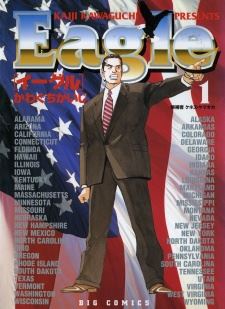
...
Show More
Eagle is a narrative centered on a U.S. Presidential election, featuring the Democratic Party's candidate as a Japanese-American. The story unfolds primarily from the perspective of a young Japanese journalist who is assigned to cover the campaign for a prominent newspaper.
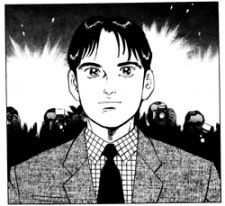
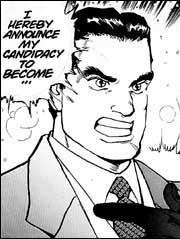

Eagle was the first Manga series I ever bought, marking the start of what has grown into a substantial collection. I share this detail as it might explain any bias in my review.
(Edit - Given that the review is receiving negative votes, I should also mention that I'm Black! For context, I once doubted that the U.S. could have a President who wasn't White. Thankfully, I was proven wrong.)
That said, I enjoyed this series initially because its premise seemed so unlikely at the time: an Asian (read: minority) American becoming the U.S. President? Coupled with the substantial content of each volume, it made for an appealing purchase at the comic book store.
Luckily, everything within the first (and subsequent volumes) maintained interest. The art is detailed and shows the artist's thorough research. Kawaguchi’s depictions of major U.S. cities and landmarks are impressive, giving an authentic and American visual feel. Characters are drawn with a clear Western influence, which might deter some manga purists debating what manga "should" look like. My only critiques might be occasional lapses in character and environmental details, but overall, the art is remarkable.
Returning to the story, the premise is straightforward: A Japanese reporter travels to the U.S. to cover the campaign of the first Asian-American presidential candidate, starting with his bid for the Democratic nomination. I won’t spoil plot specifics, but rest assured, the drama extends far beyond politics, even though one or two significant plot points are revealed early on without much fanfare.
Now that we indeed have a diverse-background minority president, the original premise doesn't seem as far-fetched anymore. A re-read from this perspective offers intriguing insights, and I’m eager to see if Kawaguchi’s vision of such a historic event holds up!
In summary, Eagle is a great read for those mildly interested in politics (and political drama) and good storytelling. However, it may be an acquired taste for everyone else.
Economy, immigration, defense, education, health care, and numerous other categories pose challenges for most countries, which is what makes Eagle timeless. Although it was written with the American presidential election of 2000 in mind, the issues it explores make it relevant today and likely tomorrow too, a thought somewhat disheartening.
Kenneth Yamaoka, a biracial man, dreams and believes he can become America's next president, and the entire work focuses on his campaign from nearly the beginning. While many people have a basic understanding of politics, it's refreshing to follow every step, seeing the truth and deceit behind each word or decision, truly realizing how hard achieving that goal is and whether one can trust any politician. The work effectively portrays the hardships faced not only by the candidate but also his family and staff who must contribute their share. Amidst all this, the main protagonist Jo Takashi, a lowly Japanese non-political reporter, has been tasked with covering this journey while trying to understand Yamaoka's character and his own role. Although this is a secondary plotline, it plays an important role in development and changing relationships, making it easy for readers to relate to Takashi as they are equally in the dark.
Despite the good pacing and variety of themes resembling a true campaign, its structure is similar to a generic battle shounen manga; they are underdogs, and everything that could go wrong happens only to them, whereas there's plot armor protecting them from more troublesome obstacles. Sometimes it feels like problems are only as far-reaching as they are solvable, then vanish into thin air, moving on to the next, which can be off-putting at times. That said, it never becomes boring due to its realistic extent, offering new perspectives through characters' struggles and emotions.
Most characters have thorough backgrounds, giving them purpose and allowing readers to relate. Everyone has problems, and watching them try to hide or sort them out without sacrificing efforts is heavy. What it lacks is connecting some dots concerning character development. As the work showcases problems through characters, they jump from point to point and may be forgotten until reappearing slightly different. It compensates with the developing story and their part in it, but it's still annoying.
The art is detailed, and most American sites are true to life. Though it's a manga lacking color, there's a western comic vibe fitting the story, setting the right mood. Designs are serious, and most characters distinct, a plus for a long-running manga with many new faces. There are definite signs of stereotypes used for different states, such as Texas, but this simplifies things for readers unfamiliar with the country and isn't offensive.
In summary, I enjoyed it sufficiently, learning more about elections and wanting to know more. It encourages participation in one's country's future, partly succeeding in its goal. I personally liked appearances by Bill and Hillary (Ellery) Clinton, adding realism and fun. This is a great read if you want something serious with mystery and much dialogue.