
...
Show More
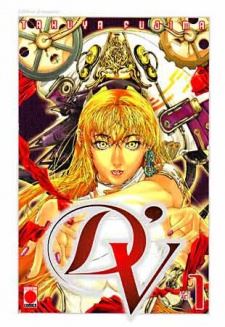
In the year 2068, the Brain Computer, developed by humans to serve as the core of a machine-dominated Earth, creates Leave, an android with capabilities far exceeding those of humans. With humanity now deemed unnecessary for the Earth's ecosystem, Leave, alongside her 'father' Fenrir (the human scientist who raised her), eliminates humanity and establishes four 'Mothers.' These Mothers then create an android race modeled after Leave, known as the Selenoid.
The world is divided into four regions, each governed by one of the Mothers. The android population is further stratified into hierarchical levels, with the strong at the top and the weak at the bottom, forming what appears to be an almost perfect society.
This societal structure would have remained intact if not for a group of surviving humans and lower-caste Selenoids joining forces. Their explicit goal is to overthrow Leave and return control of Earth to humanity.
(Source: Tokyopop)
D'v was published in English as Deus Vitae by Tokyopop from June 8 to October 1, 2004.
I found D'V to be an incredibly disappointing series. The first half of volume one hinted at a potentially decent story, only to take a complete nosedive after the initial chapters. The concept wasn't anything groundbreaking; humanity is wiped out and replaced by a race of androids called the Selenoid. These Selenoids owe their existence to a Gynoid-type deity named 'Lady Leave', and they are somehow born from computers. Their purity is ranked based on their ability to communicate with the 'Mothers', who act as messengers or high priestesses of Leave. The plot centers around a rebellion between slaves and high-ranking Selenoids, but here’s where it starts getting messy. Humans are supposedly eradicated almost entirely, and less pure Selenoids act as slaves. However, halfway through the second volume, these slaves inexplicably transform into humans. Aside from these glaring inconsistencies, the plot takes a sharp turn for the worse after the first volume. What could have been a decent series devolves into something reminiscent of a roleplay session between two 12-year-old girls. We’re introduced to Mary Sue and Gary Sue as our main characters, while the rest of the cast consists of lifeless, stock mooks. Post-volume one, the plot primarily revolves around the male lead—a whiny, angst-ridden teenager who's half-Selenoid, half-human, and infinitely strong yet "troubled." He's about as bland as they come, resembling an atrocious self-insert character typical of pre-teens. The female lead isn’t much better; she's essentially a useless damsel in distress who can cook, be cute, etc. Later, she's revealed to be important, but her significance is mostly nominal since she remains fairly useless. Another self-insert. All the supporting characters seem to adore the two mains, and there's an abundance of fanservice centered around the female lead. To make matters worse, the author throws in some shallow metaphors about love that don’t add any depth. Of course, there are always those who lap this up, thinking phrases like 'Love conquers all~*~' are profound philosophical insights. On a slightly positive note, the art is quite nice. The fight scenes are confusing and cluttered, but everything else is decent. TL;DR: I didn’t enjoy the series due to its nonsensical plot holes and inconsistencies. Would I recommend reading it? Not if you value your time. If you're looking for a way to kill time without caring about quality, go ahead—it'll keep you occupied. I finished it in about an hour and a half to two hours, so it's not a lengthy read.