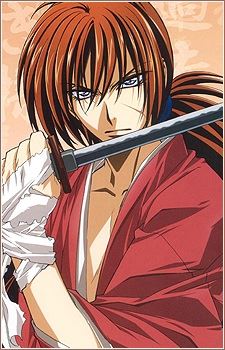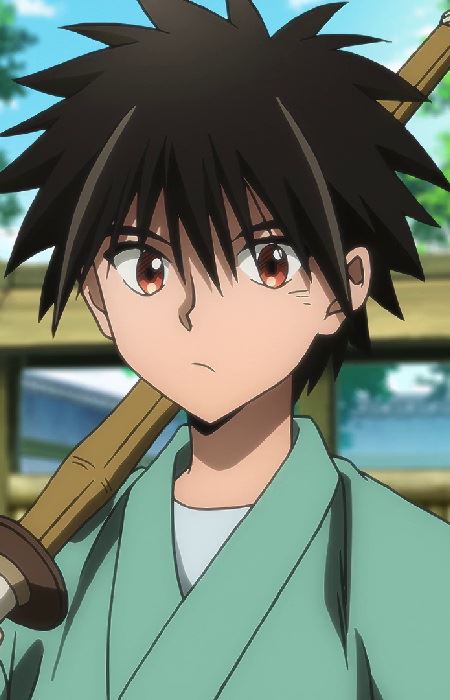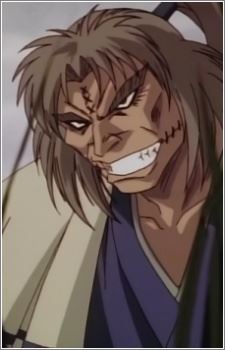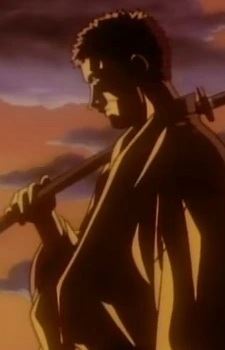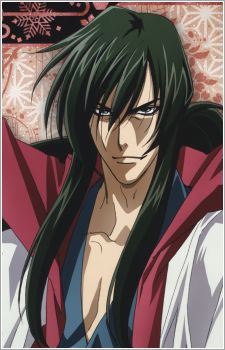
The thirteenth successor to the Hiten Mitsurugi-Ryuu sword art, Hiko Seijuurou rescued young Shinta from bandits who had killed his companions. Hiko took Shinta in and renamed him Kenshin, meaning "Heart of Sword," claiming that Shinta was not a fitting name for a swordsman. Hiko became frustrated and disappointed when Kenshin left to join the rebellion against the Tokugawa regime. Consequently, Hiko isolated himself from the world, living as a potter near the forest close to Kyoto. In Seisouhen/Reflection, he also acknowledges that the Hiten Mitsurugi-Ryuu seems less relevant in the changing times, remarking to Yahiko, "The only thing that doesn't change is the moon."
Hiko is arguably the strongest swordsman alive, far surpassing even Kenshin. While both are similarly fast, Hiko excels in combat judgment and possesses superhuman strength hidden beneath his heavy cloak, enabling him to wield Hiten Mitsurugi Ryuu to its fullest potential. Fifteen years later, master and student reunite. It is during this time that Kenshin will complete his training—if he can survive Hiko's ego.
The distinctive cloak worn by all Hiten Mitsurugi masters serves not just as a symbol but also strengthens them during peacetime. Even without immediate conflict, wearing the cloak keeps Hiko in constant training due to its composition of heavy materials weighing around 37.5 kilograms, forcing him to exert continuous effort. Watsuki mentions in the manga that he drew inspiration for the billowy capes from Spawn by Todd McFarlane (the size of the collar pieces was reduced in the anime).
The name Hiko Seijuro is actually a title passed down to each new master of the Hiten Mitsurugi-Ryuu. Since Hiko Seijuurou II, every new master has abandoned their original name in favor of the founder's name. As Kenshin declines to take the name "Hiko Seijuurou XIV," his master becomes the last person known as Hiko Seijuurou.