
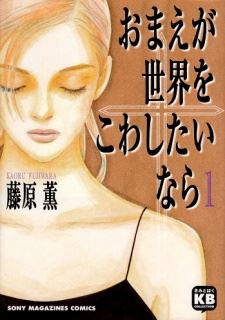
Omae ga Sekai wo Kowashitai nara
- Genre: drama fantasy supernatural
- Author: fujiwara kaoru
- Artist(s):
- Year: 1999 to 2000
- Original Publisher:
- Status: Finished
Rating(4.3 / 5.0, 3 votes)
5 stars
1(33%)
4 stars
2(67%)
3 stars
0(0%)
2 stars
0(0%)
1 stars
0(0%)
Popular Reviews
TL;DR: Give it a go if you really enjoy melodramatic shoujos with the 2000s (?) art-style otherwise, don't.
Story - 7 (Good)
Art - 5 (Mediocre)
Character - 3 (Poor)
Enjoyment - 6 (Fair)
Overall - 6 (Fair)
I read this in one sitting after midnight then decided to write this review, so some of the things I say might turn out awkward. This manga initially caught my eye as it was tagged and described as a shoujo romance with horror elements in it. Within the first few chapters, I was disappointed to find that the horror portion is barely there (they showed stuff like vampire teeth and blood splatters but no actual gore) but that's not why I rated it so poorly.
STORY & ART
I've merged these two sections as I believe the art really affected the story.
The manga started off pretty decent, pretty much whatever events that are mentioned in the manga's summary. It's one of those shoujo manga where the heroine HATES her love interest to the core at the beginning but slowly becomes attached to them. The story itself is a pretty cool concept that touches on the supernatural and later on, makes statements about fate. I actually really enjoyed manga's take on fate and this is also why I didn't give it a lower score. However, the execution of the concept itself is pretty weak.
Another review pointed out that the execution is part of what makes it so good, but I disagree. I could not sympathize with the characters as they don't look like they care that much about their own predicament either. Because of the art style, there were many times where I could not tell WHEN an event occurred. Is this happening right now or is this a flashback that the character is having? I don't know, the characters look the same, the backgrounds look the same, and this wouldn't be such a huge problem if not for the fact that often there are jumps between the present and the past without any indication.
A lot of the characters share similar hairstyles/facial features, and at times I had to double-check who is who in the panels. I thought it was just me being silly, but I've seen others complaining about the same thing, so it's not just me. There were times where I could not tell what a panel was showing, and all I can make out are lines and areas in between with different shades of grey. I also just find that the 2000s shoujo manga art-style has NOT aged well and has become a bit of a pain to look at. To sum up, the art isn't downright hideous but certainly affected the storytelling.
CHARACTER
Let me just say that there is no proper character development at all and most of the characters are simply one-dimensional. It could even be argued that some of the characters, including some main characters, actually became more bland during the climax of the story and just became plot devices to move the story towards its conclusion. I guess the more melodramatic you become, the more personality you lose. Even though horrible things happen to the characters, I just can't seem to feel bad for them since they have shown themselves to be selfish assholes, plus I can't see the intensity of their feelings since they don't look like they care that much either.
ENJOYMENT
Despite all the complaints I have about this manga, I still enjoyed it to a certain extent since I just like to binge on shoujo manga in general. As mentioned, I also enjoyed the manga's take on the concept of fate. The complaints I had did negatively affect the amount of enjoyment I could get out of it though.
OVERALL
The manga had an interesting premise and started off strong, but the quality of the story gradually deteriorated due to factors such as a confusing art style and lack of character development. I would say give it a shot if you enjoy melodramatic shoujo mangas (esp those from the 2000s) or if you have nothing else to do and don't mind wasting some time (it's not that long) skimming through one.
Wana is an ordinary girl with a regular job and a somewhat mundane love life. Her romantic experiences are limited to having a crush on someone who occasionally visits her workplace to order a hamburger without onions. It's not until she gets hit by a truck that she finally talks to him. Suddenly, the blank tarot card she drew the previous week makes sense: "no future." She is almost instantly dead on impact.
Then Wana wakes up.
Vampire Girl (also known as Omae Ga Sekai O Kowashitai Nara or If You Wanna Break This World, but hereafter referred to as Vampire Girl) tends to be a polarizing read. Either you'll despise the seemingly pointless and deeply flawed story and narration because they are indeed flawed, or you'll understand why the essence of Vampire Girl needed to be conveyed in such a manner. I fall into the latter category; this story resonated with me as one of the most thought-provoking manga works I've encountered, ranking alongside popular titles like Omoide Emanon or Music Of Marie.
The initial impression of this manga might seem messy and unpolished, but if you read slowly and consider all the symbolism, you'll notice that every detail ties into the overarching message. Vampire Girl delves into themes of God, morality, and humanity, but from a unique perspective distinct from Christianity or any other religion. The central theme appears to explore the nature of humanity and the reason behind our existence as flawed yet beautiful beings. If humans are imperfect, wouldn't that imply that whatever created us—be it evolution or creation—is also flawed? And since we're not the only creations, wouldn't everything else in this world be flawed too? The narrative of Vampire Girl tackles the weighty idea that everything in the universe has some flaw. If you're looking for a light-hearted vampire manga like Karin, look elsewhere; this story can get brutal.
The narration and storyline of this manga pose challenges for many readers. Some find it utterly confusing and riddled with flaws. Yes, I said flawed. While the concepts are fascinating, Fujiwara Kaoru brilliantly uses the plot, story, characters, and narration to highlight this 'flawed' nature. Objectively viewing the plot and characters reveals them as an endless paradox, seeming pointless and poorly executed. Complex and fragmented, the list of issues seems endless. Then you realize that it, too, is flawed and far from perfect. It seems that the only redeeming quality of humanity is its complexity... and then you see the art.
I'd love to elaborate on the necessary symbolism and the meaning I derived, but I'll leave that to potential readers. Vampire Girl was an exceptional series that thoughtful readers should definitely check out. It's definitely a 9.0/10. My advice: read very slowly, absorb the symbolism around reincarnation and the boy with the ball, and try to piece together the message and theme. Use the story, plot, and characters as tools! Don't seek their positive attributes, because there are none; just immerse yourself in it.
(A warning to some readers: sensitive topics like rape or pedophilia are portrayed realistically, so proceed with caution.)
★★★★★★★★★☆
RECOMMENDED.
Highschooler Wana has a crush on one of the customers who frequents her fast-food restaurant. It isn't until she's involved in a fatal car accident that she discovers he's actually a vampire. Could he be connected to the gruesome murders plaguing their town? Moreover, it turns out she bears a striking resemblance to someone he knew centuries ago. Watch as their relationship deepens in unexpected ways, with twists and turns right up to the very end.
Firstly, I must warn you: this is a josei manga, not shojo. It contains mature themes. There are scenes of minor graphic violence and murder displays. Rape and pedophilia play significant roles in the story, though they are not depicted positively. Still, I found these elements disturbing.
Beyond those aspects, it was still worth reading. The setting is contemporary, offering a realistic portrayal of how vampires might exist in today's world—unlike the more cheesy "Karin." The artwork is beautiful, with a slightly brushy style that lends a quiet, peaceful look, blending grittiness with beauty just like the story itself. The vampires appear normal and attractive without being stereotypical bishies.
The narrative is heavily dramatic, so there’s practically no action. It carries a gentle moodiness. While there were moments when I questioned, "Oh really? This drama is getting out of hand..." I still found the manga enjoyable overall. It’s a good read through its 17 chapters.