
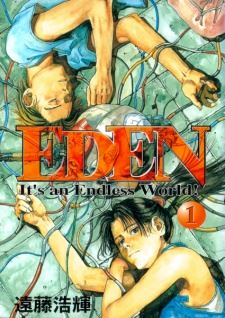
Eden: It's an Endless World!
- Genre: action drama sci-fi suspense
- Author: endo hiroki
- Artist(s):
- Year: Sep 25, 1997 to Jun 25, 2008
- Original Publisher:
- Status: Finished
Rating(3.9 / 5.0, 15 votes)
5 stars
4(27%)
4 stars
5(33%)
3 stars
6(40%)
2 stars
0(0%)
1 stars
0(0%)
Popular Reviews
Eden is a masterpiece that captures the purity and simplicity of youth. It delves into the challenges we all encounter as we grow up and confront the realities of the world. Virtually every theme prevalent in contemporary literature can be found within its pages.
Eden meticulously explores the human mind from various perspectives, illustrating psychological issues with vivid detail. This includes precise depictions of depression, childhood disorders, and even an Electra complex.
The narrative addresses impoverished neighborhoods plagued by drugs, gang violence, and prostitution. It examines the impact of war on innocent lives and the cycle of hatred that fuels further destruction. Corrupt governments riddled with scandals are also portrayed. All these societal problems are reflected in Eden, mirroring many aspects of today's world. In essence, Eden serves as a satirical commentary on present-day life and society. Simply put, Eden is a flawless work of art.
~ ~ ~
The characters in Eden were exceptional. Despite introducing a large cast, each character stands out uniquely, making it easy to follow their stories without feeling overwhelmed.
The plot maintained a good pace and never became dull. The integration of comic relief was perfectly timed. The romance depicted was among the best I have ever encountered.
In summary, Eden ranks among the finest manga ever created. Highly recommended. 10/10
(Note: It contains violence and nudity)
I hurriedly wrote this review because I just finished reading it about ten minutes ago, and it’s 3 AM. Way too tired but felt compelled to share my thoughts! That’s what inspiration does for you! Lol
The story begins exceptionally well. Everything seems perfect up until a certain point.
At the start, our main characters, akin to Adam and Eve in a new world, are introduced. Then comes a time skip. Suddenly, we follow the son of the initial protagonist for most of the narrative. We discover that the child from the early chapters grew up to become a Mafioso.
The naivety of the main character gradually fades as he confronts harsh realities. We witness some excellently executed scenes of death, despair, and hopelessness. Eliah starts learning to fight for himself and others. As he gains control over his life, he transforms into the very kind of person he had fought against. Drugs, violence, and revenge lead him to destroy the happiness of those he fights for.
However, the story then becomes saturated with fight scenes. Deaths cease to matter. Along the way, so do the characters. The main character turns into just another guy with a gun fighting because... who knows? No one explains his motives.
His sole driving force is the desire to save his sister. In the end, this arc was utterly pointless and contributed nothing to the story or the characters. The grand finale itself erased almost everything that happened.
The action is riddled with deus ex machina moments. The ideological discussions are simplistic ethnic divisions of the world. The fights start following a pattern: nearly all newly introduced minor characters die instantly, sliced like ham by evil drones.
I would have preferred the story to continue in the direction it took at the beginning.
Eden is the finest manga I've ever read to date.
Why?
Because Hiroki Endo's post-apocalyptic story has almost everything that can be considered excellent in manga: a great plot, stunning art, and nearly flawless characterization. Imagine a well-thought-out, mature narrative blending seamlessly with art that manages to be both realistic and beautiful, featuring characters who seem more real than people you meet daily. If picturing such a manga proves difficult, pick up Eden, and you'll understand my point.
Science fiction plays a significant role in Eden's storyline. However, under Hiroki Endo's guidance, speculative ideas about the future remain grounded. The story unfolds in a world hit by a major disaster—not an alien attack, a sudden explosion, or the work of a mad scientist, but rather an evolved killer virus that nearly ended the world. This scenario resonates with readers living amidst various epidemics. The mechanics of this virus (and other sci-fi elements introduced later) are explained clearly, making it easy for readers to follow along.
But Eden is far more than just another end-of-the-world sci-fi tale. It brims with drama from character interactions, touches of romance, and moments of happiness even within harsh realities. There's even occasional humor.
The maturity of the tale lies in how these elements are handled—with care and good taste. The world in Eden is brutal and cold, yet it avoids preaching doom and hopelessness. Yes, the world can be harsh and uncaring, but Eden leaves room for the good things too.
Just like all great stories, love, romance, and dramatic relationships have their place in Eden. Following Endo's approach to keep things balanced, there are some hugs and kisses, but not excessively so. Love happens, just like hate, friendships, sadness, happiness, and other life events. It isn't overly highlighted or downplayed; it simply exists alongside other aspects of life.
The lighter side of Eden becomes more prominent as the story progresses. Readers encounter sexual jokes, chibi characters, and other silly manga traits increasingly. Some find this unsettling, but I enjoyed it. It made me laugh. Paradoxically, a dose of good humor adds credibility to a story dealing with serious issues, rather than wallowing in unrelenting tragedy.
A common measure of a story's maturity is its depiction of blood, gore, violence, sex, etc. While I don't advocate this as a standard for maturity, Eden excels here too. When Endo wants to show gore, he delivers showers of blood, shredded limbs, and cracked bones, surpassing typical depictions. Similarly, when it comes to sex, we see passionate encounters instead of the usual blushes typical in "romance" mangas. Realism is key here: Endo never slips into poor taste.
The imagery is, as mentioned earlier, simply gorgeous. Endo captures the unique beauty of Japanese comic art—be it characters, scenery, or anything else—without resorting to oversized eyes or over-groomed scenes. Realistic beauty. Is that possible? In Eden, it is.
Other elements enhancing the reading experience include clean panel layouts and the author's intriguing essays at the end of each volume. Like cherries atop a well-creamed cake.
Not everything is perfect in Eden. I could list minor issues—a bit of science jargon here, a misplaced joke there, some over-the-top philosophy—but they're negligible compared to the overall masterpiece.
The bottom line? Go read it. Right now.
There are already some excellent reviews of this remarkable series here, so I'll just add a few general thoughts:
The best way to describe this series is akin to George RR Martin's Song of Ice and Fire, but set roughly 100 years into a somewhat conceivable future with a faster pace. It also includes extensive discussions on theoretical physics, references to Noam Chomsky, disturbing bio-weapons, a robust exploration of ethnic conflicts, homosexuality, and various political issues. You'll find moments reminiscent of Evangelion's strangeness, numerous characters (each with impressively realistic characterization), reflections on gnostic philosophy, and an overwhelming amount of death, brutality, and suffering. While it may not be the best manga I've read (there was a particular section in the middle that I didn't particularly enjoy), it is probably the most intellectually stimulating, boasting an impressively broad and sophisticated scope. The artwork wasn't outstanding, but it was competent and occasionally striking. Like Martin, Endo has a habit of frequently killing off characters, though I found Eden to be perhaps more gritty and unpleasant than Ice and Fire, as there were parts so brutal or sad they made me feel slightly ill. I've been reading manga for about a month now and have been fortunate enough to come across several impressive works; this one definitely ranks high among them.
Excellent manga, one of the best I've read. Eden Endless World is a manga with a dense and cruel story set in a very complex and merciless world.
The characters are fantastic. They are well-developed and avoid simplistic "bad guy and good guy" tropes, instead dwelling in the gray areas. Each character, whether Kenji, Sophia, Ennoia, or others, has a strong presence, distinct personality, character, and life philosophies that make them intriguing to follow.
The protagonist, Elijah, undergoes an incredible journey throughout the story. Starting as someone more innocent, he evolves into someone who acts upon realizing how harsh this world can be: "the world is cruel, I am cruel." Despite the well-established characters, making it sometimes unclear who drives the plot, Elijah remains the central focus.
The story is exceptional. It delves into topics ranging from existentialism, faith, discrimination, to geopolitics, showcasing the author's thorough preparation. Although these themes could potentially be dull, the author skillfully integrates them into an exciting action plot and incredible fights.
The art is beautiful, but not through detailed settings or characters. What truly stands out is the way fight choreographies and action scenes are masterfully executed within the work, especially when Kenji stars in some of the best fights across all manga.
In conclusion, Eden Endless World is an amazing manga with a great story and characters, culminating in an excellent ending that perfectly aligns with everything presented in the work. If I had to criticize something, it would be that the manga unfortunately ends.
Eden: It's An Endless World is aptly named, showcasing its defining feature: its vast and sprawling nature. The manga spans several decades, beginning long before the protagonist's birth, covering numerous locations and an overwhelming number of characters and plot points that are nearly impossible to keep track of.
The story starts in a post-apocalyptic society ravaged by a pandemic. This new virus, known as "Closure," causes people's skin to harden into an outer shell while their internal organs gradually liquefy—an agonizing process that can take years. The series opens with two children, Enoa Ballard and Hana Mayer, living isolated from society with their heavily religious guardian who is slowly dying from Closure. Their story alone is excellent but serves merely as a one-volume prologue.
Many years later, the narrative shifts to their son, Elijah Ballard. Initially navigating the post-apocalyptic society with his father's robot, Cherubim, Elijah quickly becomes involved with a band of guerrillas. This marks the true beginning of the story, though it barely scratches the surface.
To call Eden "ambitious" would be an understatement—any major theme found in fiction is likely present here. This can be a double-edged sword; some criticize Eden for being "unfocused." Understandable, given its density of plot threads and characters that sometimes overwhelm it. However, this is necessary for maintaining its sheer scale.
This isn't a manga for the faint-hearted—it's incredibly explicit in terms of sex and violence. It's unflinchingly brutal, with no character guaranteed safety; anyone can die at almost any time. Similarly, it doesn't shy away from depicting sex, which logically follows in a post-apocalyptic society where sexual trafficking and prostitution have become common. A significant portion of the story is set in a brothel revolving around prostitutes, including one of the best characters in the series. In something so thematically heavy, "good" and "bad" hold little meaning. Don't expect morality to play a big role.
Unfortunately, around the halfway mark, Eden introduces comedic elements out of character and not very funny. This coincides with an ill-advised timeskip that ruins a great character who is soon killed off unceremoniously. Several volumes suffer from mistakes, dragging down what is otherwise exceptional. Outside of these issues, Eden sets my gold standard for manga.
Of course, such strong work can only be damaged so much. Eden definitely ranks among the best manga I've read.
Final Words: Though occasionally weighed down by its own ambition, Eden remains overwhelmingly impressive, few can compare.
Story/Plot: 9/10.
Characters: 8/10.
Art: 10/10.
Overall: 9/10.
For fans of: Akira, Nausicaä of the Valley of the Wind.
I don't know how to review manga, but I still want to share some thoughts on Eden: It's an Endless World! This will contain spoilers.
A mysterious forum user recommended this intriguing manga to me. It was in response to a post I made seeking something truly apocalyptic, where humanity is utterly destroyed. For a while, it seemed like it might fit the bill, but no such luck. That's why I'm glad I skipped ahead to see the ending. (No one should waste their time reading a long story if it might not even go in a desirable direction.)
This is a POST-APOCALYPTIC manga. That's what Eden ultimately is. I could offer some biased criticisms about its somewhat optimistic and not-so-dark outlook, but they are presented reasonably enough that critiquing them would be pointless. I am just disappointed that I didn't get to see the kind of grim destruction and downfall of mankind I was hoping for.
To me, "apocalyptic" means when all hope is completely crushed, focusing on the eve of everything's end. Post-apocalyptic stories don't have this, and as a result, they often bore me with all the "what ifs" and uncertainties attached.
I guess... it was refreshing to see the gnostic influences. They're probably uncommon in manga.
The manga delivers a wealth of information and cultural insight, presenting everything to the reader in a fluid and easy-to-understand manner. The premise is also very well crafted.
Initially, it focuses on "rebuilding the world" after its devastation by a virus that humanity is facing, the second "Black Plague." Named "Closure," this virus threatens the skin and causes internal organs to melt, turning people into empty husks. It emerged and killed 15% of the world's population.
Soon after, an organization called Propatria decides to "dominate" the planet—obviously without using those exact words. A division forms in the world: there is the Gnosia part, where Propatria operates, and Agnosia, which remains unaffected by the organization. The manga frequently shows the struggles of revolutionary groups striving for an egalitarian world against Propatria. However, as the story progresses, the virus evolves into Disclosure ("revelation," "divulgation"), completely shifting the focus of the manga. Indeed, the very name of the virus hints at a revelation, as if the author were signaling to the reader that the focus has changed. Eden draws inspiration from Gnosticism, a religious doctrine. Much of the plot follows the idea of a "corrupted" world that can never be good for human life. It's as if humanity must search for a better world, and all this is introduced by the Closure virus, which devastated the population as a prologue to the end, followed by Disclosure, which opens the door to humanity's "salvation."
In this setting, Eden begins to tell the story of the young couple Ennoia and Hanna, among the first discovered to be immune to the epidemic. They deal with the virus and their internal conflicts over the uncertain fate of humanity. The narrative, however, centers on the second generation, introducing us to the couple's son and the protagonist, Elijah. He is an intelligent boy with knowledge of his world but still very naive—a naivety that won't last long. Amidst armed guerrillas, mercenaries, prostitution, drug trafficking, and much death, the young man will discover (along with the reader) that the future is not so bright.
The aspect of the manga that most catches attention at first sight is the maturity of the plot. In less than two chapters, topics such as religion, homosexuality, politics, biology, and existentialism are discussed or mentioned.