
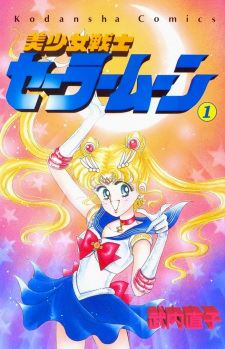
Bishoujo Senshi Sailor Moon
- Genre: award winning drama fantasy romance
- Author: takeuchi naoko
- Artist(s):
- Year: Dec 28, 1991 to Feb 3, 1997
- Original Publisher:
- Status: Finished
...
Show More
Rating(4.4 / 5.0, 20 votes)
5 stars
11(55%)
4 stars
6(30%)
3 stars
3(15%)
2 stars
0(0%)
1 stars
0(0%)
Popular Reviews
I didn't grow up watching Sailor Moon like many of my friends, so I don't share the same nostalgia most people seem to have for it. Despite that, I was always curious about it because I constantly heard how great it was from those around me.
Be warned, there will be spoilers ahead:
In my opinion, considering what it is, Sailor Moon turned out to be a fairly decent series overall. However, since I didn't grow up with it, my expectations were probably too high given how much everyone hyped it up. It wasn't really for me. Most characters felt somewhat one-dimensional, with Usagi being the most developed character. We don’t see full character arcs or significant growth for most of the other characters. From what I recall, Chibi-Usa and Mamoru might be the exceptions. For the rest of the cast, their development felt somewhat rushed towards the end of the series.
Another issue I had was with the writing. From an outsider's perspective, it sometimes struggled to connect different story arcs smoothly. This was especially noticeable during crucial moments. For instance, early on, they emphasized the importance of the Silver Crystal, which was passed down through generations in the Moon Kingdom. But later, in the Dead Moon Circus Arc, this changes when Chibi-Usa gets her own crystal, along with the rest of the Sailor Senshi. This felt a bit convoluted to me, as it introduced the idea that every Sailor Senshi has a Sailor Crystal. It seemed to undermine the significance of the Silver Crystal as a family heirloom and proof of the Moon Kingdom Royal Family lineage.
Overall, despite its flaws, Sailor Moon is still a decently good series. I would give it a 6 out of 10.
If you're like me and absolutely adored the 90's Sailor Moon anime, please steer clear of this manga. Everything captivating in the anime simply isn't present here.
Sailor Moon is your typical magical girl story that you've encountered before: a girl gains powers and battles evil to save the world, but that's essentially all there is to it. Each arc follows nearly the same plot, reusing the same formula for 61 chapters, which quickly makes you weary of the story. Additionally, character development is virtually nonexistent. Apart from the irritating crybaby Usagi Tsukino, we don't get to know the other characters' personalities at all.
And last but not least, the art—while cute—is very generic and certainly does not stand out among other works from the same era.
Overall, the Sailor Moon manga is uninteresting and lacks charisma and personality, making it the exact opposite of the anime, being much inferior to its animated counterpart. It's no surprise that this is Takeuchi's only work.
ENJOYMENT SECTION: 8/10
Ah, good ol’ pretty sailor warriors! Despite being the series most other magical girl shows copied thereafter, it remains at the top because very few managed to have its variety and vividness. Plus, I like it too.
ART SECTION: 7/10 [Bishoujos in Sailor Suits.]
Following the trend, the artwork is extremely shoujo, meaning very breezy sketches and loose borders between frames. It looks very amateurish in the beginning but improves considerably as it progresses, eventually looking splendid towards the end. You just have to get used to the idea that the plot is driven by dialogue and mostly cinematics, rather than motion or action. The battles are mostly short and unimpressive, but what happens in between is plain wonderful.
Despite its girly appearance, there are parts with quite disturbing graphic violence. The way most people die in it borders on occult horror, as they are either turned into mummies or dust (and this applies to many innocents as well). There are also lots of illusions and psychedelic scenes that make this inappropriate for very young readers. For the same reason, I liked it even more, heh.
STORY SECTION: 8/10 [Once upon a time, there was a princess on the moon...]
The story is basically separated into five arcs, and in each we have the stereotypical tale of superpowered girls fighting demons who want to take over the world. The plot is extremely fast for manga standards and in each chapter, there will always be something new to further the plot. Although it gets repetitive and predictable after a while, the events that happen in-between the battles are quite captivating so it is not that annoying.
Despite the cheesy premise, there are several undertones in each arc which don’t allow things to be too black or white, or even good or evil. To some extent, each character has its dark side, some villains have more reasons than just being born evil, and every challenge attacks the mind as well as the body. Thus, the story is more psychological and even philosophical than your typical superpower fighting formula. Although it always amounts down to using the power of love or friendship, it is still quite creepy and exciting most of the times.
There are also several themes that go far beyond the notions of good and evil. What is happiness, how it feels to be immortal, how can you live as nothing but a vessel for everyone’s grief. Also, the scale of the battles escalates to encompass entire worlds and eventually the whole galaxy, making you feel like you are watching a story that is bigger than life itself. So although the basic idea is that of a fairy tale, it constantly expands to various serious matters that make it appear to be far more than just that.
CHARACTER SECTION: 8/10 [Although there are no original characters, their quirks and decent coloring make up for it.]
The characters are the rather standard bunch of people you expect to see in such a tale. The teenage girls who do girly stuff by day (school, romance, hobbies) and battle demons by night. The thing is that they are colorized a lot along the way and each one becomes a distinctive personality, despite usually being grouped together in battles as a unit. So you are not supposed to criticize them in battles, which as I said are very fast and unexciting, but rather focus on what they are doing, saying, or feeling between battles. They are still two-dimensional for the most part but are very distinctive for their stereotype and easily become likable and memorable.
A thing which I didn’t like that much is how most of the villains weren’t given much attention. Most were nothing but generic one-chapter enemies and were killed right away before we get the time to even understand why or who or when. The anime version deliberately prolonged the plot with lots of stand-alone episodes where you could get to know them, but here they come and go in a few pages. The big bads are otherwise nicely colorful and make delightfully evil adversaries.
VALUE SECTION: 10/10 [I find no reason for not considering it amongst the best of what this genre has to offer.]
Sailor Moon is neither the first nor the best Mahou Shojo on the block. But it became famous enough, thanks to:
-its likable characters. Since all of them are stereotypes, every viewer can easily find someone he/she likes and thus root for.
-its long duration, easily becoming the longest Mahou Shojo ever made. More than enough time to bind with the characters.
-its evolving story.
-its romance. It is quite stereotypical most of the time but the visual effects and the metaphysical plot make it more interesting than that of a typical slice-of-life romantic scenario.
-its several name allusions. Every Sailor Warrior has the basic element she controls in her surname, villains are always named after a specific category (minerals in the first season, crystals in the second, animals in the fourth, metals in the fifth), and special effects are tied to their user’s personality.
VERDICT: 8/10
Very naïve and repetitive but its heart is pure and intact.
The world of Pretty Soldier: Sailor Moon is best explored through its original manga, in my opinion. There's something uniquely special about the manga, a sensation that I struggle to articulate perfectly in words. When I first began reading it, I found myself slowing down because I sensed there was something profoundly worthy of appreciation within the completed work I held. What I'm trying to convey here is that Sailor Moon feels like a labor of love from its creator, Naoko Takeuchi. Each character exudes uniqueness, as if she poured so much affection and personal essence into every strand of hair she meticulously illustrated. Despite the extremely stylized shoujo features each character possesses, everything comes across as genuinely heartfelt. I recall seeing an interview where she was painting artwork presumably for a cover or art book, and she mentioned something akin to, "I work while gazing at the sunset (and perhaps the ocean too?). I attempt to paint swiftly to capture the hues and emotions of the sunset, and sometimes the result appears somewhat chaotic." This sentiment shines through in her colored pieces. Stunning works with vivid background colors that blend into one another, slightly untamed yet brimming with soul.
Having expressed all of this, I must admit that I don't have much of a review regarding the manga's storyline. I came here simply to express my admiration for Sailor Moon. Reading the manga gives me such a whimsical, delightful feeling that I hope others can experience when they read it.
The anime was a significant part of my childhood, and the manga got serialized again during my high school years. This is one of the few manga series I own completely, though it's not my favorite, even within the graphic novel genre. The more you read it, the more its flaws become apparent, making it less ideal for re-reading. Nonetheless, I rated it an 8 overall, so it still holds a special place among my favorites.
-----------
The Bad:
A major issue that has bothered me since reading this in high school is the exaggerated length of every female character's legs and how each character looks much older than they should be. In the first volume, Usagi is introduced as a 14-year-old, but she looks nothing like one. These designs make sense for adult characters like Uranus, Neptune, and Pluto, but not for teenage girls who are still developing.
Another aspect of the design I'm not fond of is the lack of differentiation in the physical builds of the characters. Even when we get "guyish" senshi, they're just taller or have larger breasts. We don't see any heavy-set, overly short, or very tall and lanky senshi. Some variance other than breast size would be nice.
Moving on to the story, it's hard not to compare it to the anime, which isn't fair, but the villains pale in comparison to their animated counterparts. The four generals in the first arc lacked individual personalities, as did Beryl. The same goes for most villains until the fourth arc, which I'll discuss later. The supporting cast also suffers from poor characterization until the fourth arc, where they deal with their inner demons separately from Usagi.
That’s about it for the bad.
----------------
The Good:
The story of Sailor Moon is mostly excellent. It's challenging to delve into without a full analysis, but you'll have to trust me on this one.
Despite weak characterization throughout, the fourth and fifth arcs make up for it with substantial character development before ultimately killing them off in the finale. Although the series ends with multiple deaths and Usagi potentially choosing paradise over starting anew, it's written in a way that makes sense if you can read between the lines. A lot of lore about Sailor Moon is revealed in these arcs, not present in the anime, and Galaxia is far more ruthless here.
I genuinely liked some of the designs too. Galaxia looks identical to her anime counterpart, fitting her character well. The same applies to Princess Kakyuu, whose role is significantly expanded in the manga. I also appreciate how the Starlights masquerade as men by day but revert to being fully female at night, without changing genders.
In conclusion, I really enjoy this series; it keeps me entertained from start to finish. Despite seeing many flaws, I still love it deeply.
The Sailor Moon manga addresses the two major issues found in the anime (the 69.9% of the series that consists of filler episodes, and some inconsistencies caused by those very episodes). I absolutely adore the Sailor Moon manga; Naoko Takeuchi's artwork is quite enjoyable, the story—though straightforward—is captivating, the characters are charismatic, and the antagonists are well-developed.
As an added bonus, it features Tuxedo Mask, which instantly makes it the best magical girl series ever (okay, not really, but still a great plus).
I absolutely adore Sailor Moon. My interest in manga was sparked by Tamadashi Horoka (apologies for the spelling), but Sailor Moon truly captivated me with its exceptional character development and an engaging plot that never lets you want to stop reading. The series offers a complete narrative from beginning to end, leaving you feeling like there's so much more to explore in this universe. Every moment of Sailor Moon is heartfelt and intense, providing an incredible experience from start to finish. It serves as an inspiration to everyone who encounters it.
Sailor Moon represents an ever-expanding universe that defies aging, which is precisely why I love it. For all these reasons, it stands as my favorite manga. In conclusion, Sailor Moon is simply amazing. I could reread it a million times, drawn in by its boundless universe, fantastic storyline, and rich character development. Each revisit feels like a new adventure into a world filled with wonder and depth.
Bishoujo Senshi Sailor Moon, also known as the manga you should read if you ever wondered how a piece of bad fanfiction would look if penned by an adult woman. Let's summarize the qualities of poor fanfiction, shall we?
1) A poorly written story riddled with plot holes and inconsistencies that ruin reader interest - check;
2) Unlikable and unrelatable Mary Sues (Usagi Tsukino, Sailor Venus, Chibiusa) and Gary Stus (Mamoru Chiba) who are revered by all other characters like deities on earth - check;
3) Contrived backstories that make no sense and bog down the narrative with useless infodumps that add nothing to worldbuilding - check;
4) Non-existent characterization outside the main protagonists/author self-inserts (including enemies who appear and disappear instantly), serving merely as plot devices - check;
5) Unclear action scenes so badly drawn they're impossible to understand, with powers appearing and disappearing after one use because they serve as plot devices - check;
6) Complete misunderstanding of superhero fiction, which is ridiculous given the author established a direct link to Superhero fiction in the Sailor V prequel.
Add to these six elements the usual inappropriate content typical in Japanese children's shows like Golion King of Beasts and an overall childish tone, and you have a clear picture of this manga. It's completely outshone by its 90's animated adaptation in every aspect, despite what manga elitists might claim. The reason the Crystal series hasn't been well-received is due to this core issue being untranslatable without major changes. If you want believable, relatable icons that inspire positive messages, stick to the 90's animated masterpiece (movies and specials included) and forget this manga was ever produced. You won't miss anything.
Leave a Review